Who Owns the Prompt? The Unlisted Line in Your 2027 Job Description

Somewhere in your company right now, a document nobody owns decides what your customers read.
It is a prompt: a few hundred words of instructions, examples and formatting rules that a model follows when it drafts a reply, summarises a ticket, or decides which queue a request belongs in. It was written by whoever was closest to the problem in 2025. Four people have edited it since. It has no version history, no test suite, and no line in anyone’s job description.
That is the work your 2027 scope audit will miss.
The audit has three lists. It needs four. #
On Monday, Jackson Rodriguez published a three-list scope audit for renegotiating next year’s job: work retained, added, stopped or transferred. It works because it forces a name onto every item. A priority conversation becomes concrete the moment you can point at a task and ask who has the authority to end it.
But run the audit honestly and the “added” list fills up with skills, not duties. “Use AI more.” “Get better at prompting.” “Be the team’s AI person.” None of those is a task with an owner. They are aspirations wearing a job title.
The actual added work is more specific and less flattering. Someone maintains the prompt. Someone decides whether the output is good enough to send. Someone gets the message at 4:50pm saying the agent is producing nonsense again. Someone re-runs the test set after the provider ships a silent update. Those are duties. They have hours attached. They are almost never on the list.
Six hours a week that nobody budgeted #
The evidence arrived twice this year from opposite directions.
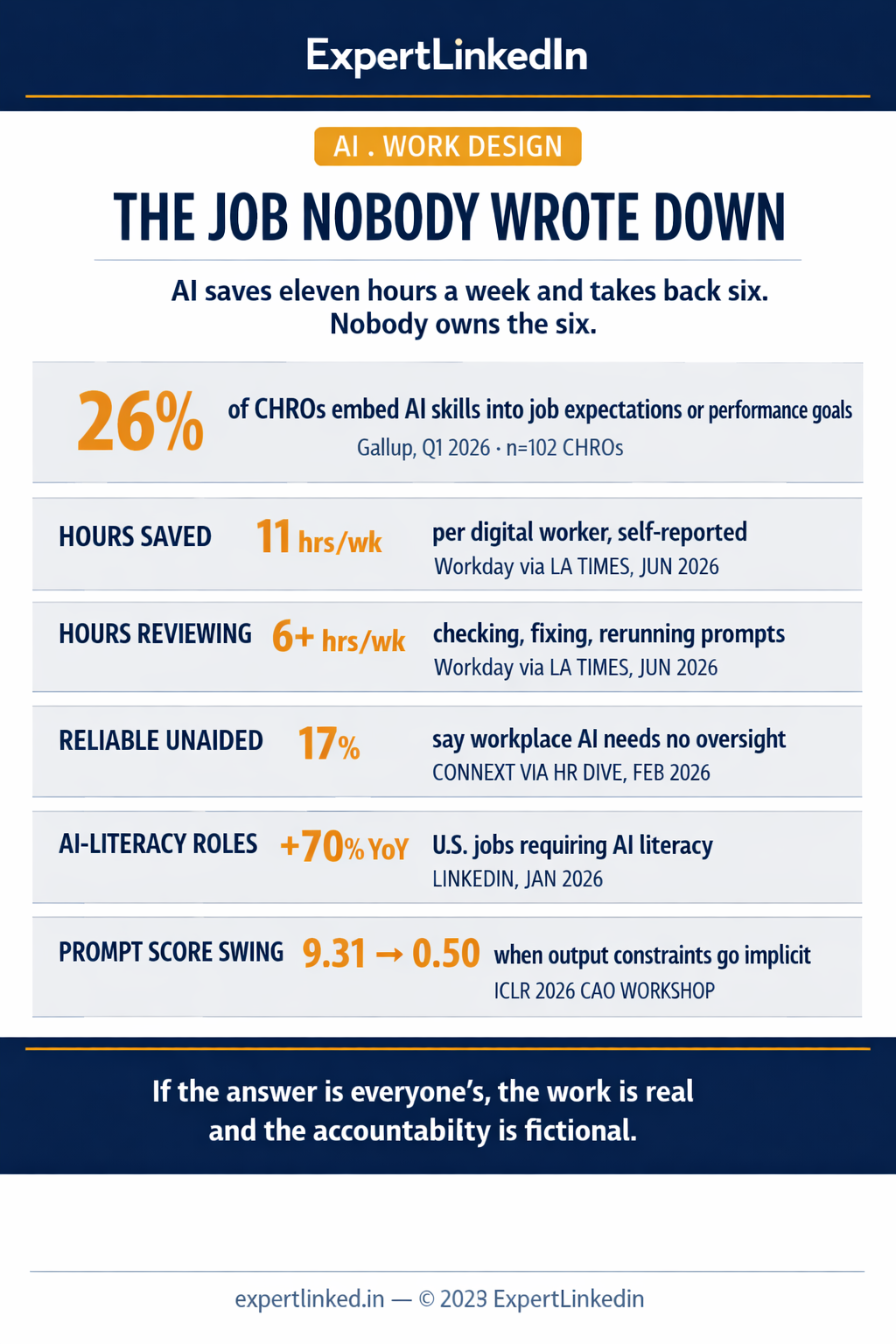
In June, the Los Angeles Times reported a Workday survey of 6,000 digital workers in the U.S., U.K. and Australia. AI saved each worker roughly 11 hours a week. Those same workers then spent more than six hours “botsitting”: checking output, fixing mistakes, rerunning the prompt. The report described a “thick, mostly invisible layer of human labor holding the whole thing together”. Only 13% of the organisations surveyed had seen significant business gains from AI adoption.
Read that as a job description. Eleven hours saved, six spent, and the six never appears in a capacity plan. A team claiming a productivity gain is usually quoting the eleven and quietly borrowing the six from whoever is careful.
The second data point is sharper about the contents. Connext Global’s 2026 AI Oversight Report, covered by HR Dive in February, found only 17% of U.S. adults called workplace AI reliable without human oversight, and 28% said it needs attention almost every time. Asked what the follow-up work was, the top two answers were editing or fixing (42%) and review or approval (34%).
That second number is the one to sit with. Review or approval is not a chore. It is a decision right. If your signature releases the output, you own the outcome, whether or not anyone wrote that down.

Why it never gets written down #
If the work is this visible in the data, why is it invisible in the org chart? Gallup’s Q1 2026 study, which surveyed 23,717 U.S. employees alongside 102 CHROs at global Fortune 500 companies, gives the cleanest answer I have found.
Only 26% of those CHROs were embedding AI skills into job expectations or performance goals. Only 8% tied AI adoption to incentives or KPIs. Compare what they are doing: 78% encourage peer learning, 62% are building centres of excellence or internal AI champions, 57% train managers.
The cheap, informal mechanisms are funded. The expensive, formal ones are not. Peer learning costs a Slack channel. Rewriting a job architecture, re-banding a role and putting AI duties into a performance goal costs money and creates visible obligations. So the work gets absorbed informally, by whoever is available, and stays off the books.
Anthropic’s usage data suggests who that is: work-related AI use on nights and weekends skews toward higher-wage occupations — the people already working outside standard hours.
The labour market tells the same story from the other side. LinkedIn’s 2026 Labor Market Report found U.S. jobs requiring AI literacy, “like prompt engineering,” grew 70% year over year, as digital and data literacy became baseline across technical and non-technical functions. Meanwhile the standalone “prompt engineer” title has been thinning for two years.
That is not a contradiction. It is the mechanism. The title died because the work succeeded in spreading. And a task bundle that loses its title does not lose its cost. It loses its pay band, its training budget, and its line in the job description.
Lightcast’s posting data adds the last piece: the AI salary premium is largest not in engineering but in traditionally non-technical fields such as architecture and law, because AI skills are worth most when combined with domain expertise. The market is pricing AI capability as an increment to an existing job. Increments do not get their own job descriptions.
Deloitte calls the residue “cultural debt”: unexamined norms and unassigned obligations accumulating while everyone is busy adopting the tool. Its 2026 Human Capital Trends report asks who has the authority to decide when algorithms act and when humans intervene, and notes that workers are already “questioning what counts as effort, ownership, fairness, and accountability.”
They are questioning it because nobody answered it.
A prompt is not a document. It is a running system. #
Here is what makes this a technical argument rather than a management complaint. A prompt that worked is not a finished artifact. It is a running system with a regression surface, and it degrades without anyone touching it.
A paper accepted to the ICLR 2026 workshop on monitoring models under drift put a number on how badly this can go. Harmless prompt variations swung model scores “from 9.31 down to 0.50” when a prompt stopped explicitly spelling out structural constraints. Top models that averaged above nine collapsed to half a point once the output contract went implicit. The paper’s framing is the useful one: the prompt is part of the evaluation protocol, and the evaluator itself carries version risk. Change the judge model and your benchmark moves underneath you.
So maintenance is not “tweaking wording until it looks better.” It is regression testing, version pinning, and re-running a small set of test cases every time a provider ships an update. That is a monitoring discipline. Every serious engineering team has an on-call rotation for it. Nowhere else does.
The human version is worse. A CHI 2025 study from Microsoft Research and Carnegie Mellon, surveying 319 knowledge workers and 936 first-hand examples, found higher confidence in generative AI was associated with less critical thinking, while confidence in your own competence was associated with more. Critical thinking showed up mainly in verification and steering, not in the first draft.
The caveat matters — self-reported, association rather than causation. But the implication is practical: review is a skill, and it needs training. A reviewer who has never been shown what failure looks like here is providing a signature, not a control.
The regulator already wrote the job description #
If this still sounds like an argument about good management, look at what the law now requires.
Article 26(2) of the EU AI Act states that deployers of high-risk AI systems “shall assign human oversight to natural persons who have the necessary competence, training and authority, as well as the necessary support”. The remainder of the Act has applied since 2 August 2026, per the official implementation timeline.
Be precise about scope: this covers high-risk systems, not every office chatbot, and most readers will not deploy one. But the structure is the interesting part. The regulator does not ask whether oversight exists in principle. It asks for a named person, and lists four things that person must have: competence, training, authority and support.
Most internal AI rollouts supply the tool and none of the four. They give someone a login, a vague instruction to “check it before sending,” and no authority to stop the workflow when the check fails. That is not oversight. That is a liability with a human face on it.
The fourth column #
So add one column to the scope audit. Not “skills I should learn.” A list of the AI work you now own, with four fields per item.
Artifact. What exactly do you maintain? The prompt, the eval set, the routing rule, the review queue, the retrieval index. If you cannot name the artifact, you are not maintaining anything — you are reacting.
Authority. Who can change it, and can you stop the workflow when it fails? If the second half is no, you have accountability without control, and that is the thing to raise in the planning conversation.
Time. How many hours a week, and which delivery work is deferred to pay for it? This field turns a feeling into a negotiation. “Six hours” is a number a manager can act on. “It takes a lot of time” is not.
Failure. Whose name is called when it drifts, and what signal tells you it has? If nobody can answer the second half, you do not have a monitoring system. You have a hope.
Then add a review date, because the work changes shape when the model changes underneath it.
A filled row might read: Customer reply drafter — prompt and 40-case eval set — I can edit the prompt, cannot pause the send — 4 hrs/week, taken from the reporting backlog — failure signal is a spike in escalations, owner is me, review 2027-02-01. That is a job description line. It is also the kind of record an auditor would accept.
Whose name is on the prompt? #
Microsoft’s 2026 Work Trend Index, surveying 20,000 AI-using knowledge workers across ten markets, ends with three questions every organisation will have to answer: who reviews agent performance, who has the authority to update the workflows agents run, and how a local win gets captured and scaled.
Notice what is missing: “whose job is it?” The report treats ownership as a leadership and platform problem, which it is — but the answer has to land somewhere with a name, a calendar and a pay grade, or it does not land at all. The same survey found only 19% of AI users in the “frontier” zone where capability and organisational readiness reinforce each other, and 10% in “blocked agency”: skilled people whose organisations cannot absorb what they can already do. That 10% is where the unlisted work accumulates.
So here is a better question for your 2027 planning conversation:
Whose name is on the prompt?
If the answer is everyone’s, the work is real and the accountability is fictional. If it is yours, it belongs in the fourth column, with hours and authority attached, before the budget locks. And if it is nobody’s, you have found the most consequential thing missing from next year’s job description — and the cheapest thing to fix while everyone is still pretending it is nobody’s job.
Maintaining a prompt, an eval set, or a review queue that nobody officially gave you? I’d like to hear what your version of the fourth column looks like — especially the authority field.
Email me at alex.winters@tlnw.uk
References #
- Los Angeles Times (June 12, 2026). “AI saves office workers hours — and then demands hours of babysitting.” https://www.latimes.com/business/story/2026-06-12/ai-saves-office-workers-hours-but-then-demands-hours-of-babysitting (Accessed November 7, 2026)
- HR Dive (February 24, 2026). “AI output will increasingly require more oversight, workers report.” https://www.hrdive.com/news/workplace-ai-not-reliable-human-oversight/812949/ (Accessed November 7, 2026)
- Gallup (2026). “AI’s Effect on Workplace Culture.” https://www.gallup.com/workplace/712976/ai-effect-on-workplace-culture.aspx (Accessed November 7, 2026)
- LinkedIn Economic Graph (January 2026). “Labor Market Report 2026: Building a Future of Work That Works.” https://economicgraph.linkedin.com/research/labor-market-report-2026 (Accessed November 7, 2026)
- Lightcast (2025, refreshed). “The Lightcast Global AI Skills Outlook.” https://lightcast.io/resources/research/the-lightcast-global-ai-skills-outlook (Accessed November 7, 2026)
- Deloitte Insights (March 4, 2026). “2026 Global Human Capital Trends.” https://www.deloitte.com/us/en/insights/topics/talent/human-capital-trends.html (Accessed November 7, 2026)
- Zhu, Y. et al. (2026). “Prompt-Level Drift as an Operational Monitoring Problem: Schema Failure Cliffs and Judge-Version Risk in Artifact-Grounded Evaluation.” ICLR 2026 CAO Workshop. https://github.com/yuchenzhu-research/iclr2026-cao-prompt-drift-lab (Accessed November 7, 2026)
- Lee, H-P. et al. (2025). “The Impact of Generative AI on Critical Thinking: Self-Reported Reductions in Cognitive Effort and Confidence Effects From a Survey of Knowledge Workers.” CHI 2025, Microsoft Research and Carnegie Mellon University. https://www.microsoft.com/en-us/research/publication/the-impact-of-generative-ai-on-critical-thinking-self-reported-reductions-in-cognitive-effort-and-confidence-effects-from-a-survey-of-knowledge-workers/ (Accessed November 7, 2026)
- EU AI Act, Article 26. “Obligations of deployers of high-risk AI systems.” https://artificialintelligenceact.eu/article/26/ (Accessed November 7, 2026)
- EU AI Act Implementation Timeline (updated August 31, 2026). https://artificialintelligenceact.eu/implementation-timeline/ (Accessed November 7, 2026)
- Microsoft WorkLab (2026). “2026 Work Trend Index: Agents, human agency, and the opportunity for every organization.” https://www.microsoft.com/en-us/worklab/work-trend-index/agents-human-agency-and-the-opportunity-for-every-organization (Accessed November 7, 2026)
- Anthropic (June 2026). “Anthropic Economic Index report: Cadences.” https://www.anthropic.com/research/economic-index-june-2026-report (Accessed November 7, 2026)
- Jackson Rodriguez (November 2, 2026). “How to Renegotiate Job Responsibilities for 2027 With a 3-List Scope Audit.” ExpertLinked.In. https://expertlinked.in/posts/2026-11-02-how-to-renegotiate-job-responsibilities-for-2027-with-a-3-list-scope-audit/ (Accessed November 7, 2026)
- Emily Chen (October 15, 2026). “The Verification Tax: Who Actually Pays for the AI Productivity Gain.” ExpertLinked.In. https://expertlinked.in/posts/2026-10-15-the-verification-tax-who-actually-pays-for-the-ai-productivity-gain/ (Accessed November 7, 2026)
- Alex Winters (September 24, 2026). “The Team That Owns the Eval Owns the AI Product.” ExpertLinked.In. https://expertlinked.in/posts/2026-09-24-the-team-that-owns-the-eval-owns-the-ai-product/ (Accessed November 7, 2026)
- Alex Winters (June 25, 2026). “End of the Whisperer: Why Prompt Engineering Must Grow Up or Die.” ExpertLinked.In. https://expertlinked.in/posts/2026-06-25-end-of-the-whisperer-why-prompt-engineering-must-grow-up-or-die/ (Accessed November 7, 2026)
AI Content Notice
This article was created using artificial intelligence technology. Whenever possible, we include references and sources to support the information presented. Readers are encouraged to consult these sources for further information. While we strive for accuracy and provide valuable insights, readers should independently verify information and use their own judgment when making business decisions. The content may not reflect real-time market conditions or personal circumstances.
Related Articles
Infographic: Who Owns the Prompt? The Unlisted Line in Your 2027 Job Description
AI saves the average knowledge worker 11 hours a week and then takes back six of them in checking, …
Your Next AI Feature Shouldn't Write a Word: The Quiet Rise of Decision Models
In four weeks, ‘return a decision instead of a paragraph’ went from one startup’s …
The Team That Owns the Eval Owns the AI Product
Benchmarks can narrow a model choice, but they do not tell you whether your agent survives your …