AI Can Rate, Watch and Fire You. Who Owns That Decision?

Somewhere in your working life, an algorithm may already hold authority over you. It can rank your application before a person sees it. It can set the pace of your shift, watch your keystrokes, score a day’s output, and recommend — sometimes trigger — the end of your job. What it cannot do is answer for any of it.
That is the strange new arrangement at work: authority has migrated to the machine, and responsibility has not. The system that makes the decision is not the system that can be held to account. The robo-boss has no manager.
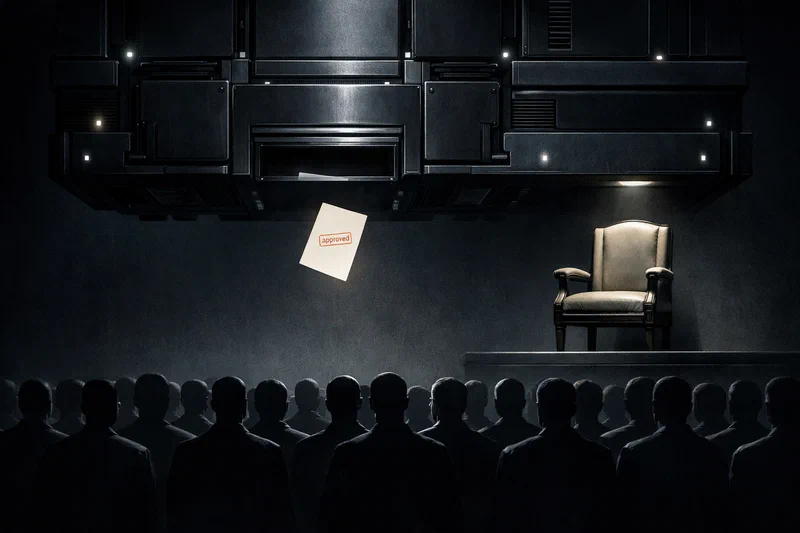
From assistant to authority #
For a few years, the workplace-AI debate was about a tool you used. That framing is now out of date. AI has moved from assisting work to managing people: screening candidates, scheduling and pacing shifts, monitoring activity, scoring performance, and flagging workers for discipline or exit.
The scale is no longer hypothetical. Stanford’s 2026 AI Index reports that AI’s workforce disruption “has moved from prediction to reality, hitting young workers first” — employment among software developers aged 22–25 has fallen nearly 20% since 2024. At the manager level, Fortune’s October interviews with chief information officers captured the same shift in one line: a leader who now manages “three human employees and 19 agents.”
When a machine only drafted your email, its mistakes were an inconvenience. When it decides whether you are hired, paced, promoted, watched, or let go, its authority is your livelihood. That is the line 2026 crossed — and why the old reassurance, “there will still be a human in the loop,” no longer settles anything.
The law already wrote the answer #
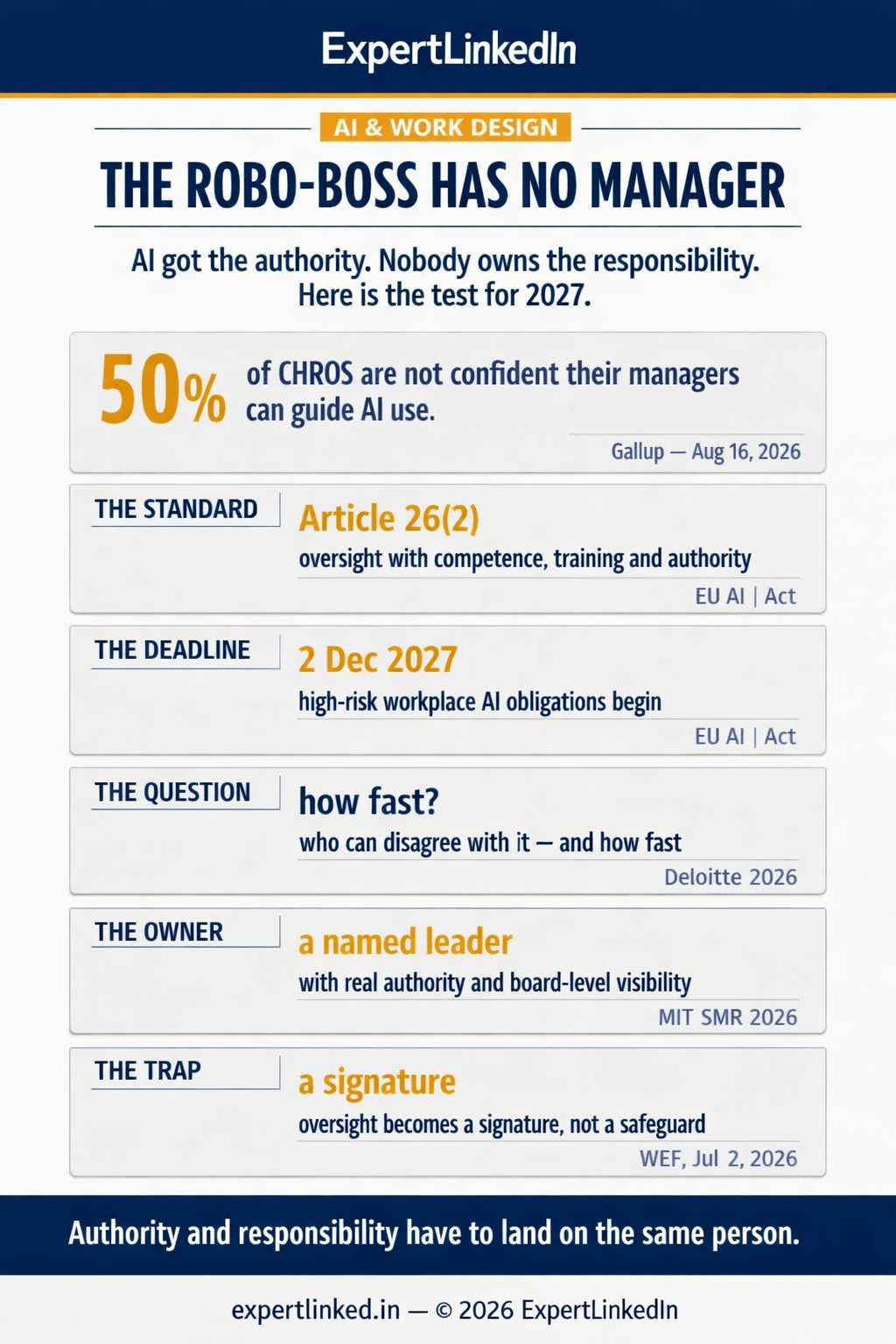
If you want to know what “responsible” is supposed to mean here, read the European Union’s AI Act. Its Article 26 puts the duty on the deployer — the organisation that puts the system to work, which in the workplace is your employer. Article 26(2) says deployers “shall assign human oversight to natural persons who have the necessary competence, training and authority, as well as the necessary support.” Article 26(7) requires employers using high-risk AI “at the workplace” to inform workers’ representatives and the affected workers. Article 26(11) requires that people subject to an AI-assisted decision be told it is happening.
Read those clauses together and you get a single principle, and it is this week’s theme in legal form: match the authority to the responsibility. Name a capable, trained, genuinely empowered human to own the decision; tell the worker it is happening; give the worker a way to answer.
The timing matters for 2027 planning. Under the Act’s phased application, the obligations for the broadest high-risk category — which includes employment and worker-management uses — begin applying on 2 December 2027. That is close enough that “we’ll sort it out later” is a choice, not a defence. And the EU is not alone: a politically diverse set of US states has passed some form of “human-in-the-loop” law requiring human judgment where algorithms shape sensitive decisions — a wave that includes California’s move to bar decisions about hiring and firing from being made by AI alone, reported in 2026 as the “robo-boss” rule.
A name is not enough #
Here is where the comfortable version of the fix falls apart. Naming an owner does not, by itself, make anyone accountable. The risk is that it becomes what the researcher Nicolas Spatola calls “procedural theater: present in the workflow, but too thin to function as a real safeguard”. He is writing about government, but the mechanism transfers exactly: an override that is only formally available is not a safeguard; it has to be “operationally meaningful.”
Two further checks expose the gap.
The first is whether the owner can actually act. Europe’s AI Act asks for “authority” and “support,” not a job title. Deloitte’s 2026 Human Capital Trends warns that traditional accountability charts “presume static authority”; with AI, rights must become dynamic, “incorporating override privileges, escalation paths, and consensus rules.” Its sharpest formulation is the question every worker should ask about an AI decision made about them: “Who gets to disagree with it, and how fast?”
The second is whether the owner still has the judgment to disagree. The World Economic Forum calls this the oversight paradox: the competence to supervise an AI is built through the same practice the AI now does instead. The more capable the system, the less the overseer exercises the skill, until — as the WEF authors put it — “oversight stops being a safeguard and becomes a signature.” A person whose name is on a decision they can neither redo nor reverse is not the accountable one. They are the cushion.
So the organisation-level answer is not “add a reviewer.” MIT Sloan Management Review’s panel of AI experts puts it plainly: a responsible organisation must “designate a specific leader, with real authority and board-level visibility, who is accountable” for how AI affects people — and warns that “if no single leader owns workforce impact, it will remain a talking point in governance documents.” One expert’s line is the thesis of this column: if responsible AI only means making the model safe and compliant, “responsible AI becomes a technical checklist with a moral halo.”
The uncomfortable truths #
Three objections deserve honest answers, because this is not an anti-technology argument.
Much monitoring is lawful and can be fairer. Automated scoring can reduce some human bias and inconsistency. The target is the unowned, unconstrained, uncontestable version — not oversight itself. Say that out loud, because it is true.
The owner is often as boxed in as you are. Gallup finds that half of CHROs are not confident their managers can guide AI use, and managers are already absorbing expanded responsibilities. “Ask your manager” is incomplete advice when the manager may not hold the stop button either.
And the tool may be a worse judge than advertised. Research summarised by MIT Sloan Management Review on implementing workplace AI tools finds these systems can disrupt workflows, worsen joint human–AI decisions, and flatter users’ existing judgments. Handing a sycophantic tool authority over someone’s evaluation is not efficiency. It is an un-owned design failure.
What to do before 2027 #
You do not have to wait for a regulation to ask a better question. If an AI system shapes a decision about you, ask three things:
- Who owns this decision? A role and a name, not “the team.”
- What can they actually do about it? If they cannot pause, override, or reverse it in time, you have found the gap.
- How do I contest it? Who reviews my challenge, by when, and what happens to the decision while it is disputed?
Then write down the answers — and the non-answers. A dated note (“asked on this date; told no one owns it”) is the difference between a bad outcome and an open question someone has to resolve. Where you have one, a works council or workers’ representative can press the legal duty directly; where you don’t, human resources and legal are the owners of record. Where a decision touches safety, pay, privacy, or employment status, route it to the owner who holds the legal authority — by name and by clock.
None of that creates rights on its own. Statutory duties and unequal bargaining power mean some workers can push and some cannot. But a decision with no owner is not a neutral fact. It is a choice the organisation made, and naming it is the first move toward changing it.
Authority and responsibility have to land on the same person. Where they cannot, the honest answer is not a signature — it is to stop the automated decision until someone can own it. The “human in the loop” was never really a person. It was an allocation of authority. Let’s put it back where it belongs.
Is an algorithm holding authority in your workplace that no one will claim? Tell me the decision it makes about you — and whether anyone can actually answer for it.
Email me at emily.chen@tlnw.uk
References
-
European Union (accessed November 20, 2026). “Article 26: Obligations of Deployers of High-Risk AI Systems.” EU Artificial Intelligence Act. https://artificialintelligenceact.eu/article/26/
-
European Union (accessed November 20, 2026). “Implementation Timeline.” EU Artificial Intelligence Act. https://artificialintelligenceact.eu/implementation-timeline/
-
Spatola, N. (May 5, 2026). “AI Efficiency Can Undermine Accountability Even With Humans in the Loop.” Tech Policy Press. https://techpolicy.press/ai-efficiency-can-undermine-accountability-even-with-humans-in-the-loop
-
World Economic Forum (July 2, 2026). “The oversight paradox: Human control over AI may be eroding the very competence it requires.” https://www.weforum.org/stories/2026/07/oversight-paradox-human-control-ai/
-
MIT Sloan Management Review (2026). “Beyond the Model: Why Responsible AI Must Address Workforce Impact.” https://sloanreview.mit.edu/article/beyond-the-model-why-responsible-ai-must-address-workforce-impact/
-
MIT Sloan Management Review (2026). “Three Things to Know About Implementing Workplace AI Tools.” https://sloanreview.mit.edu/article/three-things-to-know-about-implementing-workplace-ai-tools/
-
Deloitte (2026). “Decision-making with AI.” 2026 Global Human Capital Trends. https://www.deloitte.com/global/en/insights/topics/talent/human-capital-trends/2026/decision-making-with-ai.html
-
Gallup (August 16, 2026). “AI’s Effect on Workplace Culture.” https://www.gallup.com/workplace/712976/ai-effect-on-workplace-culture.aspx
-
Fortune (October 8, 2026). “Your next manager may have three employees and 19 agents. Who’s accountable?” https://fortune.com/2026/10/08/ai-management-digital-workers-accountability/
-
Stanford HAI (2026). “Inside the AI Index: 12 Takeaways From the 2026 Report.” https://hai.stanford.edu/news/inside-the-ai-index-12-takeaways-from-the-2026-report
-
Brookings Institution (2026). “AI and the future of work: A policy framework.” https://www.brookings.edu/articles/ai-workforce-policy-framework/
-
Microsoft (May 5, 2026). “2026 Work Trend Index: Agents, human agency, and the opportunity for every organization.” https://www.microsoft.com/en-us/worklab/work-trend-index/agents-human-agency-and-the-opportunity-for-every-organization
-
ExpertLinked (November 5, 2026). “The ‘Human in the Loop’ Is Not a Job. It’s a Liability.” https://expertlinked.in/posts/2026-11-05-the-human-in-the-loop-is-not-a-job-its-a-liability/
-
ExpertLinked (November 16, 2026). “How to Set AI Decision Rights for 2027 With a 4-Question Team Agreement.” https://expertlinked.in/posts/2026-11-16-how-to-set-ai-decision-rights-for-2027-with-a-4-question-team-agreement/
-
ExpertLinked (November 20, 2026). “I’m Accountable for AI Decisions I Can’t Override—What to Change Before 2027.” https://expertlinked.in/posts/2026-11-20-im-accountable-for-ai-decisions-i-cant-override-what-to-change-before-2027/
AI Content Notice
This article was created using artificial intelligence technology. Whenever possible, we include references and sources to support the information presented. Readers are encouraged to consult these sources for further information. While we strive for accuracy and provide valuable insights, readers should independently verify information and use their own judgment when making business decisions. The content may not reflect real-time market conditions or personal circumstances.
Related Articles
Infographic: AI Can Rate, Watch and Fire You. Who Owns That Decision?
AI at work stopped only helping you and started managing you—ranking, monitoring, scoring and …
Infographic: The 'Human in the Loop' Is Not a Job. It's a Liability.
‘There will still be a human in the loop’ is how companies claim to govern AI. But …
The 'Human in the Loop' Is Not a Job. It's a Liability.
‘There will still be a human in the loop’ is how companies claim to govern AI. But …