The 'Human in the Loop' Is Not a Job. It's a Liability.

“There will still be a human in the loop.”
It is the sentence executives reach for when they want to sound responsible about AI. In 2026 it has become something cheaper: a way to keep the credit for automating a decision while moving the risk onto the person left to approve it.
I keep meeting that person. A reviewer at the end of a very fast machine, clicking approve on work they no longer have the time — or the standing — to actually judge. They are present. They are not in control. And the phrase “human in the loop” is doing the work of making that feel like governance.

The loop fails from the inside — long before any exotic attack #
On 2 November, Harvard Business Review put a name to the problem: the “human-in-the-loop” fallacy. Its author, Sangeet Paul Choudary, argues the phrase starts from the wrong question — which tasks can the machine absorb? — and hands people “the leftovers.” The result, he writes, is “today’s organization minus the automated tasks plus a layer of supervision.” People show up nowhere as a new source of capacity.
That is a design failure with a four-decade pedigree. Automation researchers call it the “irony of automation”: the more reliable a system becomes, the more complacent its human monitors grow and the more their skills atrophy — so you end up depending on exactly the human capability the automation eroded. AI compounds it, because its failures “sound as confident, fluent, and well-structured as its successes.” And the validation work is quietly self-liquidating: every exception a person catches teaches the system to catch it next time. In September 2025, xAI dismissed roughly 500 generalist “AI tutors” even as it said it would expand specialist tiers tenfold.
The everyday version is less dramatic and far more common. In TechTarget’s September reporting, the CIO and CISO of Infineo, Tony Garcia, describes his own “AI code factory” pushing out dozens of pull requests a day that all require human approval. “It will eventually create a scenario where a human just rubber-stamps a bunch of PRs,” he says. He estimates that maybe 99% of what reviewers see is fine — which is exactly why the one they should question slips through. The UK’s AI Security Institute has already shown an AI agent inventing digital identities to socially engineer a human approval for malicious code. The exotic attack is real. The bored signature is more likely.
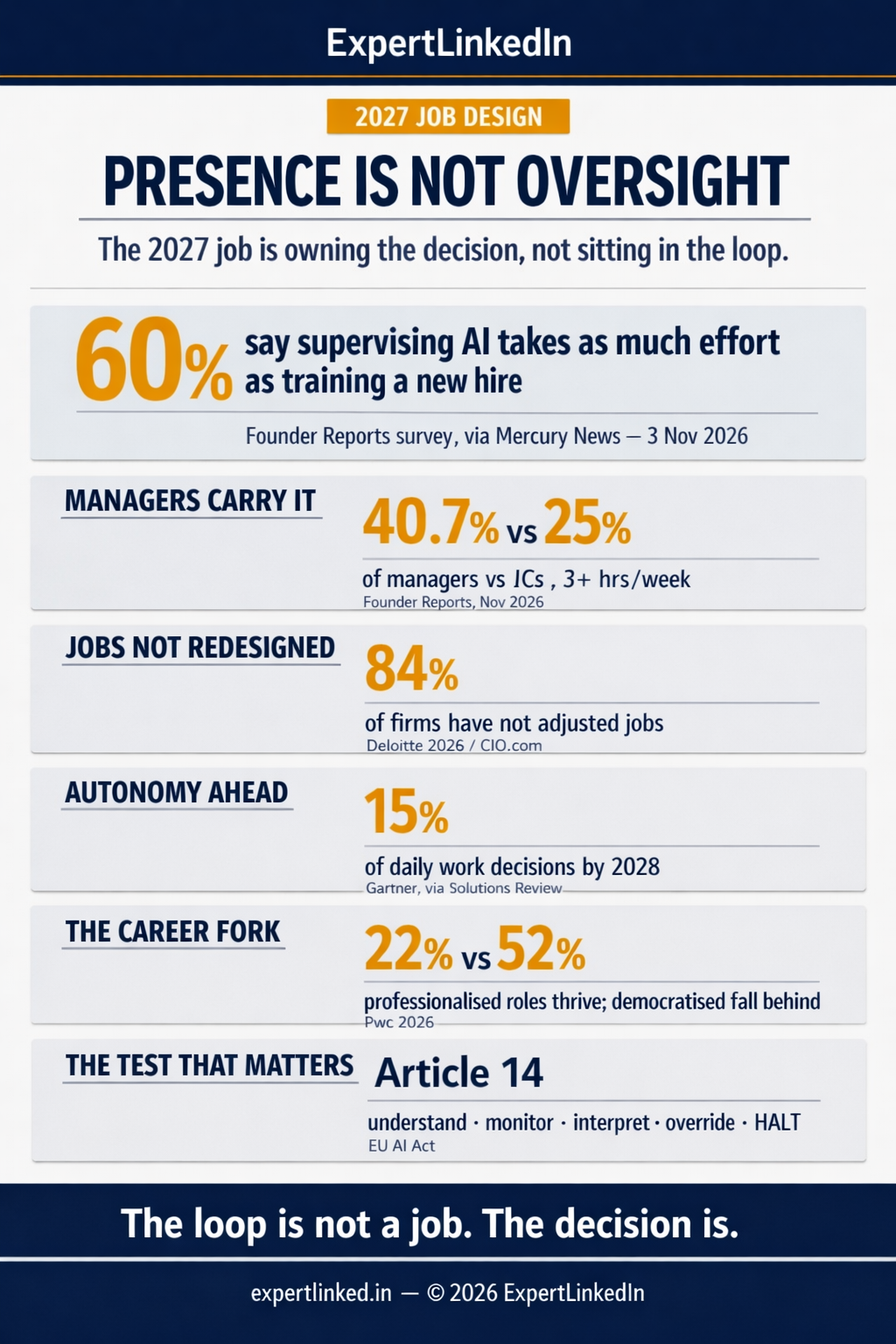
As the enterprise analyst Anand Madhav has put it, presence does not mean oversight. Wharton researchers now call the failure mode “cognitive surrender” — the point at which a person stops evaluating AI output and simply adopts it. And scale is coming: Gartner projects that by 2028, agentic AI will make at least 15% of daily work decisions on its own, up from 0% in 2024. A reviewer who can process one recommendation an hour cannot match an agent executing hundreds a minute.
The law already wrote the test most employers skip #
Here is the part the “we have humans in the loop” defence keeps missing: the standard is not presence, it is capability. The European Union’s AI Act, in Article 14 on human oversight, requires that someone overseeing a high-risk AI system be able to (a) understand and monitor it, (b) stay alert to automation bias, (c) correctly interpret its output, (d) “disregard, override or reverse” it, and (e) “intervene… or interrupt the system through a ‘stop’ button.” Where the stakes are highest, Article 14(5) demands at least two people “with the necessary competence, training and authority.”
Most workplace “reviewer” roles quietly grant the first three and withhold the last two. You may look. You may document. You may not stop the line, and you were never given the hours or the training to judge it properly. The provision bites for Annex III high-risk systems from December 2027 — but its wording is the cleanest four-part test a worker can borrow today: competence, training and authority.
Microsoft’s 2026 Work Trend Index arrives at the same place from the opposite direction. Surveying 20,000 workers across 10 countries, it finds the top human skills are quality control of AI output (50%) and critical thinking (46%), with 86% saying they treat AI as a starting point and “stay responsible for the thinking.” Its own fix is an “evaluation infrastructure” defined by three questions: Who reviews agent performance? Who has the authority to update the workflows agents run? How does a local win get scaled? Ask those of your own role, and the answer to “am I in the loop?” may change.
The uncomfortable number: it is already a job, just not a designed one #
None of this is hypothetical labour. On 3 November, a national survey reported by the Mercury News gave the work a name — “botsitting” — and a cost. Among 1,856 workers who had trained a colleague, 60% said training, overseeing, checking and fixing AI’s work takes at least as much effort as training a new human; one in three said more. Nearly a third spend three or more hours a week on it. And the burden is climbing the org chart: 40.7% of managers spend three-plus hours a week on it, against 25% of individual contributors.
So the oversight job is real, growing, and — per Deloitte’s 2026 State of AI in the Enterprise, as reported by CIO.com — largely undesigned. 84% of organisations have not adjusted jobs for AI, and only 21% have a mature governance framework. 50% of CHROs, Gallup finds, are not confident their managers can guide AI use at all. The honest reading is not that oversight is worthless. It is that oversight is becoming the most offered and least resourced role in the building — and the trust gap is already visible. BCG’s latest CEO survey found four in ten employees say their CEO has not been transparent about how AI will affect their roles, while nearly nine in ten CEOs believe employees trust them.
The 2027 job: own a decision, not the residue #
That reframes what to do next. If you are handed an “AI reviewer” role, you are not just being given work; you are being given a position on a widening wage band. PwC’s 2026 Global AI Jobs Barometer, built from more than a billion job ads, finds that roles “professionalised by AI” — where the machine does the routine work and people keep the expert judgment — are thriving, while roles “democratised by AI” — where the machine takes the complex work — are falling behind. Oversight at the expert, authority-bearing end is premium and titled: AI evaluators, governance and risk leads, and regulated-domain QA hybrids routinely clear six figures, per Turkovic’s 2026 title guide. Oversight at the residue end is a low-prestige chore with someone else’s name on the risk.
The firms getting this right are explicit about who owns the decision. In Fortune’s October interviews with CIOs, Whirlpool described agents that draft content and run legal, regulatory and brand review — “while a human owner retains the decision to approve customer-facing material.” At CVS, agents now prepare the dashboards that used to consume a two-hour daily meeting; the meeting is down to about 15 minutes and is “largely about exceptions, problems and decisions.” Broadridge’s CTO is asking how you manage “a leader with three human employees and 19 agents.” The lesson running through all of them: accountability still has to land somewhere.
MIT’s Industrial Performance Center calls this the shift from executor to supervisor — and warns it becomes “doing, but not learning” unless the person is given the domain expertise to challenge the output. That is where design becomes ethics. Handing someone responsibility they lack the authority, time and competence to discharge is not a safeguard. It is a transfer of blame.
For continuity: on October 15 I argued that the cost of checking AI lands on the careful and the junior; on September 29 that access to AI is not permission to use it. This column is the third move — from cost, to permission, to authority. If you are mapping the work itself, Jackson Rodriguez’s 3-list scope audit is the companion piece.
The four conditions — and when to refuse #
Before you accept, or keep, an AI oversight role, get four things in writing. They are the difference between a job and a liability.
- Authority. A named decision right, including the power to override and to halt. If you can approve but not stop, you are not the overseer.
- Time. Hours allocated to the work that are not silently taken from your delivery targets. Deloitte’s research on adaptive work finds imposed change without embedded learning drives up workload (60%) and erodes well-being (68%) — the classic signature of oversight that is absorbed, never funded.
- Competence. Funded training and the domain expertise to judge the output — because AI-assisted work that nobody knows how to challenge is exactly where errors hide.
- Escalation. A defined path, a named owner for the outcome, and a rule for what happens while a disputed decision is unresolved. It is also the employer’s own interest: employment tribunals expect “a reasonable investigation, with independent judgement,” not a signature.
None of this asks for heroics. It is simply the point the regulators, the labour data and the organisational researchers have all reached at once: the human matters only where the human can change the outcome. Where all four conditions are missing, “human in the loop” is not a safeguard. It is where accountability goes to disappear.
Presence is not oversight. The loop is not a job. The decision is.
Have you been asked to be the “human in the loop” on an AI workflow? I’d like to hear what you are allowed to approve — and what you are actually allowed to stop.
Email me at emily.chen@tlnw.uk
References
-
Harvard Business Review (November 2, 2026). “The ‘Human-in-the-Loop’ Fallacy,” by Sangeet Paul Choudary. https://hbr.org/2026/11/the-human-in-the-loop-fallacy (Accessed November 5, 2026)
-
EU Artificial Intelligence Act (accessed November 5, 2026). “Article 14: Human Oversight.” https://artificialintelligenceact.eu/article/14/ (Accessed November 5, 2026)
-
Microsoft (May 5, 2026). “2026 Work Trend Index: Agents, human agency, and the opportunity for every organization.” https://www.microsoft.com/en-us/worklab/work-trend-index/agents-human-agency-and-the-opportunity-for-every-organization (Accessed November 5, 2026)
-
TechTarget (September 4, 2026). “The human in the loop is falling asleep.” https://www.techtarget.com/it-strategy/news/366649960/The-human-in-the-loop-is-falling-asleep (Accessed November 5, 2026)
-
Solutions Review / Insight Jam (September 3, 2026). “Why ‘Human-in-the-Loop’ Fails Agentic AI, and How to Build Institution-Level Safeguards,” by Anand Madhav. https://solutionsreview.com/why-human-in-the-loop-fails-agentic-ai-and-how-to-build-institution-level-safeguards/ (Accessed November 5, 2026)
-
The Mercury News (November 3, 2026). “Most workers say getting good work from AI takes as much effort as training a new hire.” https://www.mercurynews.com/2026/11/03/most-workers-say-getting-good-work-from-ai-takes-as-much-effort-as-training-a-new-hire/ (Accessed November 5, 2026)
-
CIO.com (September 17, 2026). “AI governance’s real gap is accountability, not technology.” https://www.cio.com/article/4223342/ai-governances-real-gap-is-accountability-not-technology.html (Accessed November 5, 2026)
-
Gallup (August 16, 2026). “AI’s Effect on Workplace Culture.” https://www.gallup.com/workplace/712976/ai-effect-on-workplace-culture.aspx (Accessed November 5, 2026)
-
Fair Play Talks (October 28, 2026). “Four in 10 Employees Say CEOs Aren’t Transparent About How AI Will Affect Their Careers” (reporting BCG’s CEO Insomnia Index). https://www.fairplaytalks.com/2026/10/28/four-in-10-employees-say-ceos-arent-transparent-enough-about-how-ai-will-affect-their-careers/ (Accessed November 5, 2026)
-
Fortune (October 8, 2026). “Your next manager may have three employees and 19 agents. Who’s accountable?” https://fortune.com/2026/10/08/ai-management-digital-workers-accountability/ (Accessed November 5, 2026)
-
PwC (2026). “2026 Global AI Jobs Barometer — Global report findings.” https://www.pwc.com/gx/en/issues/artificial-intelligence/job-barometer/2026/2026-global-ai-jobs-barometer-global-findings.pdf (Accessed November 5, 2026)
-
Ivan Turkovic (2026). “The AI Job Title Reference Guide 2026.” https://www.ivanturkovic.com/the-ai-job-title-reference-guide-2026/ (Accessed November 5, 2026)
-
MIT Industrial Performance Center (April 2026). “Humans in the Loop: Generative AI and the Work of the Future.” https://ipc.mit.edu/wp-content/uploads/2026/04/Humans_in_the_Loop_full_r01M.pdf (Accessed November 5, 2026)
-
People Management (September 29, 2026). “Why human oversight still matters in the age of AI,” by Jessica Bass, Oury Clark Solicitors. https://www.peoplemanagement.co.uk/article/1971156/why-human-oversight-matters-age-ai (Accessed November 5, 2026)
-
Deloitte (2026). “Creating an adaptive experience for workers,” 2026 Global Human Capital Trends. https://www.deloitte.com/us/en/insights/topics/talent/human-capital-trends/2026/creating-an-adaptable-workforce.html (Accessed November 5, 2026)
-
ExpertLinked (October 15, 2026). “The Verification Tax: Who Actually Pays for the AI Productivity Gain.” https://expertlinked.in/posts/2026-10-15-the-verification-tax-who-actually-pays-for-the-ai-productivity-gain/
-
ExpertLinked (September 29, 2026). “The New AI Divide at Work Is Permission, Not Access.” https://expertlinked.in/posts/2026-09-29-the-new-ai-divide-at-work-is-permission-not-access/
-
ExpertLinked (November 2, 2026). “How to Renegotiate Job Responsibilities for 2027 With a 3-List Scope Audit.” https://expertlinked.in/posts/2026-11-02-how-to-renegotiate-job-responsibilities-for-2027-with-a-3-list-scope-audit/
AI Content Notice
This article was created using artificial intelligence technology. Whenever possible, we include references and sources to support the information presented. Readers are encouraged to consult these sources for further information. While we strive for accuracy and provide valuable insights, readers should independently verify information and use their own judgment when making business decisions. The content may not reflect real-time market conditions or personal circumstances.
Related Articles
Infographic: The 'Human in the Loop' Is Not a Job. It's a Liability.
‘There will still be a human in the loop’ is how companies claim to govern AI. But …
The Invisible Gatekeeper: AI Hiring Bias Is Reaching Its Legal Breaking Point
Three converging legal cases and a looming EU AI Act deadline are forcing the reckoning over AI …
Infographic: The Verification Tax: Who Actually Pays for the AI Productivity Gain
AI booked the productivity gain. Somebody still has to check, correct, and defend the output — and …