My Manager Approved Training but Keeps Cancelling Learning Time—What to Agree for 2027

The most expensive sentence in workplace learning is not “we can’t fund the course.” It is this one: the training is approved — I just never get to use it.
“My company approved a data-analytics course in January and paid for the licence. Eleven months later I’ve finished about a third of it. Every time I block two hours to practise, something lands — a client escalation, a report that has to go out, a colleague who’s out sick — and my manager asks if we can ‘push the learning to next week.’ It’s always next week. I don’t think she’s against me learning; she keeps saying how important it is. But the work always wins. How do I get us to agree a real plan for 2027 — one that doesn’t get cancelled the first time delivery gets tight?” — Data analyst, mid-size software company

That is not a motivation problem, and it is not a discipline problem. It is an allocation problem wearing a very reasonable disguise: everyone agrees learning matters, and nothing on the calendar has to give for it to happen.
The Clinical Read #
Start with a distinction that reframes the whole conversation. There are two different things we call “learning,” and one is easy while the other is nearly impossible.
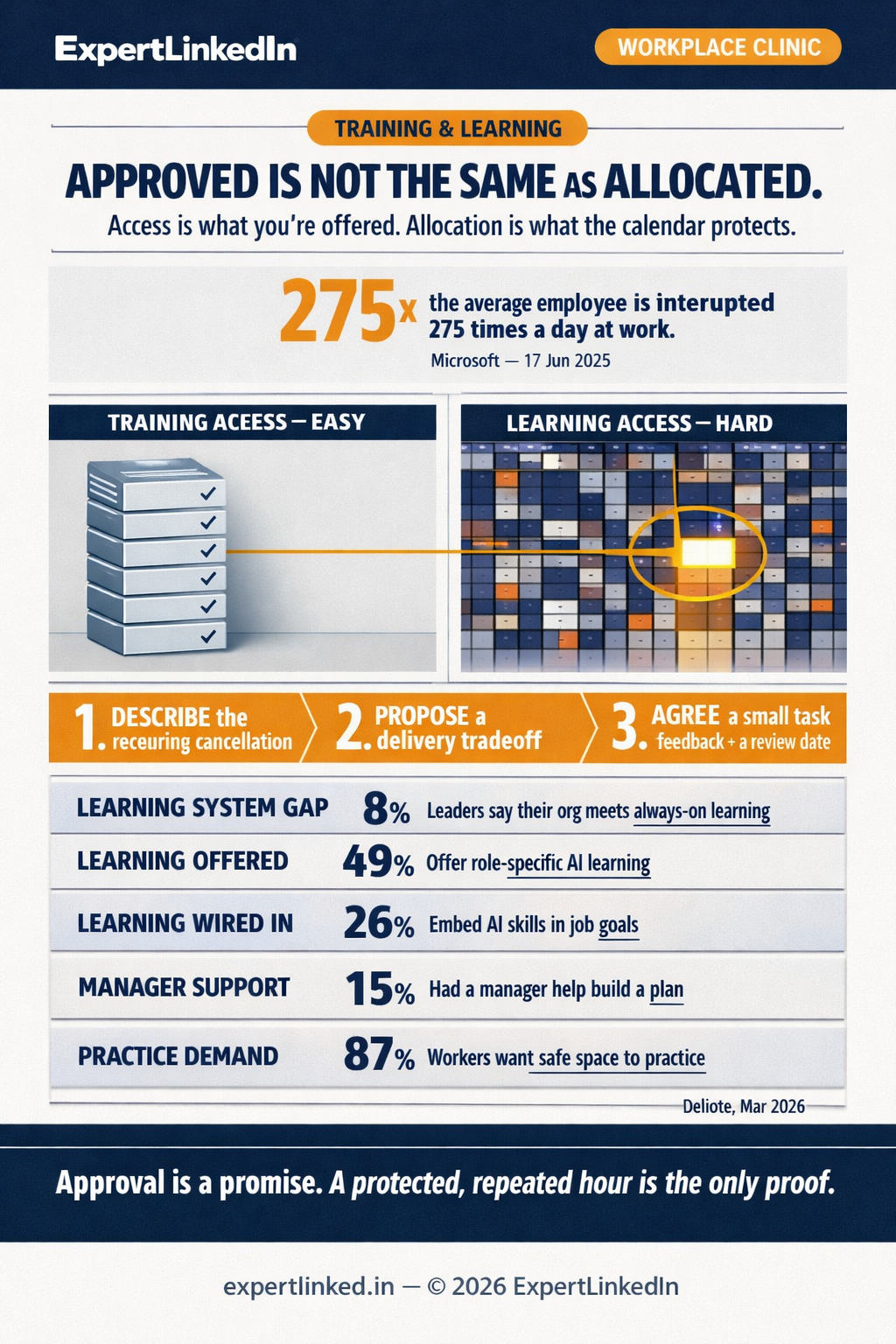
Training access is the course: the budget, the licence, the enrolment. Learning access is the hour you are allowed to spend differently — the practice block that turns a course into a capability. Organizations are routinely generous with the first and reliably stingy with the second.
The evidence for that split is now hard to argue with. Deloitte’s 2026 Global Human Capital Trends survey of more than 9,000 business and HR leaders found that only 8% believe their organizations are highly effective at meeting the continuous, “always-on” learning needs of their workforce (Deloitte, March 3, 2026). The reason is not a shortage of content. As Deloitte puts it, growth still feels like “something outside of daily responsibilities — activities that require stepping away from ‘real work.’”
Gallup shows the same gap from the other side. In its 2026 research on AI and workplace culture, 49% of organizations offer role-specific AI learning or certification — but only 26% embed AI skills into job expectations or performance goals (Gallup, Aug. 16, 2026). Buying and offering learning is common. Scheduling it into the actual job is not. And managers are rarely the problem: 50% of CHROs doubt their managers’ ability to guide AI use, and the people expected to protect your hour are themselves stretched (Gallup, Aug. 16, 2026). LinkedIn’s own numbers agree that the bottleneck is time, not intent: only 15% of employees say their manager helped them build a career plan in the past six months — down five points from 2024 — and when asked what stands in the way, 50% say managers lack proper support (LinkedIn Learning, 2025 Workplace Learning Report).
So your cancelled block is not a personal failing, and it is not proof that your manager doesn’t care. It is the local symptom of a system that has not scheduled learning next to delivery.
“Fit it in around delivery” is the default instruction, and it has a predictable result. As one engineering-practice guide puts it, that “means learning happens only at the margins, during evenings or personal time, or not at all” (Ragan McGill, “Protected Learning Time”).
The mechanics are measurable. Microsoft’s telemetry found that employees are interrupted every two minutes during core work hours — 275 times a day — by meetings, emails, or chats, and that half of all meetings land in the very windows many people rely on for deep focus (Microsoft WorkLab, “Breaking down the infinite workday,” June 17, 2025).
Part of why the block loses is that the demand on your time rarely arrives as one obvious crisis — it accumulates. HBR’s eight-month study of a U.S. tech company found AI “intensified” work: tasks expanded, and workers “increasingly absorbed work that might previously have justified additional help or head count,” describing it as “just trying things” (Ranganathan & Ye, HBR, Feb. 9, 2026). And because leaders “measure workload in hours, deadlines, and metrics,” the coordination and repair work that fills the gaps stays off any scorecard (HBR, July 24, 2026). So in a day like that, the flexible, low-consequence practice block is the first thing softened, because nothing on the scoreboard punishes it. (I wrote about a cousin of this problem last month, when being the dependable one turned reliability into a channel for other people’s late work: I’m the Reliable One.)
One cancellation proves nothing #
Before you change anything, drop the word “why.” A single cancellation is evidence of almost nothing about willingness. Your manager may have protected your block nine times and lost it once to a genuine crisis. Reading intent into one incident is what psychologists call the fundamental attribution error: we explain other people’s behaviour by their character and our own by our circumstances. Your manager’s “she doesn’t value my development” moment is usually her “the client moved the deadline” moment.
The move is to describe the pattern, not the person. “Recurring” is the word that separates a conversation from an accusation — and it is why the first move below asks you to collect evidence before you seek a remedy.
The three moves #
Move 1: Describe the recurring cancellation #
Write it down before you bring it up, because an implied problem is one nobody has agreed to fix. Keep a simple record for four to eight weeks: which block was booked, what displaced it, and who asked to move it. Then read the pattern out loud, without motive:
“The last four Tuesday practice blocks have all moved for delivery. I’m not asking whether learning matters — I know it does. I’d like us to fix the schedule, not the intention. Can we look at what keeps winning?”
You are stating behaviour and frequency. You are not diagnosing character. That difference is what keeps the manager on your side of the table instead of defending themselves across it.
Move 2: Propose an actual delivery tradeoff #
Here is the sentence that makes an approved intention real, and it is the same one our Nov. 9 column on building a 2027 development plan puts to managers: what will we move so the first practice session actually happens?
Not “can I have some learning time?” — that request contains no trade, so the honest answer is always “we’ll see.” Ask for a decision instead. The hour has to come out of the capacity model, not out of goodwill. Ragan McGill is blunt about this: learning time is only protected when it is “ring-fenced in the calendar” and visible “in the same place as delivery work.” A manager carrying an average of 12 direct reports (Gallup, 2025) has no room for a vague request; hand them a choice they can make in ten seconds:
“To make the first practice real, one of these moves: the Thursday rollup shifts to Friday, or I miss the weekly sync for four weeks. Which do you prefer — or is there a better swap?”
Move 3: Agree a small practice task with feedback and a review date #
Small scope, deliberate structure. One repeatable rep on real work, a named person who gives feedback, and a date to re-read the agreement. That shape is not arbitrary — it is the minimum definition of practice that changes performance. Research on deliberate practice finds a session only counts when it has a specific goal, immediate feedback, and repetition; practice without feedback tends to lock in existing habits rather than correct them (Ericsson, Krampe & Tesch-Römer, 1993). The transfer-of-training literature locates the deciding factors in the work environment — an opportunity to perform, support, and regular check-ins (Baldwin & Ford, 1988). And goal-setting research is clear that a specific goal with feedback beats a vague “do your best,” which is exactly what “I’ll get to the course soon” is (Locke & Latham, goal-setting theory).
A single sentence holds it together — an if-then plan, which research shows raises follow-through because it fixes when, where, and how the action happens (Gollwitzer, implementation intentions):
“For four weeks I’ll practise reviewing the AI-drafted forecast every Tuesday at 10. Priya marks one thing I got wrong, and we’ll re-read this on Dec. 12.”
The course is the 10% amplifier; the practice on real work is the 90% (Center for Creative Leadership, 70-20-10 rule). You are not asking to step away from the job. You are asking to do a piece of the job differently, with feedback, until it counts.
For managers: the light version #
If you lead someone, you do not have to fund more learning to make this work. Microsoft’s research on the most advanced AI users shows the cheap behaviours that separate them: their managers create space for experimentation (84% vs. 61%), set quality standards (83% vs. 57%), and model the skill themselves (Microsoft, 2026 Work Trend Index, May 5, 2026). Gallup adds the payoff: employees whose manager actively supports their development and AI use show 48% engagement, against 30% for those who don’t (Gallup, July 21, 2026). Three small acts: name one thing you will move; put the hour in the capacity model where delivery work can see it; and review it on a date you set. An intention that stays verbal will lose to a deadline every week.
If you have little leverage #
Not every reader can defer anything, and I won’t pretend a script guarantees an hour. The lowest-risk version of the move still applies: describe the pattern in writing; ask for the smallest possible rep (thirty minutes on one real task); propose the trade you control yourself (“I’ll do this before the standup, not instead of anything”); and keep the record. You are trying to make one hour observable and repeatable — not to force a confrontation. If the pattern continues for months after you have named it plainly, that is information too, and it belongs in your 2027 planning.
The honest part #
None of this fixes the real problem, which is organizational. Deloitte’s finding — that only 8% of leaders think their organization handles always-on learning well — is not something one conversation can solve. The individual move is a workaround that fills the vacuum until the organization schedules learning next to delivery. Several of the surveys above are self-reported and come from vendors with products to sell; treat them as directional, not causal, and as a description of a common condition rather than a diagnosis of your manager. The same goes for the attribution research: it explains why you should not read intent from one cancelled block — it does not tell you what your manager was thinking.
Urgency is not the same as opportunity. The World Economic Forum estimates that two-fifths (39%) of existing skill sets will be transformed or become outdated by 2030 (WEF, Future of Jobs Report 2025, Jan. 7, 2025). That makes the practice hour matter. It does not make it appear.
What to agree before 2027 planning locks #
Approval is a promise. A protected, repeated hour is the only proof. Do not spend December arguing about whether your manager believes in your development — most of them do. Spend it establishing the one thing a belief cannot supply: which piece of delivery work moves when the week fills up. Ask that question, and you will learn more about your learning time than any course ever taught you.
Stuck with training that’s approved but never protected? Send me the sentence your manager says when the block gets cancelled — and what actually displaced it. The most useful Workplace Clinic letters start where the good intentions end.
Email me at olivia.bennett@tlnw.uk
References #
- Baldwin, T. T., & Ford, J. K. (1988). “Transfer of training: A review and directions for future research.” Personnel Psychology, 41(1), 63–105. Concept summary: https://en.wikipedia.org/wiki/Transfer_of_training (Accessed November 12, 2026)
- Center for Creative Leadership (April 24, 2025). “The 70-20-10 Rule for Leadership Development.” https://www.ccl.org/articles/leading-effectively-articles/70-20-10-rule/ (Accessed November 12, 2026)
- Deloitte (March 3, 2026). “Staying relevant in a world that won’t sit still.” 2026 Global Human Capital Trends. https://www.deloitte.com/us/en/insights/topics/talent/human-capital-trends/2026/creating-an-adaptable-workforce.html (Accessed November 12, 2026)
- Ericsson, K. A., Krampe, R. T., & Tesch-Römer, C. (1993). “The role of deliberate practice in the acquisition of expert performance.” Psychological Review, 100(3), 363–406. Concept summary: https://en.wikipedia.org/wiki/Deliberate_practice (Accessed November 12, 2026)
- Gallup (2025). “Span of Control: What’s the Optimal Team Size for Managers?” https://www.gallup.com/workplace/700718/span-control-optimal-team-size-managers.aspx (Accessed November 12, 2026)
- Gallup (July 21, 2026). “Employee Engagement Remains Flat as AI Adoption Accelerates.” https://www.gallup.com/workplace/712433/employee-engagement-remains-flat-adoption-accelerates.aspx (Accessed November 12, 2026)
- Gallup (August 16, 2026). Meinen, M., & Mulherin, M. “AI’s Effect on Workplace Culture.” https://www.gallup.com/workplace/712976/ai-effect-on-workplace-culture.aspx (Accessed November 12, 2026)
- Gollwitzer, P. M. (1999). “Implementation intentions: Strong effects of simple plans.” American Psychologist. Concept summary: https://en.wikipedia.org/wiki/Implementation_intention (Accessed November 12, 2026)
- Harvard Business Review (February 9, 2026). Ranganathan, A., & Ye, X. M. “AI Doesn’t Reduce Work—It Intensifies It.” https://hbr.org/2026/02/ai-doesnt-reduce-work-it-intensifies-it (Accessed November 12, 2026)
- Harvard Business Review (July 24, 2026). “The Invisible Work Draining Your Best Employees.” https://hbr.org/2026/07/the-invisible-work-draining-your-best-employees (Accessed November 12, 2026)
- LinkedIn Learning (2025). “2025 Workplace Learning Report.” https://learning.linkedin.com/resources/workplace-learning-report (Accessed November 12, 2026)
- Locke, E. A., & Latham, G. P. Goal-setting theory. Concept summary: https://en.wikipedia.org/wiki/Goal_setting (Accessed November 12, 2026)
- Microsoft (May 5, 2026). “2026 Work Trend Index: Agents, human agency, and the opportunity for every organization.” https://www.microsoft.com/en-us/worklab/work-trend-index/agents-human-agency-and-the-opportunity-for-every-organization (Accessed November 12, 2026)
- Microsoft WorkLab (June 17, 2025). “Breaking down the infinite workday.” https://www.microsoft.com/en-us/worklab/work-trend-index/breaking-down-infinite-workday (Accessed November 12, 2026)
- Ragan McGill. “Protected Learning Time.” Engineering Practice. https://www.raganmcgill.co.uk/c4e/climate-for-learning/Practice/practice-protected-learning-time (Accessed November 12, 2026)
- World Economic Forum (January 7, 2025). “Future of Jobs Report 2025.” https://www.weforum.org/publications/the-future-of-jobs-report-2025/ (Accessed November 12, 2026)
- ExpertLinked (November 9, 2026). Jackson Rodriguez, “How to Build a Career Development Plan for 2027 With Learning Time at Work.” https://expertlinked.in/posts/2026-11-09-how-to-build-a-career-development-plan-for-2027-with-learning-time-at-work/ (Accessed November 12, 2026)
- ExpertLinked (October 23, 2026). Olivia Bennett, “I’m the Reliable One, So Everything Late Lands on Me - and What to Do Before Year-End 2026.” https://expertlinked.in/posts/2026-10-23-im-the-reliable-one-so-everything-late-lands-on-me-and-what-to-do-before-year-end-2026/ (Accessed November 12, 2026)
AI Content Notice
This article was created using artificial intelligence technology. Whenever possible, we include references and sources to support the information presented. Readers are encouraged to consult these sources for further information. While we strive for accuracy and provide valuable insights, readers should independently verify information and use their own judgment when making business decisions. The content may not reflect real-time market conditions or personal circumstances.
Related Articles
Infographic: My Manager Approved Training but Keeps Cancelling Learning Time—What to Agree for 2027
Your manager approved the course — then cancelled every practice block. Training access and learning …
How to Build a Career Development Plan for 2027 With Learning Time at Work
Most 2027 development plans fail at the same field: the calendar. A funded course can sit unused for …
Infographic: How to Build a Career Development Plan for 2027 With Learning Time at Work
Most 2027 development plans fail at the same field: the calendar. A funded course can sit unused for …