What October 2026 Jobs Data Says About Where to Invest Your Learning Time

October added 165,000 jobs — more than three times the 48,000 monthly average of the previous year (BLS, November 6, 2026). By Thursday it will have been turned into advice. The market is back. Pick a growth sector. Retrain into anything with an index above 100.
Here is the number I would rather you sat with: 1.2%.
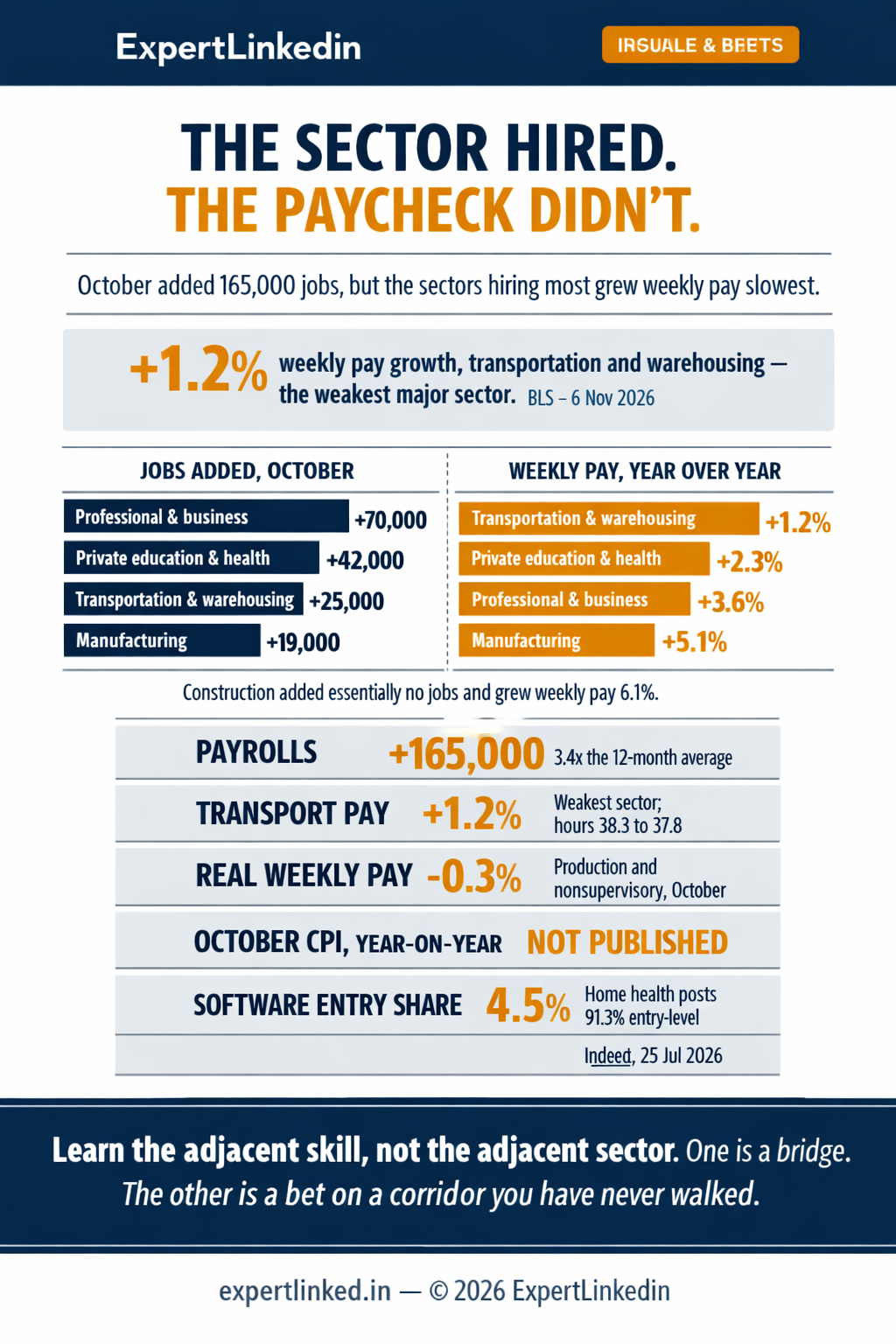
That is how much average weekly pay in transportation and warehousing grew over the past year — dead last among major sectors, in the same month the sector added 25,000 jobs. Its fastest-growing line was couriers and messengers, up 71,000 since February. Its hours fell from 38.3 a week to 37.8. Hourly pay rose 2.5%. The paycheck rose 1.2%, because the schedule ate the rest (Table B-2, Table B-3).
Growth tells you where the work is. It does not tell you where the money is. And it tells you nothing at all about the course.

One headline, three different questions #
A payroll report is a flow of filled jobs. A postings index is a stock of advertisements. A course is a bet one person places on their own future. Every month they get collapsed into one sentence: hiring is up, so learn something.
Proposition one: are jobs being created? Yes — 165,000 of them, with August revised up to +186,000 and September to +60,000 (BLS).
Proposition two: are there postings for the role I want? Sometimes. Indeed’s index sits at 103.8, up 2.8% on the year, with 68% of occupational sectors above year-ago levels, from 49% in early September (Indeed Hiring Lab, October 22, 2026). But new postings are stuck at 99.2.
Proposition three: will this course change my odds? The data cannot answer that. Only you can, and only by asking a narrower question than the one the course is selling.
Signal one: the jobs are real, and they are narrow #
Four sectors did the work. Professional and business services added 70,000 against a 15,000 monthly average — professional, scientific and technical services +33,000, administrative and support +28,000. Health care added 42,000. Transportation and warehousing 25,000. Manufacturing 19,000. Construction, retail, information, finance, leisure and government were flat.
Over twelve months, employers added 885,000 jobs. Health care and social assistance alone added 519,000 — roughly 60% of net growth (Indeed Hiring Lab, November 6, 2026). If your work is not in or next to that supersector, this month’s headline is weather, not climate.
The slack is just as informative: 27.6% of unemployed workers have been out six months or longer, and part-time work for economic reasons jumped 339,000 to 4.8 million (BLS). Strong hiring and long joblessness are one market seen from two ends.
I owe you an update. On November 4 I argued a vacancy is an intention, not a colleague: September’s JOLTS showed openings in professional and business services up 106,000 while hires fell 30,000. October was the first conversion test, and the sector converted — which still does not tell you what to study.
Signal two: the schedule ate the raise #
| Sector | October payrolls | Weekly pay, year over year |
|---|---|---|
| Professional and business services | +70,000 | +3.6% |
| Private education and health services | health care +42,000 | +2.3% |
| Transportation and warehousing | +25,000 | +1.2% |
| Manufacturing | +19,000 | +5.1% |
| Construction | little changed | +6.1% |
| Retail trade | little changed | +4.3% |
| All private | +165,000 | +3.7% |
Three of the four sectors that actually hired grew weekly pay slower than the private average. The sector that added essentially no jobs, construction, grew it 6.1%. Hiring volume and pay growth were close to uncorrelated this month.
Then the number that belongs on a poster: average hourly earnings rose 0.4% to $38.00, but the workweek for production and nonsupervisory workers fell 0.1 hour to 33.8. Their real hourly earnings rose 0.1%. Their real weekly earnings fell 0.3% (BLS Real Earnings, November 10, 2026).
A raise that does not survive the schedule is not a raise.
Two caveats. These figures are nominal, because no October deflator exists. Averages also move with composition: a sector hiring junior staff shows lower average pay without anyone’s wages falling. Treat it as a prompt, not a law.
Signal three: the denominator is missing #
October’s consumer price index rose 0.4% on the month, with core up 0.3% for a third straight month (BLS, November 10, 2026). What BLS did not publish is any twelve-month change, because it never collected October 2025 data during the 2025 appropriations lapse. The year-over-year column is a row of dashes.
So every “inflation is back” or “beaten” take this week rests on a number the agency declined to produce. Even Indeed’s jobs analysis reached back to September’s 3.7% — core 2.6%, energy 20.4%, and CPI-W, the index for wage earners, 3.9% (BLS, October 14, 2026). The index tracking hourly workers ran hotter than the headline everyone quotes.
Worse, the raise is absorbed before it arrives. Third-quarter employer costs rose 3.4%, but wages rose 3.1% while benefits rose 3.9%, driven by health insurance costs up 6.4%. Real wages fell 0.6% year over year, a second consecutive decline. Workers’ own premiums rose 8.5% for single cover and 7.6% for family cover, the largest since 2010 (Indeed Hiring Lab, October 30, 2026).
And money is getting dearer. The Fed held rates at 3.75%–4.00% on October 28 by a 10–2 vote, with both dissents arguing for a hike (FOMC statement). Higher financing costs land first on what pays for learning: training budgets, tuition reimbursement, and the small employers who hire career changers.
The question the postings can answer #
Postings can still tell you something specific — if you ask about the door, not the corridor.
Indeed’s occupational index puts engineering near 145 and health care near 131, against software development at 79. Read only that and the answer is “train for engineering.” But look at how they are staffed. In software development, 69.3% are senior-level and just 4.5% entry-level. In personal care and home health, 91.3% are entry-level. As of May, senior postings were up 14.7% on the year; entry-level postings were down 7.5% (Indeed Hiring Lab, July 23, 2026).
Demand at the top of a ladder is not demand at the bottom. A bootcamp into software is a ticket to the 4.5%.
The same logic rescues the AI question. AI now appears in 822 distinct US job titles — 8.3% of all titles, about one in twelve — and 63% of those titles are outside tech: physical therapists with AI documentation, HR managers asked to use AI in HR, real estate agents, truck test drivers (Indeed Hiring Lab, July 8, 2026). Indeed’s own conclusion: this “does not necessarily mean deep technical knowledge.”
The most attainable AI upgrade is not a data science conversion. It is AI inside the job title you already have.
The move that works: adjacent, not adjacent-sector #
Burning Glass Institute and NYU’s School of Professional Studies tracked 1.3 million career histories and found 24.2% of mid-career professionals are stalled — employed, but with years of flat wages, no promotion, and no route out. The average stalled software developer loses $43,000 over fifteen years, and the warning signs appear at the ten-year mark (Sidetracked, May 2026).
Then the finding that should reorganise how you think about a course. Moving into an adjacent, higher-mobility role cuts stall risk by as much as 86%. A programmer who pivots to data scientist cuts it 86%; to software developer, 44%; to QA analyst, 51%. The task overlap in those moves runs 87% to 93%. “The key is not starting over.”
The report names three shapes: deepen (programmer to data scientist), broaden (cost estimator into project management), and change domain (office manager into business operations). The best targets, it says, have “moderate experience requirements — where targeted reskilling is legible as preparation rather than as a substitute for tenure.”
That sentence is the whole argument. The skill has to read as preparation, not as a replacement for the years you already have.
Why the certificate is the weakest link #
Employers say one thing and do another. Harvard Business School and Burning Glass studied more than 11,000 firms from 2014 to 2023. Companies dropped degree requirements, and non-degree hiring moved 3.5 percentage points — under one point once you account for how few postings changed. Fewer than 1 in 700 new hires was affected. Where firms changed practice, the non-degree hires did better: 25% higher pay and retention ten points above degreed colleagues (HBS, 2024). “Simply dropping stated requirements seldom opens jobs,” Joseph Fuller concluded.
The same caution applies to credentials, and is field-specific. Burning Glass finds a non-degree credential reduces stall risk 29% on average, and 52% when it is high-quality and market-aligned. In education the reduction is 46%; health professions 37%. In engineering, holding one is associated with 67% higher stall risk; in public administration, 79% higher. Why? In the fields where credentials help, the postings they map to ask for about two years of experience. Where they don’t, four or five. For a mid-career professional, a credential mapped to a five-year role marks where you entered, not where you are going.
The randomised evidence agrees. MDRC followed four sector-training programmes for ten years. One produced earnings gains at year ten — St. Nicks Alliance, up 32%, with seven points more participants earning $45,000 or more. The other three had no effect on either measure, though all four helped at some point (MDRC, September 2025).
Which is why vendor surveys should be read with your hand on your wallet. Coursera finds 94% of employers “willing” to pay micro-credential graduates more. Willingness is cheap; 1 in 700 is what happened. Its one useful number: 82% of credit-bearing credential holders report salary gains of 10% or more, against 60% for non-credit ones (Coursera, 2026).
The part that makes this urgent #
Labour’s share of output fell to 53% in the third quarter, its lowest reading since the series began in 1947. Since late 2019, productivity is up 16% and real hourly compensation 7.3% (Indeed Hiring Lab, November 5, 2026).
So the default outcome of getting better at your job is that your employer gets better margins. A skill that raises your output without changing your role is a donation. Capturing it means pointing the skill at a different title, scope, or employer — precisely what the adjacency evidence describes.
Five questions before you spend the next 100 hours #
- Name the role, not the sector. “Health care” does not hire. A home health aide, a hospital coder, a clinic scheduler — those are roles, with different doors.
- Name the entry share. What fraction of that occupation’s postings are entry- or mid-level? Closer to software’s 4.5% than home health’s 91.3%, and you are buying a lottery ticket with a syllabus.
- Name the overlap. List the target role’s tasks you already do. Under roughly 80% similarity, assume the credential will be read as a substitute for tenure.
- Name who pays — your employer’s budget or yours — and plan as if capital gets dearer in December.
- Name the scoreboard and the date. Real weekly earnings, or total compensation. Then a date, decided now. Not “after the course.” A date.
The headline this week is 165,000. The number that should govern your next hundred hours is the share of postings you could actually be hired into, in a role where your experience reads as an asset, not a detour.
Learn the adjacent skill, not the adjacent sector. One is a bridge. The other is a bet on a corridor you have never walked.
Working out which adjacent role is realistic for you? Send me the two roles and the overlap you can already document — I’ll tell you which one I’d test first.
Email me at jackson.rodriguez@tlnw.uk
References
-
U.S. Bureau of Labor Statistics (November 6, 2026). “The Employment Situation — October 2026.” https://www.bls.gov/news.release/empsit.nr0.htm (Accessed November 11, 2026)
-
U.S. Bureau of Labor Statistics (November 6, 2026). “Table B-2. Average weekly hours and overtime of all employees on private nonfarm payrolls by industry sector, seasonally adjusted.” https://www.bls.gov/news.release/empsit.t18.htm (Accessed November 11, 2026)
-
U.S. Bureau of Labor Statistics (November 6, 2026). “Table B-3. Average hourly and weekly earnings of all employees on private nonfarm payrolls by industry sector, seasonally adjusted.” https://www.bls.gov/news.release/empsit.t19.htm (Accessed November 11, 2026)
-
U.S. Bureau of Labor Statistics (November 10, 2026). “Consumer Price Index — October 2026.” https://www.bls.gov/news.release/cpi.nr0.htm (Accessed November 11, 2026)
-
U.S. Bureau of Labor Statistics (November 10, 2026). “Real Earnings — October 2026.” https://www.bls.gov/news.release/realer.nr0.htm (Accessed November 11, 2026)
-
U.S. Bureau of Labor Statistics (October 14, 2026). “Consumer Price Index — September 2026.” https://www.bls.gov/news.release/archives/cpi_10142026.htm (Accessed November 11, 2026)
-
U.S. Bureau of Labor Statistics (accessed November 11, 2026). “Schedule of Selected Releases for November 2026.” https://www.bls.gov/schedule/2026/11_sched.htm
-
Indeed Hiring Lab (November 6, 2026). “October 2026 Jobs Report: Some Tarnish Beneath the Headline Shine.” https://hiringlab.indeed.com/2026/11/06/october-2026-jobs-report/ (Accessed November 11, 2026)
-
Indeed Hiring Lab (October 22, 2026). “US Labor Market Snapshot — October 2026.” https://hiringlab.indeed.com/2026/10/22/us-labor-market-snapshot-october-2026/ (Accessed November 11, 2026)
-
Indeed Hiring Lab (July 23, 2026). “The Labor Market Is Tilting Toward Seniority.” https://hiringlab.indeed.com/2026/07/23/the-labor-market-is-tilting-toward-seniority/ (Accessed November 11, 2026)
-
Indeed Hiring Lab (July 8, 2026). “AI Is No Longer Just a Tech Occupation Story: It’s Spreading Across Job Titles in the US and Europe.” https://hiringlab.indeed.com/2026/07/08/ai-is-no-longer-just-a-tech-occupation-story/ (Accessed November 11, 2026)
-
Indeed Hiring Lab (October 30, 2026). “Q3 2026 Employment Cost Index: Rising Healthcare Costs Keep Haunting Employers.” https://hiringlab.indeed.com/2026/10/30/q3-2026-employment-cost-index/ (Accessed November 11, 2026)
-
Indeed Hiring Lab (November 5, 2026). “Q3 2026 Productivity and Costs Release: Doing More with Less.” https://hiringlab.indeed.com/2026/11/05/q3-2026-productivity-and-costs/ (Accessed November 11, 2026)
-
Board of Governors of the Federal Reserve System (October 28, 2026). “Federal Reserve issues FOMC statement.” https://www.federalreserve.gov/newsevents/pressreleases/monetary20261028a.htm (Accessed November 11, 2026)
-
Salerno, C., Sigelman, M., Kamath, A., Saleh, Y., Yuan, A., Kreiss, K., Perkins, G., and Guilford, G. (May 2026). “Sidetracked: The Hidden Crisis in Mid-Career Mobility.” Burning Glass Institute and NYU School of Professional Studies. https://www.burningglassinstitute.org/research/sidetracked-the-hidden-crisis-in-mid-career-mobility (Accessed November 11, 2026)
-
Harvard Business School (2024). “Harvard Research: Fewer than 1 in 700 get hired without a college degree.” https://www.hbs.edu/bigs/joseph-fuller-college-degree-gap (Accessed November 11, 2026)
-
Yusim, A., Schaberg, K., Tessler, B., and Ubalijoro, A. (September 2025). “Effects of Sector-Focused Training After 10 Years: Findings from the WorkAdvance Evaluation.” MDRC. https://www.mdrc.org/sites/default/files/WorkAdvance_10-Year_Report_MDRC.pdf (Accessed November 11, 2026)
-
Coursera (2026). “Introducing Coursera’s Micro-Credentials Report 2026.” https://blog.coursera.org/coursera-micro-credentials-impact-report-2026/ (Accessed November 11, 2026)
-
ExpertLinked (November 4, 2026). “What the September 2026 JOLTS Report Says About 2027 Staffing Assumptions.” https://expertlinked.in/posts/2026-11-04-what-the-september-2026-jolts-report-says-about-2027-staffing-assumptions/
-
ExpertLinked (October 14, 2026). “What the September 2026 CPI Report Could Change About Q4 Pay Talks - and What It Probably Won’t.” https://expertlinked.in/posts/2026-10-14-what-the-september-2026-cpi-report-could-change-about-q4-pay-talks-and-what-it/
AI Content Notice
This article was created using artificial intelligence technology. Whenever possible, we include references and sources to support the information presented. Readers are encouraged to consult these sources for further information. While we strive for accuracy and provide valuable insights, readers should independently verify information and use their own judgment when making business decisions. The content may not reflect real-time market conditions or personal circumstances.
Related Articles
Infographic: What October 2026 Jobs Data Says About Where to Invest Your Learning Time
Payrolls rose 165,000 in October, but the sector adding the most jobs grew weekly pay slower than …
Career Mechanics: Build a Skills Evidence Stack Before the Market Forces You To
Use this step-by-step skills evidence stack to prove capability faster than a resume can signal it.
Skills-Based Hiring: The Career Transition Game-Changer You've Been Waiting For
The transition from degree-based to skills-based hiring is revolutionizing career transitions, …