What Q3 2026 Profits and October PCE Mean for 2027 Staffing Claims

Here is the sentence you are about to hear a lot. “Profits are up, so of course we’re hiring.”
It is wrong — not because profits are down, but because a profit is not a hiring decision. This week’s data is unusually good at showing the distance between the two.

First, the profitable economy is real #
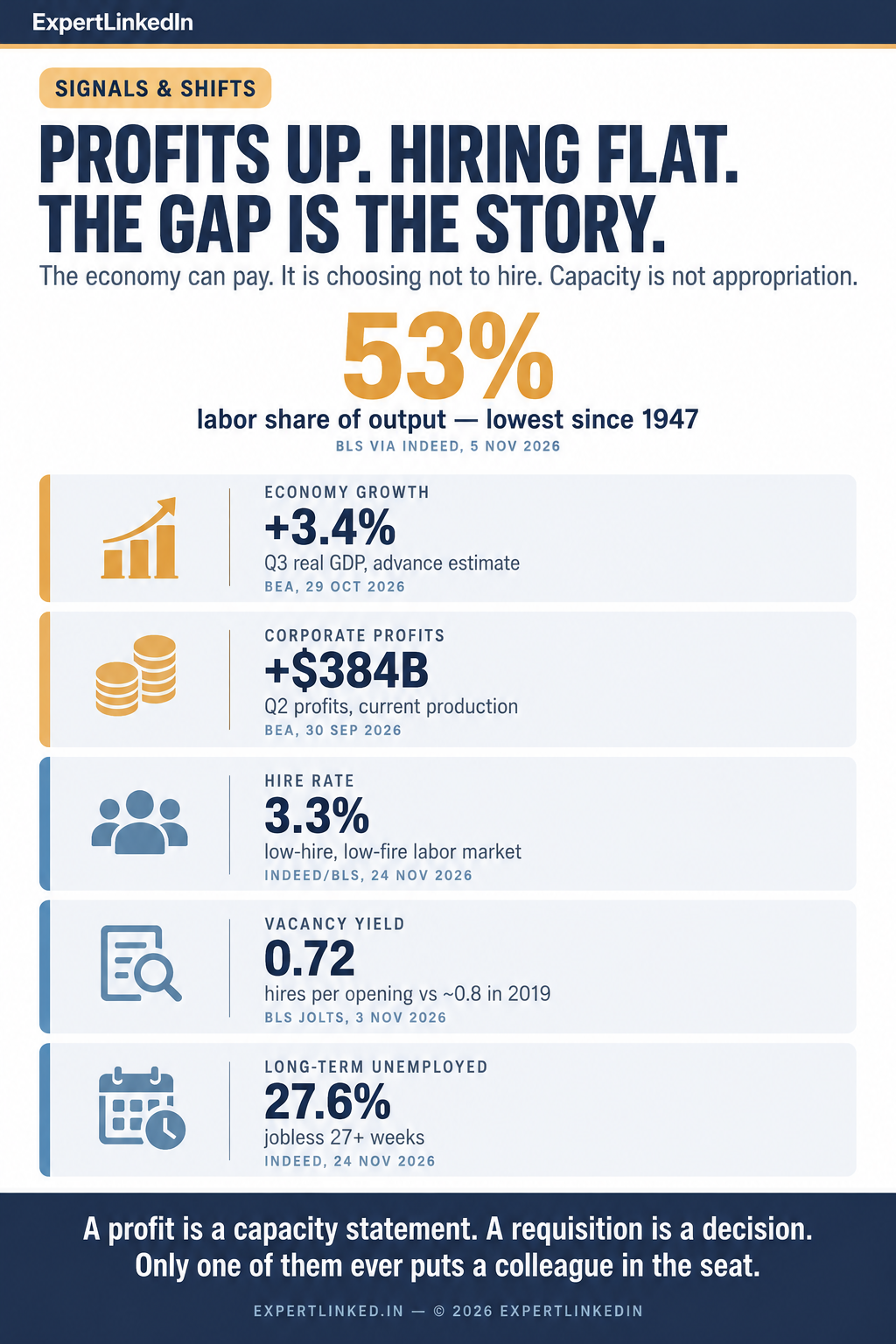
Start with what nobody disputes. The Q3 advance estimate, published October 29, put real GDP growth at 3.4% — up from Q2’s +2.2% and Q1’s +2.5%, both revised higher. Corporate profits from current production climbed $384 billion in the second quarter after $63 billion in the first (BEA, September 30). And productivity is genuinely strong: third-quarter nonfarm business productivity rose 3.6% at an annual rate while hours worked rose just 0.1%, so unit labor costs actually fell 0.7% (BLS, November 5). The capacity to pay is not in question. It never was.
Today the second part of the picture lands. At 8:30 a.m. Eastern — 9:30 p.m. in Singapore, the evening this column publishes — the government releases the second estimate of Q3 GDP and the first look at Q3 corporate profits, together with October’s personal income and spending. Two questions decide whether the profit headline survives contact with the household: did the Q3 growth estimate hold near 3.4%, and did October’s income print stop the slide in real disposable income? Hold those two questions. Everything below is how to read the answers.
The hire rate is the part nobody puts in the press release #
If profits drove hiring, 2026 should have been a boom. It wasn’t. September’s JOLTS report showed 7.523 million openings against 5.4 million hires — a vacancy yield of about 0.72 hires per opening, below the roughly 0.8 of a healthy 2019 market. The hire rate sits at 3.4%; the quits rate is 2.1%. Employers added roughly 696,000 jobs across the first three quarters of 2026, near the fifth-lowest pace of any expansion, and 27.6% of unemployed workers have now been out of work 27 weeks or more — the highest share outside the aftermath of a recession since 1950 (Indeed Hiring Lab, November 24).
So the profit went somewhere else. Follow the productivity number and the answer is obvious. Since the end of 2022, output has risen about 12% while hours worked rose less than 1% and employment rose just 1.7% (Indeed Hiring Lab, November 5). The reward for that has gone to capital, not labor: workers’ share of output fell to 53% in the third quarter, the lowest since the series began in 1947.
That is the uncomfortable truth hiding inside the “profitable economy” line. Firms are getting more output from the people they already have — and that is exactly why they do not need to add more. A rising profit line and a flat hiring line are not a contradiction. They are the same story told twice.
The household is where the gap becomes visible #
Now watch what strong profits are doing to the people who produce them. In September, personal income rose 0.2% — but real disposable income fell 0.3% month over month, and the personal saving rate slid to 3.8%, down from 4.5% in July (BEA, October 29). The PCE price index was up 3.6% year over year; core was 3.1%. Households are funding consumption by draining a thinner cushion. That supports today’s revenue and today’s profits — and squeezes the worker at the same time.
The survey data agree. Consumer confidence jumped 7.5 points in October, but forward spending intentions fell, and The Conference Board tied that to “higher price levels and persistent inflation, which eroded consumers’ purchasing power” (The Conference Board, October 27). Meanwhile, prices are up about 33% since 2019: a mid-level salary of $66,000 buys roughly what $50,000 did. October’s income-and-PCE release is the test of whether that squeeze eased or deepened.
The Fed already told you profits don’t equal hiring #
You do not have to take my word for it. The October FOMC minutes, released November 18, describe the economy in two sentences that sit uneasily together. First: “Economic activity is expanding at a strong pace… Productivity growth is strong, and capital investment is robust.” Then, in the same document: “labor market dynamism remained unusually low, as reflected in low rates of hiring and layoffs, a low job-finding rate, elevated long-term unemployment, and perceptions of weak job availability.”
Read what the Fed says “strong corporate earnings” support: household spending and business investment — not hiring. And read who the minutes say is struggling: “higher prices of necessities were straining the budgets of lower- and middle-income households.” The central bank, looking directly at strong profits and strong productivity, describes a labor market with unusually low dynamism. That is the whole argument in one document.
The specific evidence a staffing claim requires #
So the next time someone tells you profits mean hiring — or, in the other direction, that the company simply can’t afford to add anyone — the honest response is not to argue about the profit number. It is to ask for the employer-level evidence. Four things turn a staffing claim into a staffing decision:
- The work. Which specific tasks or role will change? Not “we’re investing in AI.” Which process, owned by whom?
- The funded requisition. A job posting is intent; a funded req is a commitment. Ask how many are approved, at what level, and against which budget.
- The fill date. Name the week the person must be in the seat — and name the fallback if they aren’t.
- The approver. Identify the manager who can actually sign the req. Most “we’re hiring” claims die here.
A vacancy is an intention; the hire is the fact. This week simply extends the same logic up one level: a profit is capacity; a requisition is a decision. The NVIDIA capex that dominated early November was a demand signal, not a headcount plan. The Q3 profit print is the same category of evidence: it tells you what a company could fund, never what a team will.
One more test is coming. The Beige Book, due November 25 at 2 p.m. Eastern, is the qualitative cross-check — the one place where actual employers, in their own words, might describe funded headcount additions rather than cautious intent. If districts report concrete hiring plans and rising entry-level demand, the “capacity without appropriation” read is wrong and I will say so. If they report the same low-hire caution the numbers show, the gap is the story of 2027.
Read a 2027 staffing claim the way you read a P&L — by appropriation, not by profit. For every “we’re hiring” or “we can’t afford it,” ask for the work, the req, the date, and the approver. A profit is a capacity statement. A requisition is a decision. Only one of them ever puts a colleague in the seat.
Disagree with this read — or have a staffing claim you’d like pressure-tested? Tell me which employer evidence you actually trust for 2027 planning.
Email me at jackson.rodriguez@tlnw.uk
References
-
U.S. Bureau of Economic Analysis (October 29, 2026). “Gross Domestic Product, 3rd Quarter 2026 (Advance Estimate).” https://www.bea.gov/data/gdp/gross-domestic-product (Accessed November 24, 2026)
-
U.S. Bureau of Economic Analysis (September 30, 2026). “GDP (Third Estimate), Industries, Corporate Profits, State GDP, and State Personal Income, 2nd Quarter 2026.” https://www.bea.gov/news/2026/gdp-third-estimate-industries-corporate-profits-state-gdp-and-state-personal-income-2nd (Accessed November 24, 2026)
-
U.S. Bureau of Economic Analysis (August 26, 2026). “GDP (Second Estimate) and Corporate Profits, 2nd Quarter 2026.” https://www.bea.gov/news/2026/gdp-second-estimate-and-corporate-profits-2nd-quarter-2026 (Accessed November 24, 2026)
-
U.S. Bureau of Economic Analysis (October 29, 2026). “Personal Income and Outlays, September 2026.” https://www.bea.gov/news/2026/personal-income-and-outlays-september-2026 (Accessed November 24, 2026)
-
U.S. Bureau of Economic Analysis (accessed November 24, 2026). “Personal Saving Rate.” https://www.bea.gov/data/income-saving/personal-saving-rate
-
U.S. Bureau of Economic Analysis (accessed November 24, 2026). “Release Schedule.” https://www.bea.gov/news/schedule
-
U.S. Bureau of Labor Statistics (November 5, 2026). “Productivity and Costs, Third Quarter 2026 (Preliminary).” https://www.bls.gov/news.release/prod2.nr0.htm (Accessed November 24, 2026)
-
U.S. Bureau of Labor Statistics (November 3, 2026). “Job Openings and Labor Turnover — September 2026.” https://www.bls.gov/news.release/jolts.nr0.htm (Accessed November 24, 2026)
-
U.S. Bureau of Labor Statistics (November 6, 2026). “The Employment Situation — October 2026.” https://www.bls.gov/news.release/empsit.nr0.htm (Accessed November 24, 2026)
-
U.S. Bureau of Labor Statistics (November 10, 2026). “Consumer Price Index — October 2026.” https://www.bls.gov/news.release/cpi.nr0.htm (Accessed November 24, 2026)
-
U.S. Bureau of Labor Statistics (November 10, 2026). “Real Earnings — October 2026.” https://www.bls.gov/news.release/realer.nr0.htm (Accessed November 24, 2026)
-
Board of Governors of the Federal Reserve System (November 18, 2026). “Minutes of the Federal Open Market Committee, October 27–28, 2026.” https://www.federalreserve.gov/monetarypolicy/fomcminutes20261028.htm (Accessed November 24, 2026)
-
Board of Governors of the Federal Reserve System (accessed November 24, 2026). “Calendar: November 2026.” https://www.federalreserve.gov/newsevents/2026-november.htm
-
Indeed Hiring Lab (November 24, 2026). “US Labor Market Snapshot — November 2026.” https://hiringlab.indeed.com/2026/11/24/us-labor-market-snapshot-november-2026/ (Accessed November 24, 2026)
-
Indeed Hiring Lab (November 5, 2026). “Q3 2026 Productivity and Costs Release: Doing More with Less.” https://hiringlab.indeed.com/2026/11/05/q3-2026-productivity-and-costs/ (Accessed November 24, 2026)
-
Indeed Hiring Lab & Glassdoor Economic Research (November 18, 2026). “Indeed & Glassdoor’s 2027 U.S. Hiring and Worklife Trends Report.” https://hiringlab.indeed.com/2026/11/18/indeed-glassdoor-2027-us-hiring-and-worklife-trends-report/ (Accessed November 24, 2026)
-
Indeed Hiring Lab & Glassdoor Economic Research (November 18, 2026). “Total Compensation Is Under Pressure.” https://hiringlab.indeed.com/2026/11/18/total-compensation-is-under-pressure/ (Accessed November 24, 2026)
-
The Conference Board (October 27, 2026). “US Consumer Confidence Increased in October.” https://www.conference-board.org/topics/consumer-confidence (Accessed November 24, 2026)
-
ExpertLinked (November 4, 2026). “What the September 2026 JOLTS Report Says About 2027 Staffing Assumptions.” https://expertlinked.in/posts/2026-11-04-what-the-september-2026-jolts-report-says-about-2027-staffing-assumptions/
-
ExpertLinked (November 18, 2026). “What NVIDIA Earnings and Microsoft Ignite 2026 Can Reveal About AI Work Design.” https://expertlinked.in/posts/2026-11-18-what-nvidia-earnings-and-microsoft-ignite-2026-can-reveal-about-ai-work-design/
AI Content Notice
This article was created using artificial intelligence technology. Whenever possible, we include references and sources to support the information presented. Readers are encouraged to consult these sources for further information. While we strive for accuracy and provide valuable insights, readers should independently verify information and use their own judgment when making business decisions. The content may not reflect real-time market conditions or personal circumstances.
Related Articles
Infographic: What Q3 2026 Profits and October PCE Mean for 2027 Staffing Claims
Q3 GDP came in at 3.4% and Q2 corporate profits jumped $384 billion — yet hiring never followed. A …
Infographic: What the September 2026 JOLTS Report Says About 2027 Staffing Assumptions
September JOLTS added 333,000 openings and only 131,000 hires. A vacancy is an intention, not a …
What the September 2026 JOLTS Report Says About 2027 Staffing Assumptions
September JOLTS added 333,000 openings and only 131,000 hires. A vacancy is an intention, not a …