Southeast Asia's Next Payments Moat Is the Designed Pause, Not the Faster Rail

For twenty years the job in payments was to remove seconds. Southeast Asia’s rulebooks have started putting them back.

My last few columns followed the moat downward: from the QR code to the payout network, then recoverability, then settlement finality, and most recently the human who can halt an agent. Each time, the scarce capability sat one layer beneath the headline.
This month it sits somewhere payments people never wanted to compete on: the clock.
Five markets, five clocks #
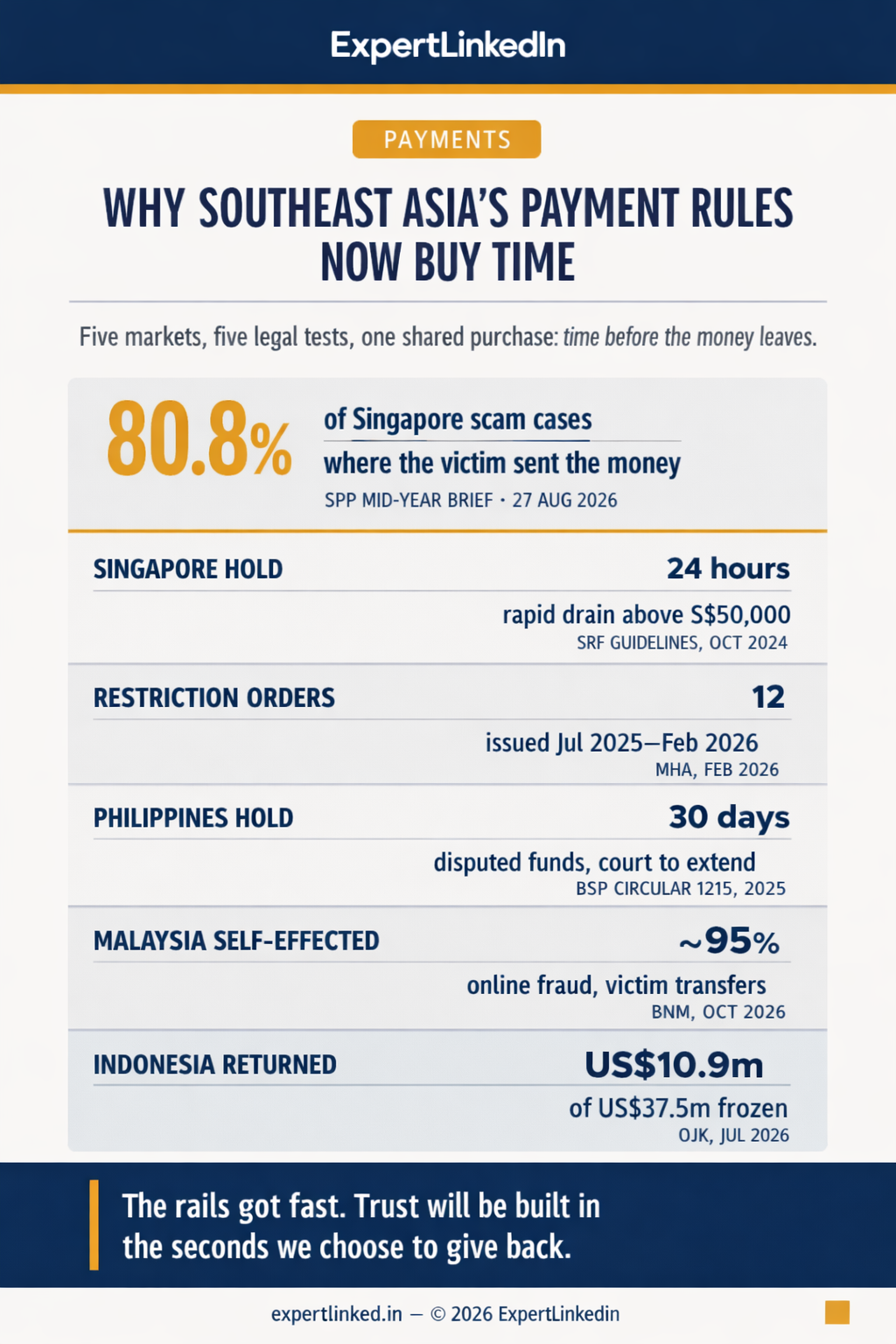
Singapore’s Shared Responsibility Framework, live since 16 December 2024, does not ask banks to be right. It asks them to be specific. A 12-hour cooling-off when a digital token is activated or a new device logs in. Real-time alerts on high-risk actions. A 24/7 kill switch. And, under the fraud-surveillance duty, a mandatory block or 24-hour hold when an account holding at least S$50,000 is drained by more than half within a day. Then the clock keeps running: a customer has 30 calendar days from the bank’s alert to report, three days to furnish the evidence, and the bank has 21 business days to decide a straightforward claim, 45 for a complex one.
Thailand runs the same instinct through a different legal machine. Under the Technology Crime Decree (No. 2), effective 13 April 2025, financial institutions, payment operators, telcos and social platforms may be held liable for scam damages unless they can prove they complied with prescribed standards. The burden reverses. A new centre, CPOT, can suspend transactions immediately on credible evidence.
The Philippines legislated the hold outright. Under AFASA and BSP Circular 1215, institutions may hold disputed funds for up to 30 calendar days — five initially, up to 25 more through a bank-initiated extension, and beyond that only by court order — and must build automated tracing of disputed transactions across banks. It is the only regime here that has staged the hold itself.
Malaysia is buying the pause before the payment. Bank Negara’s governor, Abdul Rasheed Ghaffour, said in October that banks and PayNet will pilot industry-wide fraud alerts in the first half of 2027, prompting customers to pause, think and verify. He conceded the cost in the same breath: “this capability may introduce additional friction.”
Indonesia bought speed of recovery instead. OJK’s anti-scam centre has blocked 557,751 accounts holding about US$37.5 million, and returned about US$10.9 million to victims.
Read those as a product catalogue, not a legal survey, and the pattern is obvious. Every regime is buying time at a specific point in the payment’s life: before it, during it, or after it. The doctrine differs — duty-breach, compliance-defence, criminal liability, network alerting, central recovery. The purchase is identical.
The pause had to move upstream #
The reason is in the loss data. In Singapore, victims made the transfer themselves in 80.8% of reported cases in the first half of 2026, when losses still reached S$410.6 million. The 2025 police brief put it at 81.8%. Bank Negara’s governor put Malaysia at about 95%.
That single fact retires a decade of security theatre. Device binding, one-time passwords, liveness checks and kill switches all defend the moment of authentication. But if the customer is the one pressing send, authentication was never the attack surface. Persuasion was.
As LexisNexis’s Vishal Verma put it in an October interview with Fintech News Singapore: “When the customer is genuine but may be acting under the influence of a scammer, identity alone is no longer sufficient.”
The uncomfortable part: the duty reaches further than the payout #
Here is the detail that stopped me, and it is buried in a footnote.
Singapore’s framework is usually described as covering phishing only. That is true of the payout. It is not true of the duty. Paragraph 4.2.5 of the SRF guidelines requires real-time surveillance “directed at detecting seemingly authorised transactions to a scammer” — the language is explicit — and mandates a block or hold when an account is rapidly drained. So a bank can be required to stop a self-effected transfer that the framework will never require it to compensate.
Our sister title worked through the coverage gap in October, and I will not re-litigate it here. My point is structural. Intervention obligations are now broader than compensation obligations. The duty to pause runs to the regulator. The duty to pay runs to the customer. Those are different businesses, and only one of them has a budget line.
That asymmetry is the design problem. When the obligation is supervisory, the measure of success is a defensible file. When the obligation is financial, the measure is a paid claim. Most banks are optimising for the first and being measured on the second.
Three instruments and no dial #
Southeast Asia now has three ways to stop money: block it, hold it, or restrict the account. All three are blunt, and all three are account-level or transaction-level. None of them is a dial. The Philippines has staged the clock. Nobody has staged the amount.
The S$50,000 threshold, the 50% trigger and the 24-hour hold are the same for a student and a family office. Nanyang Business School’s Kelvin Law warned that customers will simply structure transfers at 49%. White Byte’s Frances Yong said the 50% benchmark could be too low for lower-income customers. Both asked for segment-specific thresholds. Both were describing a dial that does not exist.
At the harder end, Singapore’s most paternalistic tool is barely used. As of 15 February 2026, only 12 Restriction Orders had been issued under the Protection from Scams Act — one lifted, two exhausted, nine live. And the government has decided not to build graduated restrictions such as transaction limits or preserved GIRO, because, in its own words, “the banks have assessed that significant system changes are required.”
Read that again. The constraint on proportionate intervention is not legal authority. It is core-banking granularity. We built the power to freeze an account and discovered we cannot express “some, not all.”
The state is about to automate the same blunt instrument. The Scams (Countermeasures) Act 2026, gazetted in September, lets blocking directions be issued by a computer program, including AI, with human review for low-confidence cases and a named agency head responsible. Even the government has concluded that authority needs a name attached.
The cost nobody books #
Every hold is a bet. On one side is the loss you prevent. On the other is the payment you refuse, and nobody counts the second side.
BPC’s analysis, reported in September, puts false declines at about US$160,000 a year in lost interchange for a mid-sized issuer — modelled conservatively. On legacy rules, a typical issuer may wrongly decline roughly 30 good transactions for every fraud it catches. Datos Insights puts the industry-wide false-decline bill at US$213 billion in 2025, heading for US$297 billion by 2029. The structural reason is simple: “Every fraudulent transaction is tracked, reported,” BPC’s Khurram Ahmed said. “False declines do not produce the same visibility.”
The Association of Banks in Singapore has already warned that the new holds can catch legitimate payments. The Monetary Authority’s managing director, Chia Der Jiun, has been equally direct: Singapore “will need to prioritise security over convenience.”
Both are right. That is the problem. When the benefit is measurable and the cost is not, the dial gets set by whoever last suffered a loss.
What a designed pause actually contains #
If the pause is a product, it needs a specification. Five things, at minimum.
Placement. Before authorisation, in flight, or after settlement. Each has a different owner and a different legal clock. Banks usually inherit the placement from the rail rather than choosing it.
Duration. A hold should last as long as it takes to change the customer’s mind, and no longer. Singapore’s 24 hours works because a scam call loses its grip overnight. A 30-day hold is a different instrument with a different purpose — evidence gathering, not persuasion.
Release authority. A named role, not a queue. The single most common failure I see in these workflows is a hold with no one empowered to end it.
Customer explanation. What the customer sees while the money sits. “Your transfer is delayed” is not an explanation; it is a hostage note. The pause only recruits the customer if it tells them what to check.
Record. The fields that survive adjudication: what was detected, what was shown, what the customer did, who released it, and when. If that record cannot be produced in 21 business days, the rest is decoration.
The 2027 job is the release owner #
For most of my career, the valuable fintech person was the one who could build the feature. Then, in agentic finance, it was the one who could hold the mandate. Now there is a third role, and it sits exactly where Monday’s decision-rights agreement meets the fraud floor: the person authorised to end a hold, explain why, and sign the reversal.
Call it the release owner. It is not the model owner. The model owner optimises detection; the release owner owns the consequence. That means policy design, evidence architecture, dispute adjudication and plain-language customer communication in one job description — a combination that currently lives in three departments and reports to none of them.
Hiring for “fraud analyst” and hoping the rest sorts itself out is how banks end up with a 24-hour hold and a release queue nobody owns.
The agent removes the window #
This gets harder as agents take over the checkout.
OpenAI’s ChatGPT Wallet, built with American Express, Mastercard and Visa, lets agents pay — but requires the user to approve every purchase, and, in the company’s own framing, records what they authorised. That is a pause with a receipt. It is also, explicitly, a first version: OpenAI expects to allow pre-approved spending limits.
When that happens, the human leaves the moment. An agent paying in milliseconds leaves no 24-hour window to run, no cooling-off to exploit, no alert to act on. The pause has to move into the mandate itself, which is exactly where I left the argument on 3 November. The record becomes the only witness.
Five dull questions #
If I were setting payments strategy for 2027, or hiring the release owner, I would start here.
- Where in the flow can a payment be paused, and who decided that?
- Who is authorised to release it, by name and by role?
- What does the customer see during the pause, and can they act on it?
- What record does the pause leave, and would it survive 21 business days of scrutiny?
- What did the last hundred holds cost in refused legitimate payments — and who booked it?
None of those questions photograph well. Neither did reconciliation, recoverability, or settlement finality, until they quietly became the reason money moves at all.
The rails got fast. Trust will be built in the seconds we choose to give back.
Designing a payment hold, a claims pipeline or a release workflow in Southeast Asia? I would like to hear where the pause breaks before the money moves.
Email me at chloe.tan@tlnw.uk
References #
- Fintech News Singapore (August 27, 2026). “Singapore Records Fewer Scams but Losses Still Reach S$410.6 Million.” https://fintechnews.sg/136397/security/singapore-scam-losses/ (Accessed November 19, 2026)
- Monetary Authority of Singapore and IMDA. “Guidelines on Shared Responsibility Framework,” revised October 25, 2024, paragraph 4.2.5 and footnote 8. https://www.mas.gov.sg/-/media/mas-media-library/regulation/guidelines/pso/guidelines-on-shared-responsibility-framework/guidelines-on-shared-responsibility-framework.pdf (Accessed November 19, 2026)
- Fintech News Singapore (December 16, 2024). “Singapore’s Shared Responsibility Framework for Phishing Scams Starts Today.” https://fintechnews.sg/105280/regtech/singapore-shared-responsibility-framework-starts/ (Accessed November 19, 2026)
- Rajah & Tann Asia (April 28, 2025). “New Regulation on Technology Crimes.” https://www.rajahtannasia.com/viewpoints/new-regulation-on-technology-crimes/ (Accessed November 19, 2026)
- Bangko Sentral ng Pilipinas (June 2, 2025). “Circular No. 1215: Regulations on the Temporary Holding of Funds Subject of Disputed Transactions and Coordinated Verification Process.” https://www.bsp.gov.ph/Regulations/Issuances/2025/1215.pdf (Accessed November 19, 2026)
- Fintech News Malaysia (October 6, 2026). “Malaysian Banks and PayNet Plan Fraud Alert Pilot in 2027.” https://fintechnews.my/61223/security/malaysia-banks-paynet-fraud-alert-2027/ (Accessed November 19, 2026)
- Jakarta Globe (July 6, 2026). “Indonesia Blocks 557,000 Scam Bank Accounts Managing $37.5 Million.” https://jakartaglobe.id/business/indonesia-blocks-557000-scam-bank-accounts-managing-375-million (Accessed November 19, 2026)
- Fintech News Singapore (October 15, 2026). “Authorised Scams and Money Mule Accounts: What Banks Are Watching For.” https://fintechnews.sg/138132/security/authorised-scams-money-mule-accounts-lexisnexis-cimb-fraud/ (Accessed November 19, 2026)
- CNA (October 7, 2025). “CNA Explains: Banks could hold or stop transfers to fight fraud — what does it mean for customers?” https://www.channelnewsasia.com/singapore/banks-hold-reject-transfers-scam-cna-explains-5385921 (Accessed November 19, 2026)
- Ministry of Home Affairs, Singapore (February 2026). “Restriction orders issued under Protection from Scams Act 2025.” https://www.mha.gov.sg/media-room/newsroom/restriction-orders-issued-under-protection-from-scams-act-2025/ (Accessed November 19, 2026)
- Allen & Gledhill (September 30, 2026). “Scams (Countermeasures) and Other Matters Act 2026 to strengthen measures to detect, disrupt, and deter scams.” https://www.allenandgledhill.com/sg/perspectives/articles/33556/sgkh-scams-countermeasures-and-other-matters-act-2026-to-strengthen-measures-to-detect-disrupt-and-deter-scams (Accessed November 19, 2026)
- The Fintech Times (September 9, 2026). “BPC: Banks Count Fraud Losses But Not What False Declines Cost.” https://thefintechtimes.com/bpc-banks-count-fraud-losses-but-not-what-false-declines-cost/ (Accessed November 19, 2026)
- Fintech News Singapore (November 16, 2026). “ChatGPT Wallet Lets AI Agents Pay Without Seeing Your Card Details.” https://fintechnews.sg/141238/ai/chatgpt-wallet/ (Accessed November 19, 2026)
- SEA Weekly (October 22, 2026). “ASEAN Finance Brief: How Singapore payment-scam safeguards assign responsibility for customer losses.” https://seaweekly.com/posts/2026-10-22-asean-finance-brief-how-singapore-payment-scam-safeguards-assign-responsibility-for-customer-losses/ (Accessed November 19, 2026)
AI Content Notice
This article was created using artificial intelligence technology. Whenever possible, we include references and sources to support the information presented. Readers are encouraged to consult these sources for further information. While we strive for accuracy and provide valuable insights, readers should independently verify information and use their own judgment when making business decisions. The content may not reflect real-time market conditions or personal circumstances.
Related Articles
Infographic: Southeast Asia's Next Payments Moat Is the Designed Pause, Not the Faster Rail
Southeast Asia’s rails won the speed race. The liability rules now arriving are buying the …
Southeast Asia's Next Fintech Moat Is the Human Who Can Halt the Agent
AI agents are learning to move money across Southeast Asia. The scarce 2027 fintech job is not …
Southeast Asia's Next Fintech Moat Is Settlement Finality, Not the Stablecoin
Stablecoins get the headlines, but Southeast Asia’s real fintech moat in 2026 is settlement …