Southeast Asia's Next Fintech Moat Is the Human Who Can Halt the Agent
The AI agent is learning to move money. Southeast Asia has not yet decided who is allowed to stop it.

In my last few columns I traced where the real battle in regional payments keeps moving: down from the QR code to the payout network, then to recoverability, and finally to settlement finality. Each time, the scarce capability sat one layer beneath the headline. This month the layer moved again — and this time it moved up, from infrastructure to authority.
The agent arrived. The authority did not. #
UOB’s October 2026 report, Agentic Finance: Building the foundations for trusted, bounded autonomy, is the most useful thing I have read on this because it refuses the hype. Its verdict: agents will arrive gradually and unevenly. Machine-to-machine payments lead, because they are structured, repetitive and low-risk. Enterprise treasury, procurement and reconciliation follow, “potentially by 2027.” Consumer agents “possibly 2029.” Autonomous credit around 2031.
Then the report names the thing nobody wants to own. It lists three unresolved barriers — liability, agent identity and interoperability — and states the crucial point plainly: institutions consistently distinguish between executing a financial decision and making it. When an autonomous agent initiates a payment that loses money, responsibility could sit with the user who delegated, the institution that approved the mandate, the software vendor that designed the agent, the wallet that executed it, or all of them at once.
That is not a compliance footnote. It is the whole 2027 story.
Southeast Asia is building the runtime, not the robot #
While global vendors race on protocols — Google’s Agent Payments Protocol with its signed “Mandates,” AWS’s agent payments running on Coinbase’s x402, Cloudflare’s own NET stablecoin, Mastercard’s Agent Pay — Singapore is doing something quieter and more consequential. It is writing the runtime rules for what an agent may do before it acts.
The Monetary Authority of Singapore’s SAFR framework — Safeguards for Agentic Finance at Runtime sits between an agent and the systems it acts on. Before an action executes, it checks the agent’s identity, its granted authority, institutional controls and risk thresholds, and writes an audit log. MAS developed it with banks and fintechs under BuildFin.ai, and the same platform is where Mastercard, Visa and Ant International are developing an interoperable Know-Your-Agent framework — a shared way to verify which agent is acting and who operates it.
Meanwhile MAS and the Association of Banks in Singapore have set up the Singapore Payments Network, which takes over governance of national payment schemes from early 2027. Read those three moves together and the pattern is clear: Southeast Asia is not trying to win the agent. It is trying to own the authority layer that decides which agents get to act at all. That is a genuine moat, and because it looks like plumbing, most commentators will miss it.
The uncomfortable truth: the human check decays #
Here is the finding that stopped me. At a GFTN/Zühlke roundtable during the Singapore Fintech Festival, one bank described putting agents on suspicious-activity reports with a human reviewing each one before it went to the regulator. Processing time fell from six hours to five minutes. Then the humans started approving without really reading, lulled by how good the agent had become. The team now deliberately inserts mistakes into submissions to keep reviewers alert.
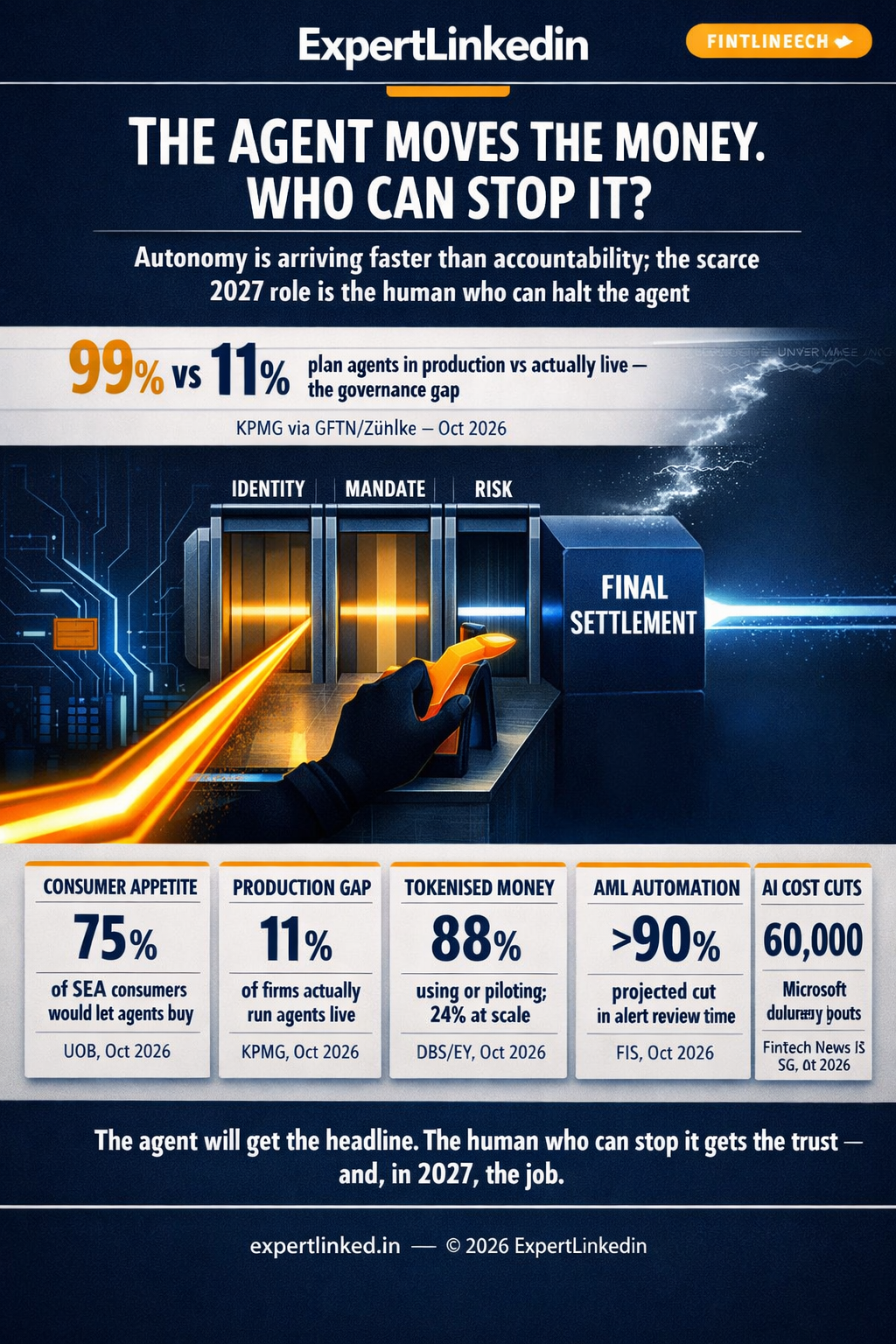
That single anecdote is worth more than most automation projections. KPMG reports that 99% of companies plan to put agents into production, but only 11% have done so — and the gap is governance. FIS now projects cutting Level 1 alert review time by more than 90% and Level 2 investigations by roughly 98% with its AML investigations agent. Those are vendor projections, not measured bank results. But take them as directional and the implication is unavoidable: if you remove 90% of the reviewing, you have not removed the need to review. You have moved the human from producing the review to owning the exception.
So here is the 2027 job #
For most of my career, the valuable fintech person was the one who could build the feature. In agentic finance, the valuable person is the one who can hold the mandate: who knows what the agent was authorised to do, can read the runtime log, can halt the payment when it is wrong, and whose name sits on the reversal.
This is the fintech version of November’s theme. The work you will own in 2027 is not the work the agent does; it is the decision right you hold over the agent. That reframes what to learn. Not prompt craft — mandate design. Not throughput — reversibility and audit. The evidence is already inside the region’s biggest banks: DBS runs more than 430 AI use cases and gave around 1,500 relationship and credit-risk managers an agentic tool in August; OCBC and UOB each count 300-plus. The money layer underneath is consolidating too: a DBS/EY survey of 422 large businesses found 88% using or piloting tokenised money, though only 24% had deployed it at scale — more automated value movement that needs a named owner. And the macro backdrop is why it matters: Microsoft offered voluntary buyouts to around 60,000 staff to fund US$175 billion of AI capital spending. When AI savings quietly become an assumption about capacity, the only defensible position is owning the work that cannot yet be automated without an accountable human.
So if I were setting a fintech career plan for 2027, I would stop asking which model wins and start asking five dull questions.
- Which agent may act, under whose mandate — and can I see that mandate before it executes?
- Who can halt it, and how fast?
- What is the audit trail, and can a regulator read it the same way I do?
- When the agent is wrong, whose name is on the reversal — a person or a policy?
- Does the runtime check stay sharp, or does the team have to insert deliberate mistakes to keep it honest?
Those questions do not photograph well. Neither did reconciliation, or recoverability, or settlement finality — until they quietly became the reason money moves at all.
The agent will get the headline. The human who can stop it gets the trust — and, in 2027, the job.
Building agentic payments, runtime controls or treasury tooling in Southeast Asia? I would like to hear where the mandate breaks before the money moves.
Email me at chloe.tan@tlnw.uk
References #
- Fintech News Singapore (October 28, 2026). “AI Agents Will Enter Finance Gradually: UOB Report.” https://fintechnews.sg/139830/ai/ai-agents-will-enter-finance-gradually-uob-report/ (Accessed November 3, 2026)
- Fintech News Singapore (July 3, 2026). “MAS, Banks Develop Safeguards for Agentic Finance at Runtime.” https://fintechnews.sg/133965/ai/mas-agentic-ai/ (Accessed November 3, 2026)
- Monetary Authority of Singapore. “SAFR — Safeguards for Agentic Finance at Runtime.” https://www.mas.gov.sg/-/media/mas-media-library/development/fintech/ai-safr/safr.pdf (Accessed November 3, 2026)
- Monetary Authority of Singapore. “BuildFin.ai.” https://www.mas.gov.sg/schemes-and-initiatives/buildfinai (Accessed November 3, 2026)
- Fintech News Singapore (October 19, 2026). “Banks Are Rethinking Human Oversight in the Age of Agentic AI.” https://fintechnews.sg/138130/ai/agentic-ai-governance-banks-gftn-zuhlke-report/ (Accessed November 3, 2026)
- Fintech News Singapore (September 10, 2026). “Mastercard, Visa, Ant International Explore Know-Your-Agent Framework.” https://fintechnews.sg/136993/ai/mastercard-visa-ant-ai-agent-payments/ (Accessed November 3, 2026)
- Fintech News Singapore (October 28, 2026). “Singapore Payments Network Names Derek Chan as Inaugural CEO.” https://fintechnews.sg/139910/payments/derek-chan-singapore-payments-network-ceo/ (Accessed November 3, 2026)
- Fintech News Singapore (October 19, 2026). “FIS AML Investigations Agent Now Available to All US Banks.” https://fintechnews.sg/139104/ai/fis-aml-investigations-agent-anthropic-us-banks/ (Accessed November 3, 2026)
- Fintech News Singapore (October 14, 2026). “How Singapore’s 3 Largest Banks Are Using AI in 2026.” https://fintechnews.sg/137393/ai/how-dbs-ocbc-and-uob-are-betting-on-ai-in-2026/ (Accessed November 3, 2026)
- Fintech News Singapore (October 28, 2026). “Microsoft Offers 60,000 Staff Voluntary Buyouts to Manage AI Costs.” https://fintechnews.sg/139868/fintech/microsoft-voluntary-buyouts-60000-staff-ai/ (Accessed November 3, 2026)
- Ledger Insights. “Google launches open protocol for AI agent payments.” https://www.ledgerinsights.com/google-launches-open-protocol-for-ai-agent-payments/ (Accessed November 3, 2026)
- Ledger Insights. “AWS unveils AI agent payments based on stablecoins.” https://www.ledgerinsights.com/aws-unveils-ai-agent-payments-based-on-stablecoins/ (Accessed November 3, 2026)
- Ledger Insights. “Cloudflare to launch NET stablecoin for AI agentic payments.” https://www.ledgerinsights.com/cloudflare-to-launch-net-stablecoin-for-ai-agentic-payments/ (Accessed November 3, 2026)
- PYMNTS (October 29, 2026). “Mastercard Pushes Back on Card Substitutes in AI Shopping.” https://www.pymnts.com/earnings/2026/mastercard-backs-tokenized-card-payments-agentic-commerce/ (Accessed November 3, 2026)
- Fintech News Singapore (October 28, 2026). “Nearly 9 in 10 Big Businesses Are Using or Testing Tokenised Money.” https://fintechnews.sg/139876/digitalassets/dbs-survey-tokenised-money-adoption/ (Accessed November 3, 2026)
AI Content Notice
This article was created using artificial intelligence technology. Whenever possible, we include references and sources to support the information presented. Readers are encouraged to consult these sources for further information. While we strive for accuracy and provide valuable insights, readers should independently verify information and use their own judgment when making business decisions. The content may not reflect real-time market conditions or personal circumstances.
Related Articles
Infographic: Southeast Asia's Next Fintech Moat Is the Human Who Can Halt the Agent
AI agents are learning to move money across Southeast Asia. The scarce 2027 fintech job is not …
Southeast Asia's Digital Banks Are Entering the Primary-Money Test
Digital wallets already won the screenshot in Southeast Asia. The harder fight for digital banks now …
Infographic: Southeast Asia's Digital Banks Are Entering the Primary-Money Test
Digital wallets already won the screenshot in Southeast Asia. The harder fight for digital banks now …