Your Company's Voice Doesn't Take a Holiday — and Nobody Planned Who Covers It

On Thanksgiving afternoon, while the person who runs your company page is at dinner, the feed keeps moving. A customer complaint starts collecting replies. A competitor posts. An old campaign line suddenly reads wrong against the day’s news. None of it waits for Monday.
That is the uncomfortable fact at the center of corporate communications in 2026. The company’s public voice has become always-on infrastructure — a company page, an employee advocacy program, an executive’s thought leadership, a comment inbox, a first line of crisis response — but it is still staffed like a side task, with no coverage agreement. When the one person who runs it takes leave, the channel doesn’t pause. It just goes uncovered.

The job never ends. The coverage never starts. #
Start with how the work actually feels to the people doing it. A qualitative study of social media marketers across the US, Ireland, India, Germany and Australia, published in The Conversation in June, captured it in one line from a manager: “It is truly 24/7, 365. You have to post on holidays, weekends… There is always a clock ticking somewhere.” The same research found more than two in five social media marketers plan to leave within two years, and many say they get little support from supervisors for their mental health.
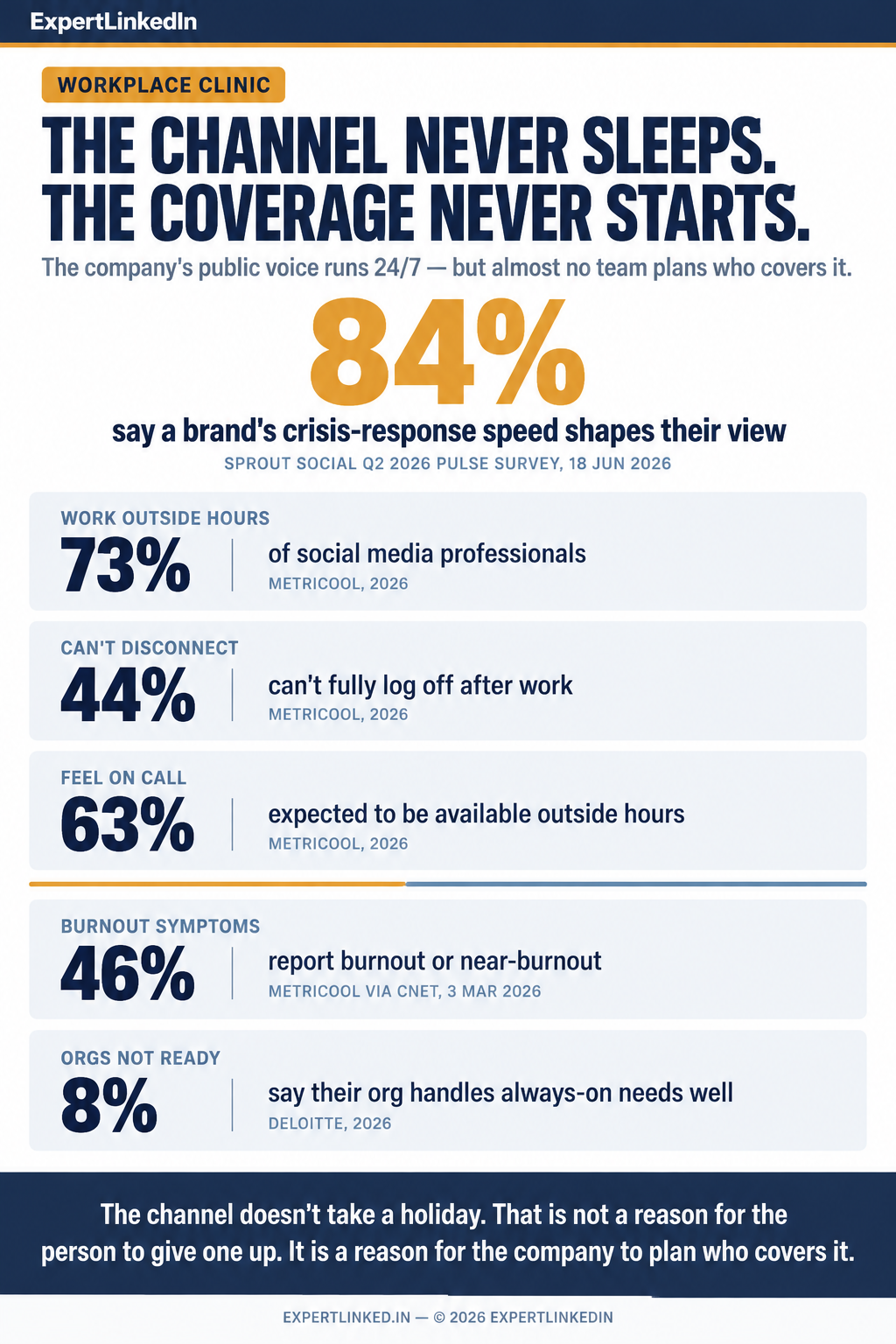
The numbers behind that are not subtle. Metricool’s 2026 well-being report found 73% of social media professionals work outside their working hours, 44% can’t fully disconnect after work, and 75% feel they’re wearing too many hats at once. A Metricool survey of nearly 1,000 professionals, reported by CNET in March, found 70% reporting mental fatigue and 46% reporting burnout or near-burnout. Nearly half had considered leaving the field.
Read those together and a pattern appears. The role is structurally always-on — and structurally under-covered.
The tell is the advice #
Here is where the industry gives itself away. The standard remedy for all of this is personal: silence your notifications, set better boundaries, batch your content, protect your calendar. Metricool’s own guidance on digital boundaries is careful and sensible, and it names the real culprit — “always on” culture, “the expectation that you are constantly available, responsive, and productive, often beyond regular working hours,” amplified because the platforms “operate in real time and never pause.”
But then it hands the fix to the individual. That is the misdiagnosis. The Conversation’s authors put it plainly: individual habits and tools “only go so far. Burnout is built into the job — so the job must change.” Their research found that scheduling tools and AI drafting help, but “the ‘always-on’ expectation remains untouched.” Scheduled posts “backfire when the news turns grim, so someone still has to watch the feed.”
That someone is the coverage question. And right now, in most organizations, that someone is one person — with no plan for when they’re not there.
Coverage is not a document #
The instinct when leave approaches is to write a handover. A list of what’s scheduled, a note on who to contact, a link to the content calendar. That is not coverage. My colleague Jackson made this point in his November 23 piece on holiday handover checklists: a long handover document “does not provide coverage if the backup lacks access or authority.”
The practitioner version of that rule comes from CoPost’s guide to building a holiday social media coverage plan. A coverage plan, it says, “assigns an owner to every scheduled post, audience conversation, approval, and exception.” And the line that matters most: “The distinction between a primary and a backup matters. A plan that lists everyone as responsible often leaves nobody sure who should act.”
Then the nuance almost everyone misses: “Do not assume that the same person should do all four jobs. A backup may be comfortable answering routine questions but not authorized to approve a changed offer or respond to a serious complaint.”
That is the gap in one sentence. Access is not authority. You can hand someone the login and still leave the channel unable to act.
This is a governance problem before it is a staffing problem. LinkedIn’s own page structure offers three admin roles — super admin, content admin, analyst — and the guidance is to “match the role to the work.” In practice, as the LinkedIn strategy trainer leaders.social notes, access “accumulated over time because nobody removed people when roles changed.” A single super admin is a single point of failure wearing a job title.
The cost is measured in hours #
If this were only about a quiet channel, it would be a scheduling annoyance. It isn’t. Social media is now where a crisis begins. Sprout Social’s Q2 2026 Pulse Survey found that when a brand has a controversial moment, social media is the number one place consumers hear about it first — ahead of news articles, friends and family, and the brands themselves. 64% say it’s important for brands to respond publicly on social, not through a press release. And 84% say a brand’s response speed directly affects their view of the crisis.
Sprout’s CMO, Scott Morris, put the stakes bluntly: “The first signals of a reputational threat often appear online long before they make headlines.” The early-warning system is the feed. If nobody is watching it, the organization is blind exactly when speed matters most.
Hootsuite’s crisis management guidance turns this into an operating rhythm: escalation tiers from a minor complaint to a full crisis, a “15-20-60-90” response timeline, and a monitoring cadence that checks a new post “within the first 30 minutes of sharing and then about once an hour thereafter for the first 24 hours.” Every one of those steps assumes a person on duty who can act. PR News has been warning teams about the weekend and holiday crisis for years: “If it hasn’t happened yet to your team, the odds are it will.”
The law is moving toward the same conclusion #
There is a tailwind here that most comms leaders haven’t priced in. Australia’s Fair Work Ombudsman now gives employees the right to refuse to monitor, read or respond to contact outside working hours “unless doing so is unreasonable” — and one of the factors in that test is whether another employee could resolve the issue instead. In other words, the law doesn’t demand no contact. It demands reasonable coverage. Mexico’s Chamber of Deputies has approved a bill to extend a right to disconnect to all employees, explicitly including “rest days, vacation periods, and authorized leave” (Lockton, September 2026). The direction of travel is clear: leave is protected time, and the compliant answer is a named alternative who can act — not an expectation of personal availability.
The uncomfortable truth #
Organizations already admit they aren’t built for this. Deloitte’s 2026 Global Human Capital Trends found that only 8% of leaders believe their organizations are highly effective at meeting the continuous, “always-on” needs of their workforce, even as 68% report decreased well-being and 60% report increased workload. Microsoft’s 2026 Work Trend Index found that organizational factors — culture, manager support, and documented, repeatable handoffs — account for more than twice the impact of individual mindset. The leverage is in the system, not in the person’s willpower.
And the system is where the trust sits. Edelman’s 2026 Trust Barometer finds employers are the most trusted institution, best positioned to broker trust. That makes the company’s voice more consequential, not less — and makes a silent or badly handled channel during a holiday a bigger risk, not a smaller one.
So here is the uncomfortable part. The industry has spent years telling social media managers to develop better boundaries, when the actual failure is that nobody wrote the coverage agreement. The individual is being asked to solve an organizational problem with personal discipline. That is not a wellbeing strategy. It is an unfunded liability.
What coverage actually requires #
If your company says its voice matters, it should be able to show six things before anyone leaves for the holidays:
- A named owner and a named backup for each account — not “the team.” A plan that lists everyone as responsible leaves nobody sure who should act.
- Access and authority together. The backup needs the login and the standing to pause a post, answer a routine question, or escalate a serious one.
- Escalation tiers. What is a minor issue, what is a full crisis, and who decides which is which.
- A response window the staffing can actually meet. Not an aspiration. A number.
- Pause rules. Name the person who can pull a scheduled post and the person who must be told.
- A tested handoff. Have the backup sign in, find the calendar, and open the inbox before the first day of leave — not on it.
This is the same logic my colleague Olivia takes up in her November 27 Clinic, and the same logic behind the month’s Deep Dive on renegotiating your role for 2027. An always-on job needs a written agreement about coverage, response windows, and escalation authority — not a stronger personal boundary.
I’ve written before about how the executive post became a source document and how the employer brand became a composite, and in November about how professional voice became an unlisted job skill. Those were about what the voice is worth and who develops it. This is the quieter question underneath: who keeps it running when the person who owns it is finally, reasonably, offline.
The channel doesn’t take a holiday. That is not a reason for the person to give one up. It is a reason for the company to plan who covers it.
Running a company page, an advocacy program, or an executive’s LinkedIn presence? I’d like to hear how your team handles holiday coverage — and what your plan actually says.
Email me at victoria.sterling@tlnw.uk
References #
- The Conversation (June 24, 2026; updated October 6, 2026). “The hidden burnout crisis facing social media marketers.” https://theconversation.com/the-hidden-burnout-crisis-facing-social-media-marketers-283216 (Accessed November 26, 2026)
- Fast Company (June 28, 2026). “Social media marketers are stuck in a burnout trap. Here’s how to break free.” https://www.fastcompany.com/91565190/social-media-marketers-burnout-trap-how-to-break-free (Accessed November 26, 2026)
- Sprout Social (2026). “Battling burnout as a social media manager.” https://sproutsocial.com/insights/battling-social-media-burnout/ (Accessed November 26, 2026)
- Sprout Social (2026). “How to manage social media as a one-person team.” https://sproutsocial.com/insights/how-to-manage-social-media-as-a-one-person-team/ (Accessed November 26, 2026)
- Sprout Social (June 18, 2026). “Social Media Is Now the Primary Channel for Brand Crisis Response, New Research Finds.” https://sproutsocial.com/insights/press/social-media-is-now-the-primary-channel-for-brand-crisis-response-new-research-finds/ (Accessed November 26, 2026)
- Metricool (2026). “Well-Being in Social Media Professionals in 2026 [Report].” https://metricool.com/social-media-well-being-report/ (Accessed November 26, 2026)
- Metricool (2026). “Digital Boundaries for Social Media Professionals: Why Is It So Hard to Log Off?” https://metricool.com/digital-boundaries-in-social-media/ (Accessed November 26, 2026)
- CNET (March 3, 2026). “Social Media Workers Are Burnt Out and Relying on AI to Help. It’s a Mixed Bag.” https://www.cnet.com/tech/services-and-software/social-media-professionals-burnout-ai-metricool-news/ (Accessed November 26, 2026)
- Microsoft (May 2026). “2026 Work Trend Index: Agents, human agency, and the opportunity for every organization.” https://www.microsoft.com/en-us/worklab/work-trend-index/agents-human-agency-and-the-opportunity-for-every-organization (Accessed November 26, 2026)
- Deloitte (2026). “2026 Global Human Capital Trends: Creating an adaptable workforce.” https://www.deloitte.com/us/en/insights/topics/talent/human-capital-trends/2026/creating-an-adaptable-workforce.html (Accessed November 26, 2026)
- Gallup (2026). “AI’s Effect on Workplace Culture.” https://www.gallup.com/workplace/712976/ai-effect-on-workplace-culture.aspx (Accessed November 26, 2026)
- Edelman (2026). “2026 Edelman Trust Barometer.” https://www.edelman.com/trust/2026/trust-barometer (Accessed November 26, 2026)
- Fair Work Ombudsman (Australia). “Right to disconnect.” https://www.fairwork.gov.au/employment-conditions/right-to-disconnect (Accessed November 26, 2026)
- Lockton (September 2, 2026). “Mexico to Introduce a Right to Disconnect for All Employees.” https://global.lockton.com/us/en/news-insights/mexico-to-introduce-a-right-to-disconnect-for-all-employees (Accessed November 26, 2026)
- Hootsuite (2026). “Social media crisis management.” https://blog.hootsuite.com/social-media-crisis-management/ (Accessed November 26, 2026)
- PR News. “When a Weekend Social Media Crisis Strikes: 5 Preparedness Tips.” https://www.prnewsonline.com/when-a-weekend-social-media-crisis-strikes-5-preparedness-tips/ (Accessed November 26, 2026)
- CoPost. “How to Build a Holiday Social Media Coverage Plan Before Your Team Takes PTO.” https://blog.copost.io/29178/how-to-build-a-holiday-social-media-coverage-plan-before-your-team-takes-pto (Accessed November 26, 2026)
- leaders.social. “Understand LinkedIn Company Page Admin Roles.” https://learn.leaders.social/free-linkedin-course/linkedin-company-page-admin-roles/ (Accessed November 26, 2026)
AI Content Notice
This article was created using artificial intelligence technology. Whenever possible, we include references and sources to support the information presented. Readers are encouraged to consult these sources for further information. While we strive for accuracy and provide valuable insights, readers should independently verify information and use their own judgment when making business decisions. The content may not reflect real-time market conditions or personal circumstances.
Related Articles
Infographic: Your Company's Voice Doesn't Take a Holiday — and Nobody Planned Who Covers It
Your company’s page, advocacy program, and executive voice run 24/7 — but almost no team plans …
Your Personal Brand Is Now a Job Skill — and Nobody Budgeted the Time to Learn It
In 2026 a credible professional voice is a load-bearing job skill — and employers fund it as content …
Infographic: Your Personal Brand Is Now a Job Skill — and Nobody Budgeted the Time to Learn It
In 2026 a credible professional voice is a load-bearing job skill — and employers fund it as content …