Your Personal Brand Is Now a Job Skill — and Nobody Budgeted the Time to Learn It

There is a skill your employer now expects you to have, rewards you for having, and has almost certainly never scheduled a single hour for you to learn. It is not coding. It is the ability to be credible in public: to hold a point of view, say it plainly, and be trusted by people you have never met.
Call it professional voice. In 2026 it has quietly become load-bearing. It shapes who wins the meeting, who gets the recruiter’s reply, and whose name a buying committee repeats when you are not in the room. And it is the one skill companies fund as output — posts, shares, a licence for a drafting tool — while refusing to fund as practice. That contradiction is the most useful thing to understand about personal brand at work right now.

The skill nobody wrote onto the training plan #
Start by naming the thing accurately, because the euphemisms hide the work. “Personal brand” and “thought leadership” sound like personality. What they actually describe is a bundle of communication and judgment skills: holding an informed view, translating it for a specific audience, reading a room without being in it, and knowing what not to say. They are learnable. They are also the capabilities the labour market is now moving toward.
LinkedIn’s own Skills on the Rise 2026 finds employers “increasingly prioritizing skills over degrees, job titles or linear career paths,” and the fastest-growing people skills are communication-centric: Executive & Stakeholder Communication, Cross-Functional Collaboration, Public Speaking, Mentorship. Meanwhile the demand side is brutal and measurable. In the 2026 Edelman-LinkedIn B2B Thought Leadership Impact Report, 82% of B2B decision-makers said thought leadership is becoming more valuable as AI becomes a common source of business answers, and 84% used AI to summarise a company’s thinking during vendor evaluation. Fifty-nine percent of final decision-makers said poor or absent thought leadership contributed to a vendor being dropped from consideration.
Read that again: the ability to publish a credible view is now part of how money moves between companies. It is a job skill whether or not it appears in a job description.
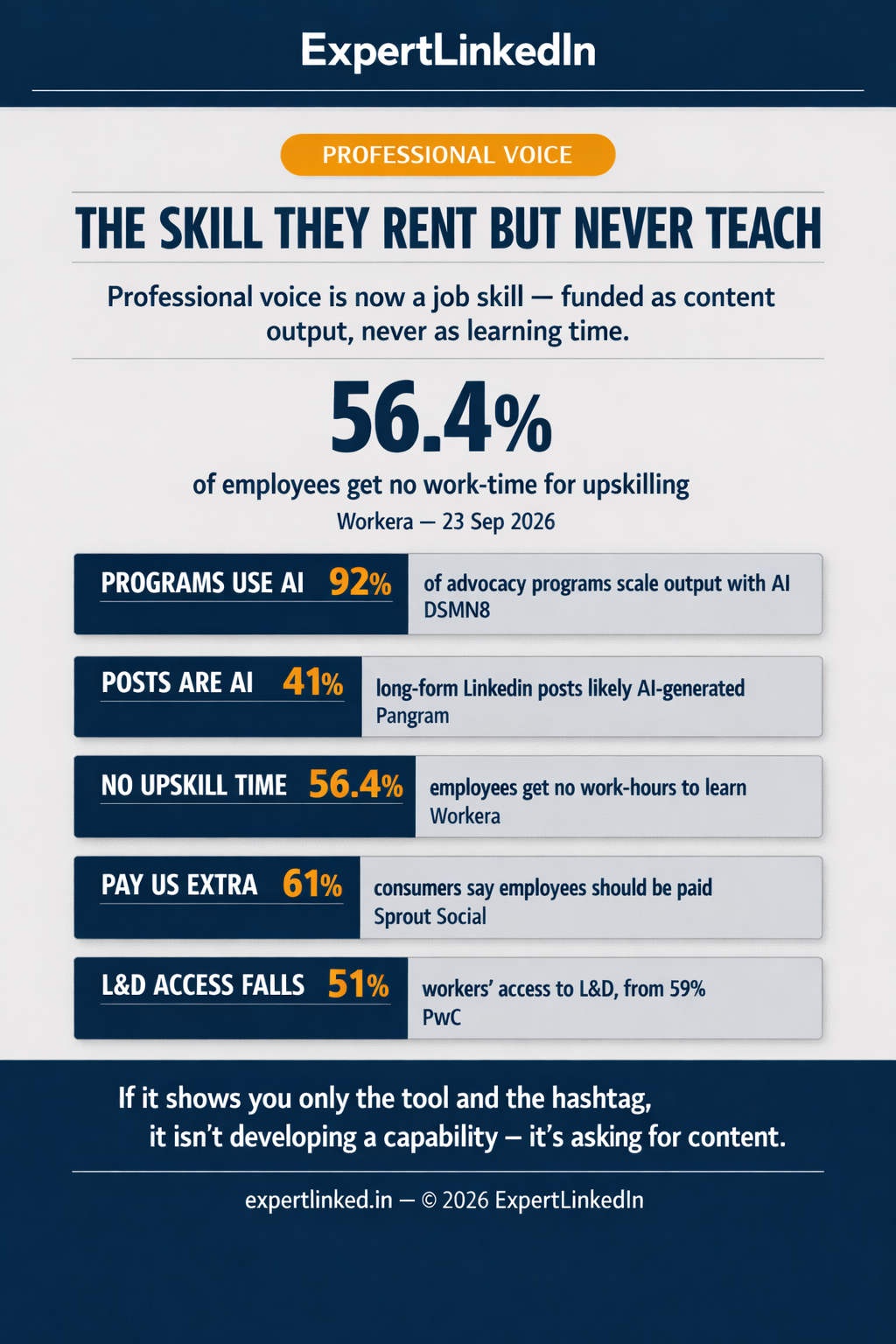
So you would expect it to be in the development plan. It isn’t. PwC’s Global Workforce Hopes and Fears Survey 2026 found that workers rated their access to learning and development lower than the year before — 51%, down from 59% — even as 88% said they had applied new skills on the job in the past year. Workera’s 2026 State of Skills Intelligence Report is blunter: 56.4% of employees say no time is allocated during work hours for upskilling, and 84.3% spend five hours a week or less on training. Google found that just 14% of workers were offered AI training by their employer in the past 12 months.
The training gap is not specific to professional voice. But professional voice is where it is most invisible, because the industry built a machine that produces the artifact without ever teaching the skill.
Employers already pay for the output. Just not the practice. #
Look at what a “funded” employee-content program actually funds. Warp, an employee-management startup, made headlines in September when Fortune reported it was paying employees to post on LinkedIn. Each post earns a raffle entry; three winners a month get “a couple hundred dollars.” About a third of staff now post at least twice a week. The company runs weekly brainstorming with marketing and offers a Claude agent that drafts posts in the employee’s voice. They hired 30 people in a quarter, and the chief people officer says nearly everyone who took a call mentioned seeing them on LinkedIn.
It is the best-documented program of its kind, and notice what it pays for: participation. The reward is a lottery ticket. The skill development is incidental.
Scale that pattern up. DSMN8’s Employee Advocacy Benchmark Report 2026, covering roughly 200 programs, found that 92% of programs now use AI to scale content production. The report’s own conclusion is the tension in one line: “While AI has made content easier to produce, it’s also made it harder to stand out. The result is more output, less impact.”
The market has priced the output precisely. Business Insider reported a corporate ghostwriting firm, Hat Tip, quoting a client $8,400 a month to write LinkedIn posts for three employees, three times a week — “the employee portion is the next evolution of what founder-led content was.” And LinkedIn itself is building the rails to monetise the voice: a Creator Marketplace, paid “experiences,” creator subscriptions, and Thought Leader ads that let brands amplify members’ posts, according to internal documents reviewed by Business Insider.
Everyone is willing to pay for the voice. Almost nobody is willing to pay for the practice.
The tell is the slop #
If employers were developing the skill, the output would look like competence. Instead it looks like volume. Pangram, an AI-detection firm, estimated that 41% of long-form LinkedIn posts analysed between April and June were likely AI-generated; a separate 2025 Originality AI study put more than half of long-form posts in that category, and found post length had grown 107% since ChatGPT’s release.
The extreme version is an offshore content mill. Rest of World spent months documenting Filipino virtual assistants writing executives’ “thought leadership” for $4 to $7 an hour, generating 30–40 comments a day from a prompt, and coordinating fake engagement in WhatsApp groups. One former assistant’s verdict: “It’s all AI comments by fake people answered with fake replies by other fake people.”
Recruiters already discount it. “Overposting would be a red flag,” the recruiting-firm founder Matt Stabile told Business Insider. “If you are busy, in demand and talented, why would you spend your time posting on LinkedIn?” That is the cruelest part of the status quo: the same activity the market rewards is the activity that looks like poor judgment when it is done without training or judgment.
And the two problems are not separate. Workera’s chief executive draws the line directly: “the amount of AI slop is probably correlated with people knowing or not knowing how to use AI.” Untrained, unscheduled voice production and the flood of generic content are the same failure, seen from two ends.
The allocation test #
This is the part the industry keeps skipping, and the part this week’s calendar is really about. My colleague Jackson laid out the five-field structure of a real 2027 development plan on Monday — a named skill, a practice task, allocated calendar time, a feedback source, and a chance to apply it. The insight is that a paid course can coexist with zero time to use it. The calendar is the plan.
Apply that test to professional voice, and it exposes the gap immediately:
- Named skill. Not “personal brand” — say the actual capability, such as executive communication or building a public point of view on a specific problem.
- Practice task. A real post, comment, or talk that matters to someone, not a template to fill.
- Allocated time. Hours on the calendar, protected, with the competing delivery work explicitly deferred.
- Feedback source. A named person who reviews the work and says what landed — the same live coaching Sprout Social describes building for its internal creator network, which grew from a six-person pilot to about 100 employees.
- Applied opportunity. A conference slot, a client conversation, a recruiting campaign, an internal explainer where the skill is actually used.
Then add the three questions most advocacy programs never ask, because they are the difference between developing a capability and extracting free content:
- Is this paid or volunteered? Consumers are already ahead of employers here: 61% told Sprout Social that companies should compensate employees extra for their social promotion. DSMN8’s own training guide warns that “the last thing employees want is to feel like a free marketing channel.”
- Is it safe and permissioned? Hootsuite’s 2026 program guide is candid: “Skip training and you’ll get a handful of nervous reposts and little else.” The barrier is not motivation; it is uncertainty about what is allowed.
- Can you decline without penalty? If posting is quietly scored, it is not development — it is an unlisted obligation.
The manager is the gatekeeper #
Skills do not get built where managers cannot protect time or model the behaviour. Gallup’s State of the Global Workplace 2026 found that employees whose manager actively supports AI use are 8.7 times as likely to agree that AI has transformed how work gets done — and 7.4 times as likely to say it gives them more opportunity to do what they do best. Yet fewer than a third of U.S. employees strongly agree their manager supports it. Deloitte’s 2026 Human Capital Trends adds the mechanism: workers are twice as likely to feel negatively about an employer-imposed change as a self-imposed one, and 87% say safe digital spaces to practise would help them adapt.
For a manager, that translates into one uncomfortable sentence: “I can support building your professional voice, but only if we name the hours and agree what delivery work comes off my team’s plate this quarter.” If the answer is “there’s no room,” you have not found a training problem. You have found a resourcing decision, made honestly.
The honest limit #
A self-directed professional voice is not equally safe or negotiable for everyone, and pretending otherwise would be its own kind of slop. PwC’s data shows the “engine room” majority — 56% of the workforce — has the least access to learning and innovation, while a 14% “front-runner” cohort gets nearly all of it. Pew’s research, reported by Fortune, found that in AI-exposed occupations men’s employment grew 6.3% per point of exposure while women’s barely moved. “Opting out is no longer an option,” Fast Company’s personal-brand report concludes — but that is easier to declare from a position of security.
So keep the option to decline the unpaid version. Building a public voice can be genuine career insurance, or it can be an employer quietly moving marketing cost onto your evenings. The skill is real either way; the question is who pays for it, who teaches it, and whether you chose it.
If your organisation says your voice matters, it should be able to show you four things: the time, the coaching, the feedback, and the choice. If it can show you only the tool and the hashtag, it is not developing a capability. It is asking for content.
Wondering whether your employer is developing your professional voice or just using it? Tell me what your programme actually funds — and what it quietly skips.
Email me at victoria.sterling@tlnw.uk
References #
- PwC (2026). “Global Workforce Hopes and Fears Survey 2026.” https://www.pwc.com/gx/en/issues/workforce/hopes-and-fears.html (Accessed November 10, 2026)
- ZDNET / Workera (September 23, 2026). “Nearly 70% of workers use AI regularly now – but many get no time to upskill.” https://www.zdnet.com/innovation/workera-study-ai-skills-upskilling-2026/ (Accessed November 10, 2026)
- Deloitte (March 3, 2026). “Staying relevant in a world that won’t sit still — 2026 Global Human Capital Trends.” https://www.deloitte.com/us/en/insights/topics/talent/human-capital-trends/2026/creating-an-adaptable-workforce.html (Accessed November 10, 2026)
- Gallup, via Poppulo (July 8, 2026). “7 Key Findings From Gallup’s State of the Global Workplace 2026 Report.” https://www.poppulo.com/employee-experience-platform/blog/gallup-state-global-workplace-2026 (Accessed November 10, 2026)
- Fortune / Google-Ipsos (February 19, 2026). “Just 5% of workers have this skill, according to Google, and they’re 4.5 times as likely to have a higher salary.” https://fortune.com/2026/02/19/exclusive-google-ipsos-report-five-percent-of-workers-ai-fluent-raises-promotions-workforce-advantage-gen-z-advice/ (Accessed November 10, 2026)
- LinkedIn News (February 24, 2026). “Skills on the Rise: The Fastest-Growing Skills in 2026.” https://news.linkedin.com/2026/Skills-on-the-rise-2026 (Accessed November 10, 2026)
- Edelman-LinkedIn (2026). “2026 Edelman-LinkedIn B2B Thought Leadership Impact Report — Thought Leadership Isn’t Just What You Say. It’s What People Do With It.” https://www.edelman.com/insights/thought-leadership-isnt-just-what-you-say-its-what-people-do-it (Accessed November 10, 2026)
- LinkedIn News (2026). “How B2B Brands Can Drive Impact with Creators and Stronger Creative on LinkedIn.” https://news.linkedin.com/2026/how-b2b-brands-can-drive-impact-with-creators-and-stronger-creat (Accessed November 10, 2026)
- Fortune (September 21, 2026). “This startup is paying employees to post on LinkedIn—and solving its hiring problem.” https://fortune.com/2026/09/21/this-startup-is-paying-employees-to-post-on-linkedin-and-its-solving-its-hiring-problem/ (Accessed November 10, 2026)
- Net Influencer / DSMN8 (March 19, 2026). “Employee-Generated Content in 2026: From Amplification to Infrastructure.” https://www.netinfluencer.com/employee-generated-content-in-2026-from-amplification-to-infrastructure/ (Accessed November 10, 2026)
- Business Insider (August 27, 2026). “LinkedIn posts can be cringe. Workers feel like they have to write them anyway.” https://www.businessinsider.com/linkedin-posts-personal-brand-career-arms-race-job-market-careers-2026-8 (Accessed November 10, 2026)
- Business Insider (June 10, 2026). “Internal LinkedIn docs reveal the new features it’s cooking up.” https://www.businessinsider.com/linkedin-creator-plans-new-features-roadmap-2026-6 (Accessed November 10, 2026)
- Rest of World (May 18, 2026). “The Filipino virtual assistants behind LinkedIn’s ’thought leadership’ content mill.” https://restofworld.org/2026/virtual-assistant-linkedin-engagement/ (Accessed November 10, 2026)
- Cybernews (May 20, 2026). “Filipino workers using AI are behind CEO thought leadership posts on LinkedIn.” https://cybernews.com/ai-news/linkedin-thought-leadership-ai/ (Accessed November 10, 2026)
- Sprout Social (2026). “The 2026 Influencer Marketing Report.” https://sproutsocial.com/insights/data/2026-influencer-marketing-report/ (Accessed November 10, 2026)
- Hootsuite (2026). “11 employee advocacy program examples for 2026.” https://blog.hootsuite.com/employee-advocacy-program-examples/ (Accessed November 10, 2026)
- DSMN8 (updated September 7, 2026). “The Perfect Employee Advocacy Training Plan.” https://dsmn8.com/blog/employee-advocacy-training-plan/ (Accessed November 10, 2026)
- Fortune / Pew Research Center (November 2, 2026). “A Microsoft exec says AI is killing the career ladder. But its replacement comes with a catch.” https://fortune.com/2026/11/02/a-microsoft-exec-says-ai-is-killing-the-career-ladder-but-its-replacement-comes-with-a-catch/ (Accessed November 10, 2026)
- Fast Company (September 2026). “Personal Brand Special Report: 207 insights and ideas to grow your brand and career.” https://www.fastcompany.com/91582246/personal-brand-special-report-207-insights-ideas-grow-brand-career (Accessed November 10, 2026)
AI Content Notice
This article was created using artificial intelligence technology. Whenever possible, we include references and sources to support the information presented. Readers are encouraged to consult these sources for further information. While we strive for accuracy and provide valuable insights, readers should independently verify information and use their own judgment when making business decisions. The content may not reflect real-time market conditions or personal circumstances.
Related Articles
Infographic: Your Personal Brand Is Now a Job Skill — and Nobody Budgeted the Time to Learn It
In 2026 a credible professional voice is a load-bearing job skill — and employers fund it as content …
The Employee Advocacy Multiplier: How Smart B2B Companies Are Turning Their Workforce Into Their Biggest Distribution Engine
Companies with employee advocacy programs see 561% higher reach and 8x more engagement—yet only 31% …
Employee Creators > Brand Posts: How to Turn Colleagues into High-ROI LinkedIn Amplifiers
Companies get more reach and trust when employees create and amplify content—here’s a simple …