The 132-Hour Question: Clinical AI Gives Clinicians Back Three Weeks a Year. Almost None Goes to Learning.

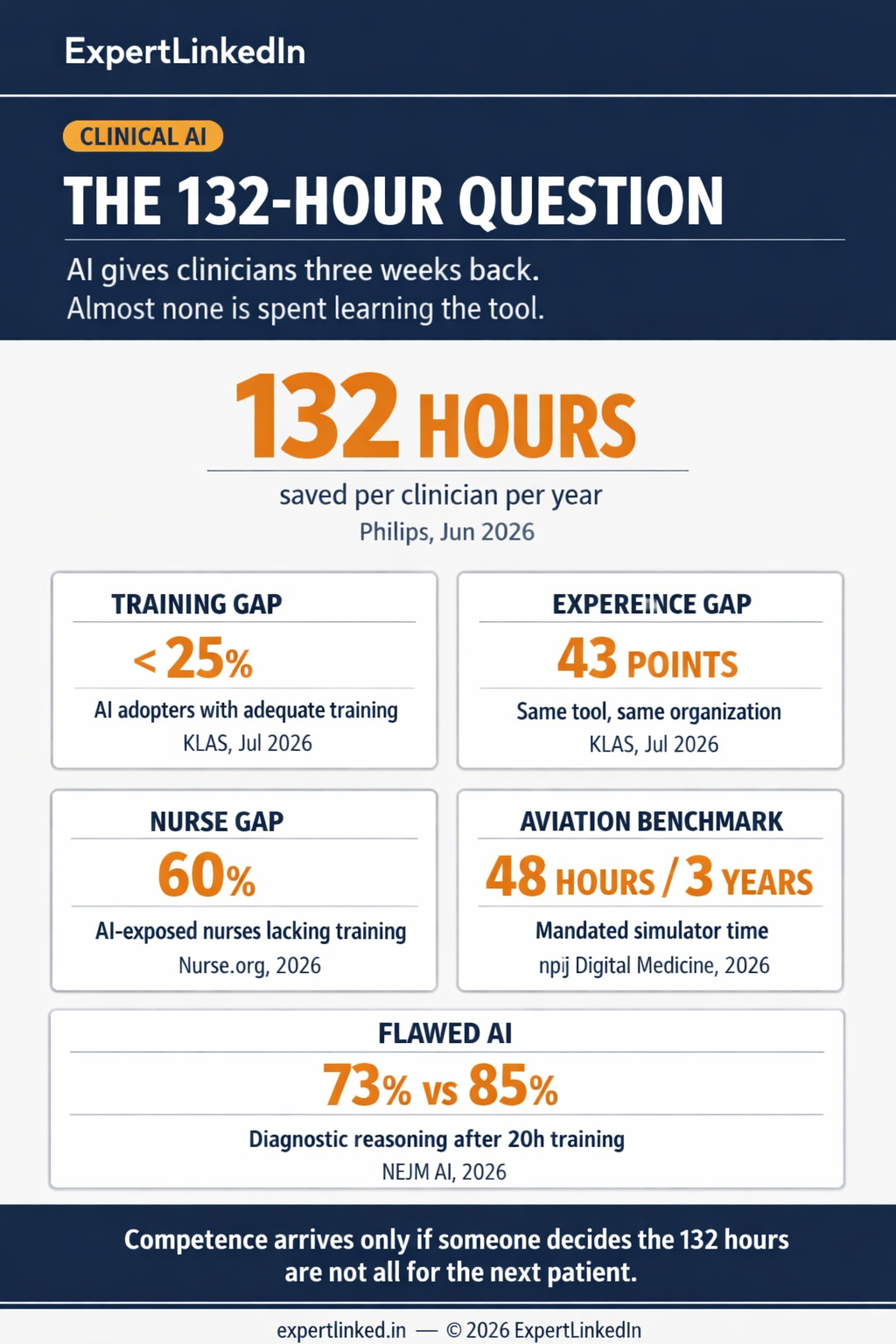
Forty-nine percent of U.S. clinicians say AI has given them back at least 132 hours a year. That is more than three working weeks — a bonus most professions would call a sabbatical.
Fewer than a quarter of the clinicians who have already adopted AI say anyone trained them adequately to use it.
Both numbers come from the same stretch of 2026, and they describe the same failure from opposite ends. The Philips Future Health Index found the time dividend. The KLAS Arch Collaborative found the training gap. Read together, they are a transfer: the institution captures the time, and the clinician is left to learn the tool on their own.
The thread: clinical AI does not have a training-content problem. It has an allocation problem. Health systems fund the deployment — the licence, the integration, the go-live support — and treat learning as a launch-day event. But the competence that actually keeps patients safe is not familiarity with the interface. It is calibrated reliance: the ability to decide when to trust the model, when to check it, when to override it, and when to stop the workflow. That skill is built through recurring, supervised practice with feedback. No go-live budget contains it, and no calendar owns it.

The gap is real, and it is shaped like a hierarchy #
The KLAS figure is blunt. Across 12 Epic organizations, fewer than 25% of clinicians who had adopted AI tools said they received adequate training on using AI-generated content in their workflows. Most executive leaders, in the same report, said they felt prepared for the next wave.
That difference shows up in the experience of the same tool. Among Epic clinicians using ambient speech, those who strongly agreed they knew how to optimize it averaged a Net EHR Experience Score of 89.7. Those who strongly disagreed averaged 46.7. Same technology, comparable organizations, a 43-point gap. The difference was not access. It tracked whether they had learned to use it well.
The gap is not evenly distributed. KLAS found that physician-centered AI strategies leave nurses and allied health behind, and warned that “a delayed version of a physician-focused rollout will not close the distance.” The Elsevier Clinician of the Future 2026, which surveyed 2,757 clinicians in 118 countries, put numbers on it: 41% of nurses use AI regularly versus 57% of physicians, and 41% of nurses say their views are rarely or never reflected in AI decisions. In the 2026 State of Nursing Survey, 60% of nurses with AI exposure lacked adequate training, only 22% trusted AI for patient care, and the gap was largest in the highest-acuity units — ER, ICU, and med-surg.
This is the part the dashboard misses. The Wolters Kluwer 2026 survey found physician AI use tripled in a year, from 10% to 38%, while awareness of formal AI governance policies crawled from 21% to 27%. A system can report rising adoption and falling calibration in the same quarter without noticing, because only one of those numbers is on the slide.
The obvious fix does not work #
The instinct is to run a course. The evidence says a course is not enough.
In a randomized trial reported in NEJM Clinician, 44 physicians who had completed a 20-hour AI literacy program worked through six clinical vignettes with optional ChatGPT consultation. Some received error-free suggestions; others received suggestions containing deliberate, clinically significant errors. About 70% consulted the model either way. The physicians exposed to the flawed advice scored significantly lower on diagnostic reasoning — roughly 73%, according to the trial’s coverage, against about 85% for the error-free group.
Twenty hours taught them to use AI. It did not teach them to disagree with it.
The automation-bias literature explains why. In a mammography study by Dratsch and colleagues, radiologists got about 80% of cases right with correct AI advice; when the AI was quietly wrong, the least experienced fell to about 20% and even the most experienced to 46%. A 2023 JAMA study of 457 clinicians found a biased model dragged diagnostic accuracy from 73% to about 62%.
The over-time version of this is the AI-off audit I wrote about in October: the skill the tool depends on can erode when nobody tests it.
The learning science points the same way. Durable skill comes from deliberate practice, desirable difficulty, and productive failure — conditions where the learner does the hard work and gets feedback. Fluency is the opposite; a tool that supplies the answer quickly can reduce the learning per hour, the uncomfortable core of the “never-skilling” problem in medical education.
This is why Mayo Clinic Platform’s training guidance is more radical than it first appears. John Halamka and Paul Cerrato argue for hands-on practice, and cite Raja-Eli Abdulnour’s recommendation that training include simulations where trainees receive AI-generated information that is deliberately wrong — and their errors are captured and measured. Their analogy is the lumbar tap: nobody would call a manual “procedure training.” You learn anatomy, practise on a simulator, then perform the procedure under supervision. The same logic applies to a model that can be confidently wrong.
Follow the 132 hours #
If learning is the missing allocation, the next question is where the money and time would come from. The Philips data offers an answer nobody has cashed in.
Nearly half of U.S. clinicians say AI saves them at least 132 hours a year. What happens to those hours? Philips reports that 36% say AI has increased their capacity to see additional patients, with a median increase of five patients a week. Nearly three-quarters — 72% — say they turn to personal AI tools when workplace options fall short.
Those are separate findings, not a measured reallocation. But they point one way. The time AI returns is being absorbed by throughput and by unpaid, ungoverned self-training on consumer tools. The learning that would make the tool safe is the one item in the workflow without a calendar block, a budget line, or an owner.
Put the two KLAS numbers side by side and the cost of that omission becomes visible. The 43-point experience gap is not between hospitals that bought the tool and hospitals that didn’t. It is between clinicians who know how to optimize the same tool and clinicians who don’t. That is a learning difference with a measurable human cost — and it is cheaper to close than most technology gaps on a CIO’s list.
Aviation budgets the competence. Medicine budgets the tool. #
There is a useful comparison here, and it is not the usual “healthcare should be more like aviation” cliché. It is narrower: aviation budgets the human side of automation on a schedule.
A 2026 npj Digital Medicine paper on “flight rules” for clinical AI lays out the benchmark. The European Union requires pilots to spend 48 hours in high-fidelity simulators every three years, and to practise manual flying on routine flights so the skill does not disappear. The industry learned the “automation paradox” the hard way: the more capable the system, the more likely the human is to offload, and the worse they become at catching its errors.
Medicine has the diagnosis without the schedule. The same paper notes that “while there is significant interest in benchmarking AI algorithms, the same level of enthusiasm has not applied to human clinicians.” Outside a few programmes, clinicians are not routinely benchmarked after their board exams. There is no equivalent of the 48-hour rule.
The policy is moving faster than the funding. The American Medical Association adopted a policy in November 2025 to expand AI literacy across medical school and continuing education. It also says the AMA will “advocate for funding and faculty-development resources” — which is the tell. The mandate exists before the money does.
For clinicians with the least institutional slack, the money comes from somewhere else. In August 2026, the American Nurses Enterprise announced a $5 million initiative for AI training in rural and underserved communities — $2.5 million from the Johnson & Johnson Foundation and $2.5 million from Google.org. It is admirable, and it is a diagnostic: when the learning a deployment requires has to be funded by philanthropy, the operating budget has already made its choice.
A learning allocation, not a training module #
If I were accountable for a clinical AI programme in 2027, I would stop asking “how do we train clinicians?” and start asking “where is the learning allocation?” Five parts:
- Name the competency, not the course. The target is calibrated reliance: when to trust, when to check, when to override, when to escalate. “AI literacy” is too vague to schedule or assess.
- Put protected practice hours on the calendar and in the budget. A recurring allocation, with a named budget owner and a review date. The aviation benchmark is 48 simulator hours every three years; the right number for a clinical team is a local decision. “As needed” is not a number.
- Practise under error conditions. Deliberately wrong AI in simulation. Unannounced AI-off or reliance drills. An independent read recorded before the AI output appears. Structured debriefs. This is the design the NEJM AI trial and Mayo both point to.
- Build a feedback and audit loop. Track override rates by clinician, human-AI error overlap, and near misses — and feed them back as learning, not blame. An override rate near zero is a warning, not a compliment. The Forbes synthesis makes the same point: a second look only adds value when the human and the model fail in different places.
- Include the whole care team, on their own timeline. Role-specific tracks for nurses and allied health. Nurse and allied-health input into procurement. Deliberate attention to rural, safety-net, and high-acuity units, where the gap is largest and the exposure is greatest.
This is the same logic Jackson Rodriguez applied to individual careers on November 9: a development plan fails at the calendar, not the course catalogue. The difference is that a clinician cannot solve this alone. The allocation has to be made by the organization that bought the tool.
What this does not fix #
Training is not the only variable, and an allocation frame can become an excuse for bad products. A badly designed workflow is not fixed by training people to work around it.
Most of the survey evidence here is vendor-commissioned or self-reported, so the magnitudes are directional. The NEJM AI trial is small and uses vignettes, not real patients. The claim that saved time is being spent on throughput is an inference from two Philips findings, not a measured reallocation.
No trial yet shows that a five-part learning allocation improves patient outcomes. The evidence supports the mechanism — calibration is trainable, and familiarity does not train it — and the gap. The bundle is a proposal, not a proven protocol.
The direction is not in doubt. The tool arrived with a licence, an integration plan, and a vendor. Competence arrives only if someone decides the 132 hours are not all for the next patient.
Working on clinical AI training, evaluation, or governance — and trying to find where the learning time actually goes? I’d like to hear how your organization budgets it.
Email me at sophia.patel@tlnw.uk
References #
- Philips (June 16, 2026). “AI in practice: how the Future Health Index 2026 shows healthcare moving from promise to progress.” https://www.usa.philips.com/healthcare/article/ai-in-practice-how-the-future-health-index-2026-shows-healthcare-moving-from-promise-to-progress (Accessed November 14, 2026)
- HealthSystemCIO (July 17, 2026). “AI Training Gap Leaves Clinicians Unprepared as Health Systems Rush Deployment, KLAS Finds.” https://healthsystemcio.com/2026/07/17/klas-ai-training-gap-clinicians/ (Accessed November 14, 2026)
- KLAS Arch Collaborative (July 17, 2026). “AI Insights from the Arch Collaborative 2026.” https://klasresearch.com/archcollaborative/report/ai-insights-from-the-arch-collaborative-2026/724 (Accessed November 14, 2026)
- NEJM Clinician (June 11, 2026). Abdulnour, R.-E. E. “When AI Steers Clinicians Wrong.” https://clinician.nejm.org/when-ai-steers-clinicians-wrong-CLINjwNA60155 (Accessed November 14, 2026)
- Forbes, syndicated via Yahoo Tech (November 12, 2026). “Doctors Are Supposed To Catch AI’s Errors. They Often Don’t—Here’s Why.” https://tech.yahoo.com/ai/articles/doctors-supposed-catch-ai-errors-111500152.html (Accessed November 14, 2026)
- Mayo Clinic Platform (September 11, 2026). Halamka, J., and Cerrato, P. “Training Clinicians to Use AI Tools Responsibly.” https://www.mayoclinicplatform.org/2026/09/11/clinical-ai-training/ (Accessed November 14, 2026)
- Wolters Kluwer (June 2, 2026). “2026 Future Ready Healthcare Survey: Rapid AI adoption in healthcare highlights worries, opportunities, for both patients and clinicians.” https://www.wolterskluwer.com/en/news/future-ready-healthcare-ai-adoption-patient-clinician-insights (Accessed November 14, 2026)
- Elsevier (2026). “Global study of clinicians by Elsevier finds nurses being left out of clinical AI adoption.” Clinician of the Future 2026. https://www.elsevier.com/about/press-releases/global-study-of-clinicians-by-elsevier-finds-nurses-being-left-out-of-clinical-ai-adoption (Accessed November 14, 2026)
- Nurse.org (2026). “Nurses Are Being Asked to Use AI Tools They Don’t Trust & Were Never Trained On.” 2026 State of Nursing Survey. https://nurse.org/articles/nurses-ai-tools-training-trust-2026/ (Accessed November 14, 2026)
- American Nurses Enterprise (August 20, 2026). “American Nurses Enterprise Awarded $5 Million to Spearhead AI Training for Rural Nursing Communities.” https://www.nursingworld.org/news/news-releases/2026-news-releases/american-nurses-enterprise-awarded-$5-million-to-spearhead-ai-training-for-rural-nursing-communities/ (Accessed November 14, 2026)
- Ong, A. Y., et al. (2026). “Flight rules for clinical AI: lessons from aviation for human–AI collaboration in medicine.” npj Digital Medicine, 9, 201. https://www.nature.com/articles/s41746-026-02410-1 (Accessed November 14, 2026)
- Ke, Y., Jin, L., Ong, J. C. L., Ting, D. S. W., and Liu, N. (2026). “AI-induced never-skilling in medical education.” Nature Medicine. https://www.nature.com/articles/s41591-026-04438-y (Accessed November 14, 2026)
- American Medical Association (November 18, 2025). “AMA adopts policy to advance AI literacy in medical education.” https://www.ama-assn.org/press-center/ama-press-releases/ama-adopts-policy-advance-ai-literacy-medical-education (Accessed November 14, 2026)
AI Content Notice
This article was created using artificial intelligence technology. Whenever possible, we include references and sources to support the information presented. Readers are encouraged to consult these sources for further information. While we strive for accuracy and provide valuable insights, readers should independently verify information and use their own judgment when making business decisions. The content may not reflect real-time market conditions or personal circumstances.
Related Articles
Infographic: The 132-Hour Question: Clinical AI Gives Clinicians Back Three Weeks a Year. Almost None Goes to Learning.
Clinical AI is giving clinicians back 132 hours a year — more than three working weeks. Fewer than a …
The AI-Off Audit: Why Clinical AI Is Erasing the Judgment It Still Depends On
Clinical AI’s safety case assumes a competent clinician will catch its mistakes. But every …
Infographic: The AI-Off Audit: Why Clinical AI Is Erasing the Judgment It Still Depends On
Clinical AI’s safety case assumes a competent clinician will catch its mistakes. But every …