The Explanation Gap: The Skill That Decides Technical Careers in 2027

By the time you finish this, your company will have produced more analysis, more code and more drafts this quarter than your team could have written by hand a year ago. Almost none of it will be credited to a person who can explain it.
That is the whole 2027 career problem in one sentence. Your work has never been easier to produce and harder to get credit for — because the scarce thing is no longer the work. It is the last mile: the explanation. I have started calling it the explanation gap.

“Personal brand” is a euphemism. The skill is translation. #
Name the thing properly, because the euphemisms hide the labour. “Personal brand” and “thought leadership” sound like personality. What they actually describe, for an engineer or a data scientist, is translation: turning deep work into a decision, a trade-off and an explanation that someone who does not share your vocabulary can act on.
The market began paying for that in 2026. LinkedIn’s Skills on the Rise 2026, published February 24, found employers increasingly prioritising skills over degrees and titles — and the fastest-growing people skills are communication-centric: Executive & Stakeholder Communication, Cross-Functional Collaboration, Public Speaking. A Purdue University summary of McKinsey’s research, published October 9, is blunter about the job itself: the professionals who fare best can “translate complex data insights into action plans” and judge AI output for accuracy and audience fit.
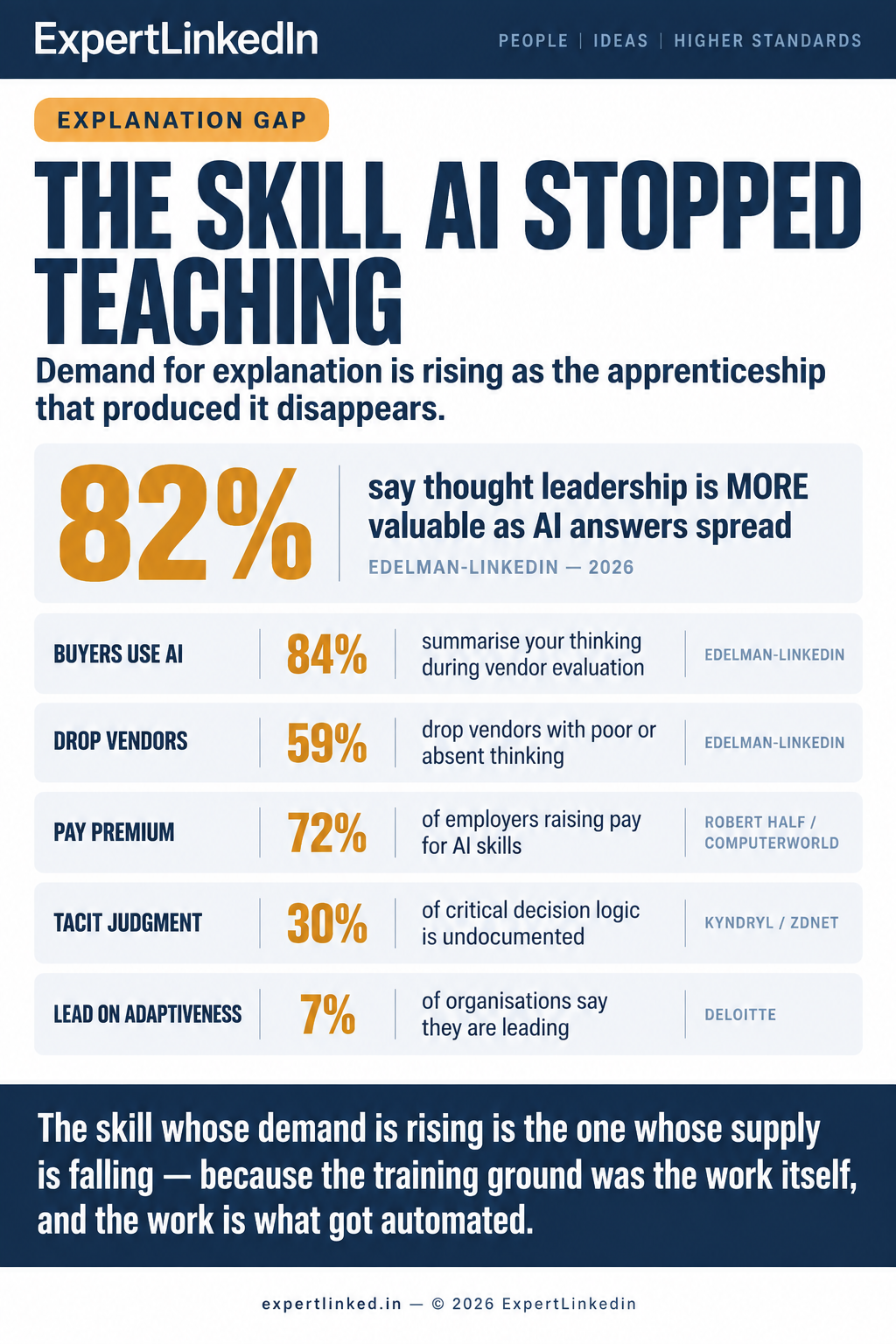
The commercial evidence is harder to wave away. In the 2026 Edelman-LinkedIn B2B Thought Leadership Impact Report, based on a survey of more than 1,100 business executives across seven countries, 82% of B2B decision-makers said thought leadership is becoming more valuable as AI becomes a common source of business answers; 84% used AI to summarise a company’s thinking during vendor evaluation; and 59% of final decision-makers said poor or absent thinking contributed to a vendor being dropped from consideration. Sit with that last figure. Being unable to explain a decision is now a reason to lose the deal.
In 2026 the market priced judgment, not just tools #
Here is the part that should reframe your development plan. Employers are paying a premium for AI skills — but the premium is not really for the tools.
Computerworld’s read of Robert Half’s 2027 salary guide found 72% of employers are increasing pay for relevant AI skills, and 42% are paying more for AI-related expertise than for other technical skills. Yet the same jobs data carries a quieter signal: employers are “seeking more experience but fewer skills.” The average number of named skills in a tech posting fell from roughly 30 to 21 since late 2024, while the experience demanded rose from about 4.6 to 4.8 years. PwC’s conclusion, quoted in the same piece, is that entry-level roles in AI-exposed jobs now ask for capabilities “traditionally developed through experience, such as leadership and strategic thinking.”
Global employer surveys point the same way. The World Economic Forum’s Future of Jobs Report 2025 ranked analytical thinking the single most sought-after core skill — above any tool — with leadership and social influence close behind, and projected that 39% of workers’ existing skills would be transformed or become outdated by 2030.
That is less a skills shortage than a judgment shortage that nobody can list in a job ad. Small wonder Gartner now expects 75% of hiring processes to test for workplace AI proficiency by 2027 — and that the same analyst expects the half-life of a technical skill to shrink from eight-to-twelve years to two-to-five. You cannot out-certify that. You can, however, learn to explain what you know.
Why you can’t pick it up by accident anymore #
For most of the last two decades, technical specialists learned to explain their work the way they learned everything else: by doing the small jobs. You wrote the ticket, and a senior colleague rewrote it. You drafted the plan, and a project manager showed you what was missing. The explanation was a by-product of the apprenticeship.
AI just removed the apprenticeship first. TechTarget’s analysis of the vanishing first rung is the clearest account of the mechanism. Junior developers now generate code with an assistant; service desks auto-resolve common faults; project assistants draft the plan, summarise the meeting and chase the actions. The commercial logic is nearly irresistible: if one experienced developer with AI can do what three juniors did, a spreadsheet somewhere will recommend hiring the one.
The line that should worry every manager is this: checking is an expert skill. Verifying an AI-generated answer often requires much of the expertise needed to produce it. “Novices can therefore produce expert-looking work without acquiring expert reasoning,” TechTarget notes — and polished output creates “an illusion of competence” for the employee and the manager alike. The work looks finished. Nobody in the room can say why it is right, or wrong.
This is already true at the frontier. At Goldman Sachs, chief information officer Marco Argenti says the firm’s engineers now spend their time transferring “tribal knowledge” to AI agents — making the understanding in people’s heads explicit enough for a model to use. And when ZDNet asked industry leaders where the value is going, Zapier’s Brandon Sammut named the real bottleneck: integration complexity is “the number one barrier to making AI work in practice, ahead of budget or model quality… the person who can close that gap keeps getting hired. It’s the ability to sit with a team, figure out what they’re actually trying to solve, and build something that survives contact with their real systems. That’s the skill in short supply.” Kyndryl’s Ismail Amla added the uncomfortable detail underneath it: as much as 30% of critical decision logic resides as tacit knowledge rather than in documented process.
The uncomfortable truth #
Put the two halves together and the 2027 problem stops being about effort. The skill whose demand is rising is the one whose supply is falling — because the training ground was the work itself, and the work is what got automated.
“Communication matters” is a forty-year-old claim, and on its own it is not worth an article. What is new in 2026 is sharper. First, the informal apprenticeship that produced judgment and articulation is being dismantled at exactly the moment employers say they need judgment. Second, your explanation now has to survive a machine before it reaches a person: 84% of buyers run a company’s thinking through an AI summariser during evaluation, per Edelman-LinkedIn. A vague explanation does not merely fail to persuade a human. It fails to be retrieved at all.
The practice loop that replaces the apprenticeship #
My colleague Jackson laid out the five fields of a real 2027 development plan on Monday: a named skill, a practice task, allocated calendar time, a feedback source and an opportunity to apply it. His insight was that a paid course can sit unused for months because the calendar is the plan. For technical specialists, the field most often skipped is the first one. Do not write “improve communication.” Name the act:
- One decision a week, explained in writing, to someone outside your discipline. Not a post — a decision: what you chose, what you rejected and what it cost. (This is the same unit of communication that travels: a decision with its price attached.)
- One reviewer who will tell you, honestly, what did not land. Not a cheerleader. Someone senior enough to say the framing buried the trade-off.
- One protected hour, with the competing delivery work named and deferred. Ask your manager the uncomfortable question: what comes off the plate so the first practice session actually happens?
- One applied audience — a real meeting, a client call, a risk committee, a hiring panel — so the skill has somewhere to land.
And one caution that the “personal branding” industry will not give you: learning to explain is not the same as posting more. Business Insider reported that one detection firm estimated 41% of long-form LinkedIn posts were likely AI-generated in a three-month window, that a corporate ghostwriting firm quoted a client $8,400 a month to write posts for three employees, and that at least one recruiter now reads heavy posting as “a red flag.” Volume is not the skill. Specificity is. As I argued in your public footprint is now part of your scorecard, sameness — not silence — is the disqualifier nobody announces.
The gatekeeper — and the honest limit #
Whether you get to practise explaining is usually a manager decision, not a talent one. Gallup’s 2026 research on AI and workplace culture found that workers who strongly agree their manager champions AI are far more likely to say AI has transformed how work gets done (33%, against just 4% of those who do not) — yet 50% of CHROs say they are not confident in their managers’ ability to guide employees’ AI use. Deloitte’s 2026 Global Human Capital Trends adds that 87% of workers say safe spaces to practise would help them adapt, that the top barrier is change feeling irrelevant to the individual (44% of leaders), and that only 7% believe their organisation is leading on adaptiveness at all.
Then the limit that most “build your voice” advice quietly skips. This is not equally available to everyone, and pretending otherwise is its own kind of spin. A Pew Research Center study cited by Fortune on November 2 found that in more AI-exposed occupations, men’s employment grew 6.3% for each one-point increase in an occupation’s AI-exposure score, while women’s barely moved. When the November plan tells us not to promise that every worker can negotiate equally, this is the data underneath it. So keep the option to build the skill inside the job — one decision, one reviewer, one audience — and treat any arrangement that turns posting into an unlisted performance metric for what it is: extraction wearing a development plan.
What the scoreboard actually rewards #
Career progress itself is changing shape — from a ladder to what Microsoft’s Aneesh Raman calls a “climbing wall,” where movement is lateral and diagonal rather than always upward. If that is right, the transferable asset is not the title you reach. It is whether other people can repeat your reasoning when you are not in the room. That was the argument in my piece on executive visibility and its two ledgers: reach is what you buy, repetition is what you earn. Explanation is how you earn it — and it is exactly the thing AI has stopped teaching by accident.
So do not wait for the training budget, the course, or the company that finally adds “communication” to the competency framework. Produce one explained decision this week. In 2027, the people who get funded, hired and promoted will not be the ones who produced the most. They will be the ones whose work arrived with a reason attached that someone else could carry.
Have a story about the explanation that changed how your work was seen — or one that never got the chance? I’d like to hear it.
Email me at marcus.johnson@tlnw.uk
References #
- LinkedIn News (February 24, 2026). “Skills on the Rise: The Fastest-Growing Skills in 2026.” https://news.linkedin.com/2026/Skills-on-the-rise-2026 (Accessed November 12, 2026)
- Purdue University Online (October 9, 2026). “Are communication skills still important in the age of AI? Research says yes.” https://www.purdue.edu/online/are-communication-skills-still-important-in-the-age-of-ai-research-says-yes/ (Accessed November 12, 2026)
- Edelman and LinkedIn (2026). “2026 Edelman-LinkedIn B2B Thought Leadership Impact Report: Thought Leadership Isn’t Just What You Say. It’s What People Do With It.” https://www.edelman.com/insights/thought-leadership-isnt-just-what-you-say-its-what-people-do-it (Accessed November 12, 2026)
- Computerworld (2026). “Want a higher paying tech job? Employers seek AI fluency.” https://www.computerworld.com/article/4237995/want-a-higher-paying-tech-job-employers-want-ai-fluency-expertise.html (Accessed November 12, 2026)
- TechTarget (2026). “AI ate the first rung of the technology career ladder.” https://www.techtarget.com/it-strategy/opinion/AI-ate-the-first-rung-of-the-technology-career-ladder (Accessed November 12, 2026)
- Business Insider (2026). “Goldman’s engineers have a new challenge: turning AI agents into firm insiders.” https://www.businessinsider.com/goldman-sachs-engineers-ai-marco-argenti-2026-8 (Accessed November 12, 2026)
- ZDNET (2026). “AI engineer vs. forward deployed engineer: Which role delivers the most business value?” https://www.zdnet.com/article/ai-engineers-versus-forward-deployed-engineers-a-tale-of-two-career-paths/ (Accessed November 12, 2026)
- Gallup (2026). “AI’s Effect on Workplace Culture.” https://www.gallup.com/workplace/712976/ai-effect-on-workplace-culture.aspx (Accessed November 12, 2026)
- Deloitte (March 3, 2026). “Creating an adaptable workforce — 2026 Global Human Capital Trends.” https://www.deloitte.com/us/en/insights/topics/talent/human-capital-trends/2026/creating-an-adaptable-workforce.html (Accessed November 12, 2026)
- Fortune (November 2, 2026). “A Microsoft exec says AI is killing the career ladder. But its replacement comes with a catch.” https://fortune.com/2026/11/02/a-microsoft-exec-says-ai-is-killing-the-career-ladder-but-its-replacement-comes-with-a-catch/ (Accessed November 12, 2026)
- Business Insider (August 27, 2026). “LinkedIn posts can be cringe. Workers feel like they have to write them anyway.” https://www.businessinsider.com/linkedin-posts-personal-brand-career-arms-race-job-market-careers-2026-8 (Accessed November 12, 2026)
- World Economic Forum (January 7, 2025). “The Future of Jobs Report 2025.” https://www.weforum.org/publications/the-future-of-jobs-report-2025/ (Accessed November 12, 2026)
AI Content Notice
This article was created using artificial intelligence technology. Whenever possible, we include references and sources to support the information presented. Readers are encouraged to consult these sources for further information. While we strive for accuracy and provide valuable insights, readers should independently verify information and use their own judgment when making business decisions. The content may not reflect real-time market conditions or personal circumstances.
Related Articles
Infographic: The Explanation Gap: The Skill That Decides Technical Careers in 2027
AI writes the code, the analysis and the memo — and it quietly deleted the junior work that taught …
Your Personal Brand Is Now a Job Skill — and Nobody Budgeted the Time to Learn It
In 2026 a credible professional voice is a load-bearing job skill — and employers fund it as content …
The Entry-Level Trust Gap in the Age of AI Copilots
The central future-of-work risk in 2026 is a trust gap where firms cut entry-level pathways on AI …