How to Renegotiate Your Role for 2027: Workload, Learning Time, and Decision Rights

Read the role agreement you think you have for 2027. Now read it again, clause by clause.
The work is listed. The learning time is promised. The authority is named. And almost every line is conditional. The learning block “holds if delivery allows.” The authority is real “in principle.” The task you finally removed stays removed “until the next urgent gap.” Nothing on the page is false. Nothing on the page is enforced.
A role agreement rarely fails because it is vague. It fails because it is complete on paper and conditional in practice — and nobody checked whether the person across the table can actually approve the conditions.

The pressure is real. The capacity is not automatic. #
The instinct this month is to negotiate from anxiety, so start with what November actually showed.
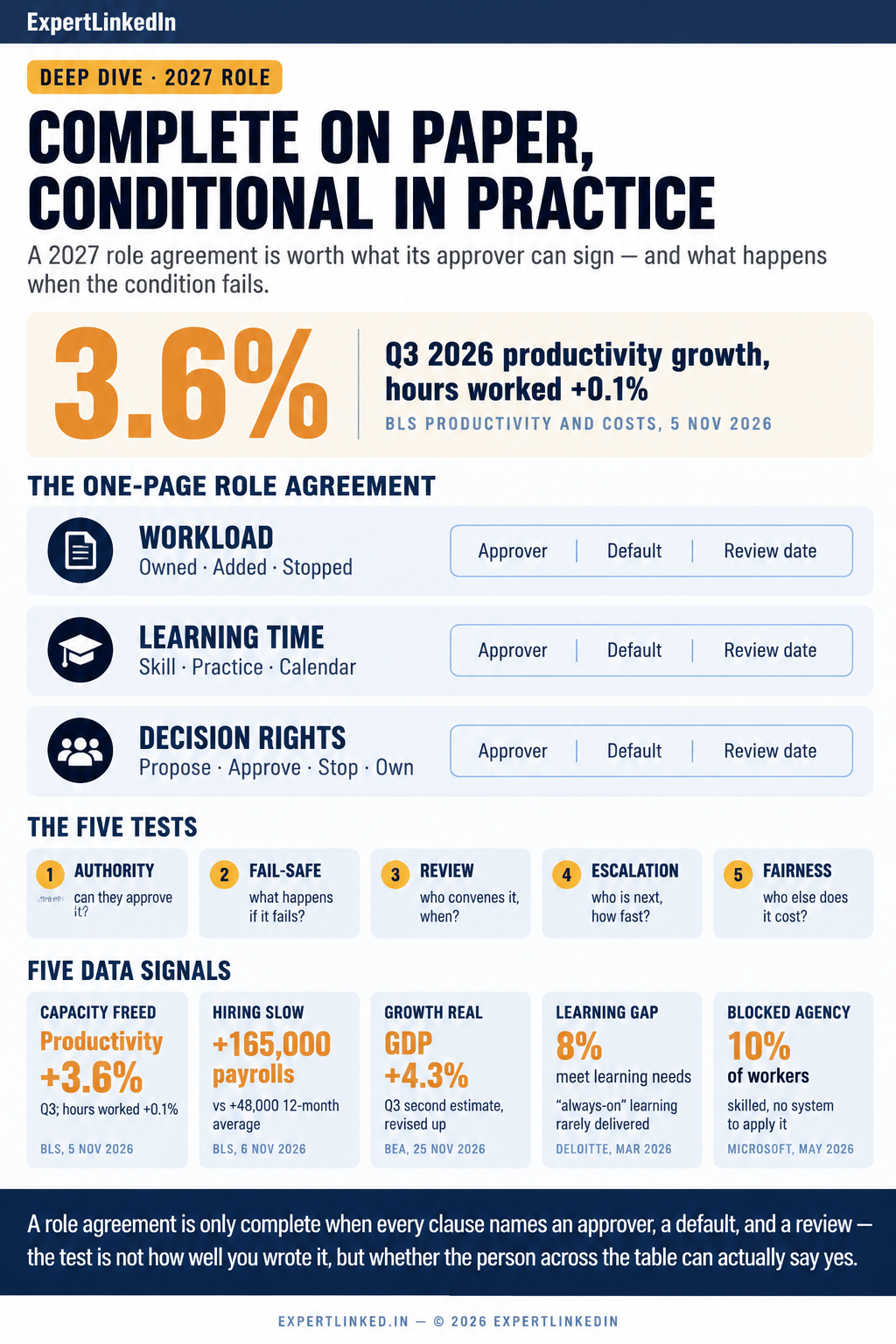
American productivity is genuinely strong. In the third quarter, nonfarm business productivity rose 3.6% at an annual rate while hours worked rose just 0.1% — output grew, and the time people spend did not (BLS, November 5). Real GDP rose 4.3% in the second estimate, revised up 0.9 percentage points from the advance reading, and corporate profits from current production climbed $206 billion (BEA, November 25). Employers can afford to invest. That is not the dispute.
Now the other column. October added 165,000 jobs — against an average monthly gain of just 48,000 over the prior year; unemployment sat at 4.1%, inside a narrow 4.1–4.3% band that has held since March (BLS, November 6). Job openings were flat at 7.5 million against 5.4 million hires (BLS, November 3). October’s PCE price index ran 3.8% above a year earlier (BEA, November 25). And the Federal Reserve’s own district contacts, in the November 25 Beige Book, described firms “hiring primarily to replace for attrition,” “utilizing existing staff more efficiently,” and facing input costs that outpace what they can charge (Federal Reserve, November 25).
Two columns, one month. One says capacity; the other says constraint. The line that follows from both: a productivity headline is capacity; an approved clause is a decision. The economy freed up time somewhere. Nobody has agreed to give you any of it.
That is why this is the month’s capstone rather than another tool. Over four weeks we built four of them: a scope audit for the work you own, a development plan for getting better inside it, a decision-rights agreement for what you can stop, and a handover that transfers all three when you are away. Each was necessary. None is sufficient alone. The 2027 role is the one-page agreement that holds them together — and its worth is not decided by the first draft. It is decided by whether it survives delivery pressure, absence, and a manager who cannot fund it.
Clause one: the work you own #
The workload clause is the scope audit condensed to three lines. What stays. What arrived. What stops or transfers. The first line is easy to write and the second is usually longer than people expect.
The Beige Book says why. When firms “utilize existing staff more efficiently,” the added work does not arrive as a new job description. It arrives as one more thing nobody else picked up. That matches what we already know about the AI era: organizations report that work is changing faster than the role definition does, and only about a quarter write new skills into job expectations at all (Gallup, 2026).
The third line — what stops — is the one that decides whether the clause is real. It is almost always empty, not because nothing should stop, but because no one was ever asked to approve a subtraction. A priorities conversation becomes concrete only at the moment it names the person who can say yes to removing something. If the third line has no name next to it, it is not a plan. It is a wish.
Clause two: the hour you protect #
The learning clause is not a training request. It is an allocation of practice inside real work, and it has five fields: the skill, the practice task, the calendar block, the feedback source, and an opportunity to apply it (November 9).
Only one of those fields ever truly fails. Deloitte’s 2026 research found that just 8% of organizations believe they meet workers’ “always-on” learning needs, and that growth often still feels like “stepping away from real work” (Deloitte, 2026). A funded course can coexist with zero hours to use it. So the calendar field is the hard one: it has to name what gets deferred, by whom, and by when. “I will find time” is not an allocation.
There is a second reason the hour is worth protecting, and it is narrower than the wellness poster version. A one-week diary study of 166 public-administration employees found that low psychological detachment in the evening predicted negative activation and fatigue the next morning (Sonnentag, Binnewies & Mojza, 2008). The related work on recovery identifies four experiences — detachment, relaxation, mastery, and control, the degree to which you decide what your own time is for (Sonnentag & Fritz, 2007). Control is the one a conditional agreement quietly removes. Say that carefully: this research is the reason to protect a block, not proof that a role agreement produces recovery.
Clause three: what you can stop #
The authority clause is four questions — who may propose, who approves, who can stop or override, who owns the follow-up — plus a fifth field most agreements omit: who can make the stop real (November 16).
That fifth field is the whole point. Approving an outcome is not the same as being able to halt the workflow that produces it. Microsoft’s 2026 Work Trend Index puts the identical question to organizations — “Who has the authority to update the workflows that agents run?” — and finds the constraint is not worker readiness but the system around them: organizational factors account for more than twice the reported AI impact of individual effort (67% vs. 32%), and about 10% of workers sit in “blocked agency,” skilled but without the systems to apply it (Microsoft, 2026). A named accountable person without a stop is a label, not a control.
Why workload and authority are the same question #
Here is the part that turns three clauses into one argument, and it comes from organizational psychology rather than this week’s data.
The job demands–control model, one of the field’s classic work-design theories, holds that high workloads combined with low control produce strain, while high control buffers the same demands and turns them into mastery (Karasek, 1979). Read that again with a 2027 calendar in front of you. It means the workload clause and the authority clause are not two negotiations. They are one. Added work without decision rights is the exact configuration the literature predicts will end in burnout — and protected learning time is the resource that flips it toward mastery.
Two more academic frames keep this honest. Job crafting — the informal changes people already make to their tasks and relationships — is real, but the original theory is explicit that it is bounded by interdependence, monitoring, and structural limits, and that it sometimes happens “against management’s wishes” (Wrzesniewski & Dutton, 2001). That is not a right to redesign your job. The negotiated version has a name: idiosyncratic deals, or i-deals — individualized arrangements a worker negotiates with an employer, of which workload reduction and development opportunities are two of the most common forms (Rousseau, 2001). I-deals share the work-design family with job crafting, but they require something crafting does not: an employer who values the person, and a deal that is fair to everyone else. And the reason to make it explicit is that unwritten expectations get broken silently. A psychological contract breach “erodes the notion of reciprocity” and is associated with burnout (Maslach, Schaufeli & Leiter, 2001). The agreement is how you write the expectation down before it breaks.
The test: five questions before you sign anything #
This is the insight the whole month points to. A complete-looking agreement can be built entirely out of conditions nobody has checked. So run five tests on every clause before you treat it as done.
- The authority test — can the person across the table actually approve this clause? A manager can approve a priority order. A manager often cannot approve a headcount transfer, a budget line, a system permission, or a change to an AI-run workflow. Name the approver, and if it is not your manager, name who it is.
- The fail-safe test — what happens by default when the condition fails? If the learning block loses to a deadline, does it move or vanish? If a stop is disputed, does the work hold or proceed? No stated default means the clause silently reverts to you.
- The review test — who convenes the review, on what date, with what evidence? A clause with no review has no revision mechanism.
- The escalation test — if the approver cannot approve, what is the named next person and the response window? An escalation needs a condition, a clock, and a channel — the same structure as the four rules in the November 23 handover checklist.
- The fairness test — what does this agreement cost someone else? I-deals are bounded by how co-workers see them. If you cannot name who else is affected, you have not finished the negotiation.
Run it against three failures #
Then stress-test the page, because an agreement that has never met pressure is a hypothesis.
Delivery pressure. Take the first busy week of 2027. Does the scheduled learning block survive it, or is it the first thing displaced? If it is, the calendar field has no owner.
Absence. Hand your clauses to whoever covers for you. Do they hold the access and the authority? Test it with a live login and one question you did not anticipate, not by reading the document.
The manager who cannot fund it. Margin pressure is real — input costs are outpacing selling prices across Fed districts. So route the clause that needs money to the person who holds the budget, the contract, or the system permission. Most “no” answers never came from your manager; they came from never asking the right approver.
What this is not #
Be precise about the evidence, because a role conversation built on overclaiming collapses the first time it is challenged.
The role agreement, the clauses, and the five tests are a proposed planning tool — this publication’s synthesis of four weeks of work, not a validated instrument. The recovery research is original but narrow: a one-week diary study and a recovery-experience questionnaire, not a study of role agreements. Job crafting is conceptual and descriptive; it explains informal change, it does not grant a right to a new job. The Deloitte, Microsoft, and Gallup figures are self-reported survey associations, not causal findings. And the Beige Book is explicitly qualitative — district anecdotes, dated November 25, not a national measurement.
One more limit, and it is the important one. Not everyone can negotiate at this table. An i-deal requires an employer who values you and a deal that is fair to others; a worker with no leverage, no sponsor, and a manager who cannot approve anything is not failing at role design. They are collecting evidence for a different decision.
The move #
Do not write a longer document. Write one page with three clauses, and on every clause write three things: the approver, the default if the condition fails, and the review date with a named convener.
Then run the five tests. Then put the page in front of the manager and ask the only question that matters: can you approve each of these lines, and if not, who can? If the answer is a clear yes for each clause, you have a 2027 role. If the answer is “not now” with a review date and a named escalation path, you have a process. If the answer is “not now” with no path and no date, you do not have a negotiation — you have a document, and the honest next step is to price an external option rather than re-send the same page.
A role agreement is only complete when every clause names an approver, a default, and a review. The test was never how well you wrote it. It is whether the person across the table can actually say yes.
Building your own 2027 role agreement — or hit a clause your manager can’t approve? Send me the clause and who you think signs it, and I’ll tell you which of the five tests it fails first.
Email me at jackson.rodriguez@tlnw.uk
References
-
U.S. Bureau of Labor Statistics (November 5, 2026). “Productivity and Costs, Third Quarter 2026 (Preliminary).” https://www.bls.gov/news.release/prod2.nr0.htm (Accessed November 26, 2026)
-
U.S. Bureau of Labor Statistics (November 6, 2026). “The Employment Situation — October 2026.” https://www.bls.gov/news.release/empsit.nr0.htm (Accessed November 26, 2026)
-
U.S. Bureau of Labor Statistics (November 3, 2026). “Job Openings and Labor Turnover — September 2026.” https://www.bls.gov/news.release/jolts.nr0.htm (Accessed November 26, 2026)
-
U.S. Bureau of Economic Analysis (November 25, 2026). “GDP (Second Estimate) and Corporate Profits, 3rd Quarter 2026.” https://www.bea.gov/news/2026/gdp-second-estimate-and-corporate-profits-3rd-quarter-2026 (Accessed November 26, 2026)
-
U.S. Bureau of Economic Analysis (November 25, 2026). “Personal Income and Outlays, October 2026.” https://www.bea.gov/news/2026/personal-income-and-outlays-october-2026 (Accessed November 26, 2026)
-
Board of Governors of the Federal Reserve System (November 25, 2026). “Beige Book — November 2026.” https://www.federalreserve.gov/monetarypolicy/beigebook202611-summary.htm (Accessed November 26, 2026)
-
Microsoft (May 5, 2026). “2026 Work Trend Index: Agents, human agency, and the opportunity for every organization.” https://www.microsoft.com/en-us/worklab/work-trend-index/agents-human-agency-and-the-opportunity-for-every-organization (Accessed November 26, 2026)
-
Deloitte (2026). “2026 Global Human Capital Trends: From tensions to tipping points.” https://www.deloitte.com/us/en/insights/topics/talent/human-capital-trends.html (Accessed November 26, 2026)
-
Deloitte (March 3, 2026). “Staying relevant in a world that won’t sit still.” 2026 Global Human Capital Trends. https://www.deloitte.com/us/en/insights/topics/talent/human-capital-trends/2026/creating-an-adaptable-workforce.html (Accessed November 26, 2026)
-
Gallup (2026). Meinen, M., & Mulherin, M. “AI’s Effect on Workplace Culture.” https://www.gallup.com/workplace/712976/ai-effect-on-workplace-culture.aspx (Accessed November 26, 2026)
-
Sonnentag, S., Binnewies, C., & Mojza, E. J. (2008). “‘Did you have a nice evening?’ A day-level study on recovery experiences, sleep, and affect.” Journal of Applied Psychology, 93(3), 674–684. https://pubmed.ncbi.nlm.nih.gov/18457495/
-
Sonnentag, S., & Fritz, C. (2007). “The Recovery Experience Questionnaire: Development and validation of a measure for assessing recuperation and unwinding from work.” Journal of Occupational Health Psychology, 12(3), 204–221. https://pubmed.ncbi.nlm.nih.gov/17638488/
-
Karasek, R. A. (1979). “Job demands, job decision latitude, and mental strain: Implications for job redesign.” Administrative Science Quarterly, 24(2), 285–308. [Job demands–control model; concept referenced via the work design literature.]
-
Wrzesniewski, A., & Dutton, J. E. (2001). “Crafting a job: Revisioning employees as active crafters of their work.” Academy of Management Review, 26(2), 179–201.
-
Rousseau, D. M. (2001). “Idiosyncratic deals: Flexibility versus fairness.” Organizational Dynamics, 29(4), 260–273. [Concept of i-deals; see also Rousseau, Ho & Greenberg, 2006.]
-
Maslach, C., Schaufeli, W. B., & Leiter, M. P. (2001). “Job burnout.” Annual Review of Psychology, 52, 397–422. [Psychological-contract breach and reciprocity.]
-
ExpertLinked (November 2, 2026). “How to Renegotiate Job Responsibilities for 2027 With a 3-List Scope Audit.” https://expertlinked.in/posts/2026-11-02-how-to-renegotiate-job-responsibilities-for-2027-with-a-3-list-scope-audit/
-
ExpertLinked (November 9, 2026). “How to Build a Career Development Plan for 2027 With Learning Time at Work.” https://expertlinked.in/posts/2026-11-09-how-to-build-a-career-development-plan-for-2027-with-learning-time-at-work/
-
ExpertLinked (November 16, 2026). “How to Set AI Decision Rights for 2027 With a 4-Question Team Agreement.” https://expertlinked.in/posts/2026-11-16-how-to-set-ai-decision-rights-for-2027-with-a-4-question-team-agreement/
-
ExpertLinked (November 23, 2026). “How to Build a Holiday Handover Checklist With 4 Clear Escalation Rules.” https://expertlinked.in/posts/2026-11-23-how-to-build-a-holiday-handover-checklist-with-4-clear-escalation-rules/
AI Content Notice
This article was created using artificial intelligence technology. Whenever possible, we include references and sources to support the information presented. Readers are encouraged to consult these sources for further information. While we strive for accuracy and provide valuable insights, readers should independently verify information and use their own judgment when making business decisions. The content may not reflect real-time market conditions or personal circumstances.
Related Articles
Infographic: How to Renegotiate Your Role for 2027: Workload, Learning Time, and Decision Rights
A 2027 role agreement can look complete while every clause stays conditional. Here is the one-page …
How to Renegotiate Job Responsibilities for 2027 With a 3-List Scope Audit
Your 2027 job is being assembled without a subtraction column. Here is the 3-list scope audit — work …
Infographic: How to Renegotiate Job Responsibilities for 2027 With a 3-List Scope Audit
Your 2027 job is being assembled without a subtraction column. Here is the 3-list scope audit — work …