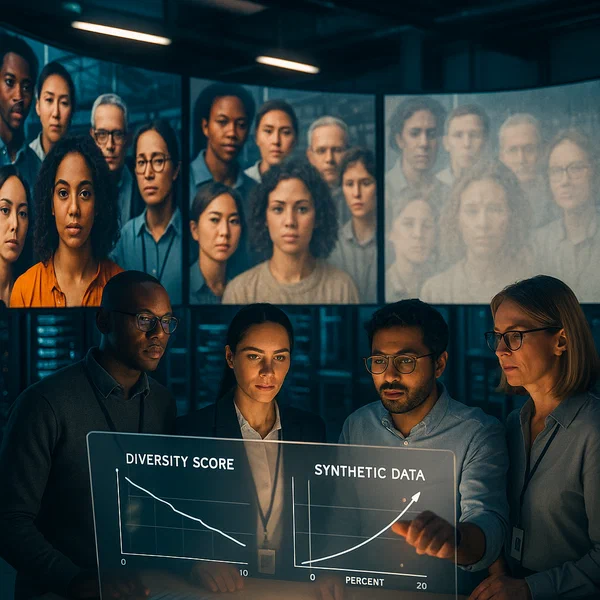
The proliferation of AI-generated content is creating a feedback loop that threatens AI model quality. Addressing this requires urgent ethical frameworks around data provenance and synthetic data management.
AI models are revolutionizing heart attack risk prediction, but responsible deployment and regulatory oversight are essential to ensure equitable, safe, and effective care.
Analyze Anthropic’s landmark copyright victory and its mixed implications for AI development. Understand how this pivotal fair use ruling affects training data rights, content creators, and the future of AI innovation while piracy allegations remain.
Navigate the critical crossroads of healthcare AI regulation as New York passes landmark safety legislation. Understand how new regulations, 23andMe’s nonprofit transformation, and emerging ethical frameworks are reshaping medical AI for safer, more responsible patient care.
Prompt engineering has evolved from experimental art to rigorous science with structured methodologies, testing frameworks, and systematic approaches that dramatically improve efficiency and reliability in enterprise AI applications.
Transform financial risk assessment through AI-powered systems that capture complex relationships, adapt to changing conditions, and provide continuous learning capabilities that surpass traditional static models.
AI revolutionizes healthcare through machine learning models that detect diseases earlier and more accurately, but success requires diverse training datasets, clinician involvement, patient privacy protection, and collaboration between doctors, data scientists, and patients for ethical implementation.
AI diagnostic systems transform medical decision-making by enhancing accuracy across radiology, pathology, and dermatology, demonstrating 73% faster critical case diagnosis while achieving diagnostic accuracy comparable to board-certified specialists through validated clinical implementations.
Prompt engineering emerges as the hottest skill in tech, teaching professionals to communicate effectively with AI systems through natural language to dramatically improve results and unlock new career opportunities in the AI-driven workplace.
AI transforms healthcare diagnosis with 94% accuracy rates for conditions like melanoma and diabetic retinopathy, serving as powerful complementary tools that reduce diagnostic errors while democratizing specialized medical expertise to underserved regions.
Natural Language Processing revolutionizes human-computer communication by enabling machines to understand, interpret, and generate human language, transforming everything from chatbots to translation services across multiple industries.
Machine learning transforms Vietnamese agriculture through disease detection systems for coffee plants, hyperlocal weather prediction models for rice cultivation, and soil health mapping that reduces fertilizer use by 27% while maintaining yields.
Machine learning revolutionizes healthcare by enabling early disease detection, personalized treatment recommendations, and predictive analytics that improve patient outcomes while reducing costs and medical errors across global healthcare systems.
Neural networks are machine learning algorithms designed to recognize patterns by mimicking brain operations through interconnected layers that process input data, adjust weights during training, and enable applications in image recognition, speech processing, and natural language understanding.
Deep learning uses multi-layered neural networks to automatically learn complex patterns from data without manual feature engineering, enabling breakthrough applications in image recognition, natural language processing, and predictive analytics.
Effective prompt engineering requires specific, detailed instructions to AI models, understanding their unique interpretations, and experimenting with phrasing and constraints to unlock their full potential and get meaningful results.
Natural Language Processing is revolutionizing human-technology interaction by making search conversational, writing collaborative, eliminating user manuals, enabling real-time translation, and reducing cognitive load through intuitive communication.
Gain practical insights into AI implementation strategies, emerging trends, and best practices for leveraging artificial intelligence in modern business environments.
Explore how AI revolutionizes healthcare through predictive analytics, personalized medicine, and improved diagnostic accuracy while addressing implementation challenges.
Explore how AI revolutionizes healthcare through predictive analytics, personalized medicine, and improved diagnostic accuracy while addressing implementation challenges.
Understand AI bias challenges and learn proven strategies for detecting, preventing, and mitigating algorithmic discrimination in business applications.
Gain practical insights into AI implementation strategies, emerging trends, and best practices for leveraging artificial intelligence in modern business environments.
Understand deep learning limitations including data requirements, computational costs, interpretability challenges, bias propagation, and overfitting risks to make informed AI implementation decisions.
Choose machine learning for complex pattern recognition and dynamic environments with quality data, but avoid expensive overkill when simple rules, basic automation, or traditional solutions solve your business problem effectively.
Understand AI language models by learning how they process text patterns, generate responses, handle context, and apply them effectively for content creation and analysis tasks.