Who Owns the AI in Your Ad Budget? The Decision Rights Nobody Wrote Down

Ask a founder how the Diwali campaign performed and she will quote you a return on ad spend to two decimals. Ask who in the business can stop that campaign mid-flight — who presses the button if it starts showing the wrong thing to the wrong people at 11 p.m. — and the room goes quiet.
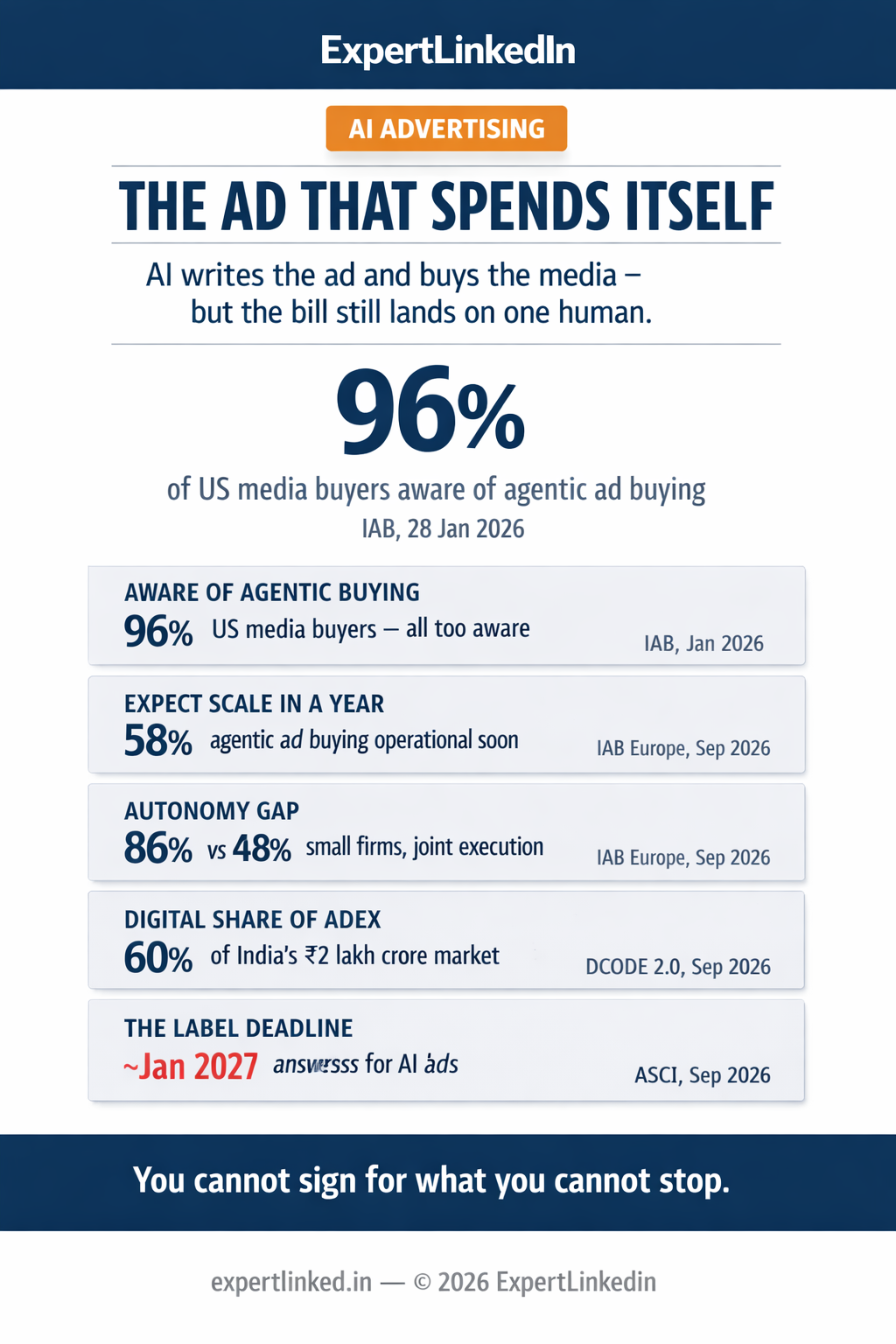
In 2026 that silence got a price tag. India has crossed into a digital-majority advertising economy: total ad spend is on track for ₹2 lakh crore, with digital now 60 per cent of it (DCODE 2.0, September 2026). More Indians now use an AI platform than shop online. The machine has moved into both rooms of the ad business — the room where the creative gets made and the room where the money gets spent. It just has not moved into the room where somebody signs for it. And on 29 September 2026, India’s advertising watchdog made that signature mean something.
First, give the machine its due #
This is not a story about robots fumbling your money. The tools work, and the demand is real. The IAB’s 2026 Outlook Study has US ad spend growing 9.5 per cent this year, with five of buyers’ top six priorities now AI; two-thirds are focused specifically on agentic buying and campaign execution, and 96 per cent are at least aware of it (IAB, January 2026). In Europe, 86 per cent of marketers use AI and 58 per cent expect agentic ad buying to reach operational scale within a year (IAB Europe, September 2026). Google’s AI Max and Meta’s Advantage+ already run targeting, bidding, creative and budget pacing; behind them sit standalone agents, and a newer layer — agent-to-agent buying — where your agent negotiates with a publisher’s agent in fractions of a second. DoubleVerify’s DV Neura can verify and act, in the company’s own phrasing, “without a human making a single click” (ppc.land, June 2026).
The honest headline is not “AI is coming to advertising.” It is already here. The question is who is left holding the decision.
The signature is becoming a formality #
The industry knows this, and believes it has the answer. At Advertising Week in October, Omnicom Media’s chief investment officer said agents would reshape media buying, but “commercial authority — negotiations, client commitments, governance — remains largely in human hands” (Beet.TV, October 2026).
Read that again. What stays human is the negotiation and the sign-off. What is being automated is everything that prepares the sign-off: the analysis, the plan, the optimisation, the creative. That is backwards. Judgment is built by doing. Automate the drafting, the testing and the pacing, and the human is left with a rubber stamp and a vague sense of guilt.
The agencies are already admitting the risk out loud. Reporting on how Carat, NBCUniversal, Dentsu and WPP Media are governing these systems, the trade press landed on the clean distinctions: a media plan can be analysed in seconds without granting software the authority to commit budget; a probabilistic recommendation is not the same as deterministic execution; oversight is “a sliding scale” (ContentGrip, October 2026). One line from that reporting should be printed above every media buyer’s desk: an agent that buys faster “is not automatically an agent that buys better.”
Which leaves one question — the only one that matters: at what point does a human have to approve before the money moves? For most Indian businesses in 2026, the honest answer is: we never decided. The platform decided for us.
The Indian rulebook just put your name on the bill #
Now add the compliance layer, because that is where “authority must match responsibility” stops being philosophy and turns into a date.
ASCI’s new guidelines are risk-based. Some AI advertising is banned outright — fabricated endorsements, deepfakes of real people, a synthetic “doctor” promoting supplements. Some must carry a clear label: virtual influencers, AI-generated product-performance visuals, realistic fake settings, “sponsored by” AI suggestions. And some — routine colour correction, plain copy — needs nothing at all (ET BrandEquity, May 2026). The rules were released on 29 September and take effect three months later, so the deadline lands around the new year.
The detail that matters is who answers. Even a correct label does not rescue a misleading ad — the “responsibility remains with advertisers to ensure that the end communication is honest, transparent and compliant,” ASCI’s chief executive said (MediaNama, October 2026). In many Indian businesses, the creative that now needs a compliance judgment and the media that now gets optimised by an agent are produced and placed by a tool, a freelancer or an agency — while the brand carries the legal and reputational weight. There are also two overlapping rulebooks: ASCI triggers on whether content “could mislead a buyer”; the IT Rules trigger on whether it is AI-generated at all. An AI ad can be platform-labelled but not brand-labelled, or the reverse, and whether a platform label satisfies ASCI is unresolved. That is not a checklist. It is a judgment somebody has to own — and right now, often nobody does.
The gap is widest where the market grows fastest #
Here is the number that should bother every small advertiser. IAB Europe found that 86 per cent of organisations with 500-plus staff have reached a level where people and agents plan, delegate and execute together — against just 48 per cent of smaller firms (IAB Europe, September 2026). Governance, in other words, is a fixed-cost capability. It scales with how many people you can put around it.
In India, growth is concentrated, not broad: retail media, quick commerce, connected TV — the channels where the smallest brands are spending for the first time (ET BrandEquity, September 2026). The MSME takes the platform’s default automation because the default is free and writing a ceiling is not. I said in October that your next customer is a machine (my October piece). This is the other half of that trade: the seller’s agent spends your budget while you cannot name the person who told it to.
What I would write down before January #
None of this argues for less AI. It argues for what the disciplined teams already do — governed autonomy. Five lines, one page, signed by a human:
- Name the owner. Not a department. A person who answers for what the agent does, including on a Sunday.
- Separate “may recommend” from “may execute.” Recommendation is cheap to reverse; execution is not. Grant them separately.
- Set the thresholds. At what spend, in which categories, on which creative does a named human have to approve before the money moves?
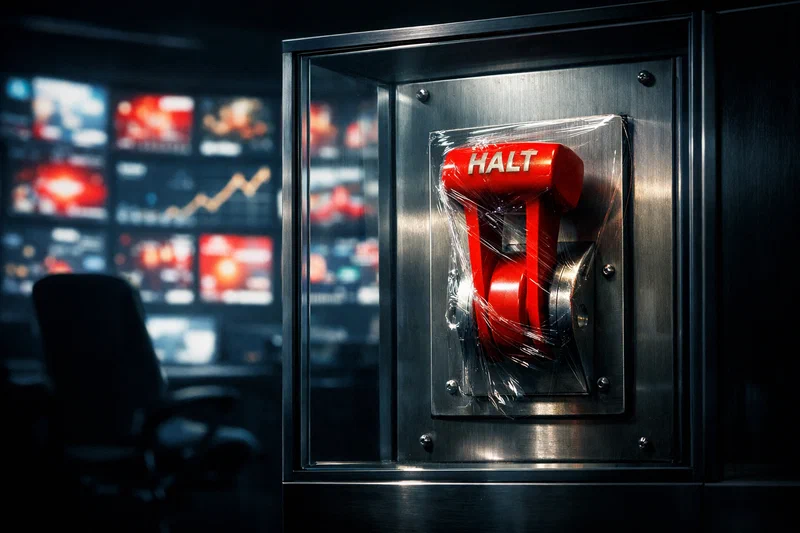
- Keep a kill switch, and test it. An override you have never once pulled is a promise, not a control.
- Keep the record. What the agent recommended, what was approved, how the result did. Attribution is not accountability; a dashboard that improved is not an audited outcome (Platformance, August 2026).
The honest limit: not every small Indian business has the leverage to demand this of a platform or an agency. Many will accept the default because the default is what they can afford. That constraint is real, and pretending otherwise would be its own kind of slop.
But the market has not finished moving. My colleague Jackson Rodriguez set out a four-question decision-rights agreement for teams on November 16 — the same logic, one floor up. On Friday, Olivia Bennett takes the human side: what to do when you are accountable for an AI decision you cannot override.
You cannot sign for what you cannot stop #
AI has not taken the marketer’s job. It has taken the marketer’s authority — quietly, one automated step at a time — while leaving the marketer’s name on the work. That is a worse trade than it sounds, because advertising was always a business of owning the message. Now the message writes and places itself, and the rulebook has started to name the advertiser as the responsible party.
So the founder’s task this quarter is not choosing a better ad tool. It is answering one question honestly: if the machine spends the money and the machine makes the ad, who can stop it when it is wrong?
Attribution is not accountability. The dashboard is the praise; the record is the allocation. Before January, write down who owns the AI in your ad budget. Because you cannot sign for what you cannot stop.
If you run advertising in India, I would like to see your one-page version of that memo — or hear the line you could not answer. Who in your business can actually stop an AI campaign mid-flight?
Email me at raj.sharma@tlnw.uk
References #
- IAB Europe (September 24, 2026). “Agentic Ad Buying Gains Ground: IAB Europe Report Finds Over Half of Industry Expect Operational Scale Within a Year.” https://iabeurope.eu/news-impact-of-ai-report-2026/ (Accessed November 17, 2026)
- IAB (January 28, 2026). “2026 Outlook Study: A Snapshot of U.S. Ad Spend, Opportunities, and Strategies for Growth.” https://www.iab.com/insights/2026-outlook/ (Accessed November 17, 2026)
- ContentGrip (October 9, 2026). “Carat and agency peers put human oversight at center of AI media buying / How agencies are governing AI media buying.” https://www.contentgrip.com/agency-ai-media-buying-oversight/ (Accessed November 17, 2026)
- Beet.TV (October 14, 2026). “AI Agents will ‘Reshape’ Media Buying, but Humans Still Set the Agenda.” https://www.beet.tv/2026/10/ai-agents-will-reshape-media-buying-but-humans-still-set-the-agenda.html (Accessed November 17, 2026)
- ppc.land (June 2026). “Agentic ad tech tries to take over the buying layer as AI search budgets surge.” https://ppc.land/agentic-ad-tech-tries-to-take-over-the-buying-layer-as-ai-search-budgets-surge/ (Accessed November 17, 2026)
- Platformance (August 6, 2026). “Media Accountability in the Age of AI: What CMOs Must Know Now.” https://www.platformance.io/post/media-accountability-in-the-age-of-ai (Accessed November 17, 2026)
- MediaNama (October 6, 2026). “India’s new AI ad labelling guidelines: What brands must disclose and when AI content counts as an ad.” https://www.medianama.com/2026/10/223-asci-ai-labelling-guidelines-advertising-2026/ (Accessed November 17, 2026)
- ET BrandEquity (May 12, 2026). “ASCI Proposes New Rules for AI-Generated Ads, Introduces Risk-Based Labelling System.” https://brandequity.economictimes.indiatimes.com/news/research/advertising/asci-proposes-new-rules-for-ai-generated-ads-introduces-risk-based-labelling-system/131035059 (Accessed November 17, 2026)
- ET BrandEquity (September 18, 2026). “Digital captures 60% of India’s ad spend as total AdEx set to cross Rs 2 lakh crore in 2026: Report.” https://brandequity.economictimes.indiatimes.com/news/research/digital-captures-60-of-indias-ad-spend-as-total-adex-set-to-cross-rs-2-lakh-crore-in-2026-report/134328236 (Accessed November 17, 2026)
- Digital Applied (June 30, 2026). “Agentic Advertising in 2026: The AI Ad-Ops Playbook.” https://www.digitalapplied.com/blog/agentic-advertising-2026-ai-ad-ops-playbook (Accessed November 17, 2026)
- PubMatic (January 14, 2026). “AI Advertising Explained: How Agentic Systems Are Changing Media Buying and Why Trust Matters.” https://pubmatic.com/blog/ai-advertising-explained-how-agentic-systems-are-changing-media-buying-and-why-trust-matters/ (Accessed November 17, 2026)
- ExpertLinked (October 27, 2026). “Your Next Customer Is a Machine: India’s Q4 2026 Agent-Readiness Test.” https://expertlinked.in/posts/2026-10-27-your-next-customer-is-a-machine-indias-q4-2026-agent-readiness-test/
- ExpertLinked (November 16, 2026). “How to Set AI Decision Rights for 2027 With a 4-Question Team Agreement.” https://expertlinked.in/posts/2026-11-16-how-to-set-ai-decision-rights-for-2027-with-a-4-question-team-agreement/
AI Content Notice
This article was created using artificial intelligence technology. Whenever possible, we include references and sources to support the information presented. Readers are encouraged to consult these sources for further information. While we strive for accuracy and provide valuable insights, readers should independently verify information and use their own judgment when making business decisions. The content may not reflect real-time market conditions or personal circumstances.
Related Articles
Infographic: Who Owns the AI in Your Ad Budget? The Decision Rights Nobody Wrote Down
AI now writes the ad and buys the media — but the bill still lands on one human. In 2026 …
Your Next Customer Is a Machine: India's Q4 2026 Agent-Readiness Test
Your next customer’s shortlist is now written by an AI agent. India’s festive season is …
Timing Beats Volume: Why India's Festive AI Marketing Boom Is a Scorecard Illusion
AI made marketing output cheap and infinite, but attention, trust, and cash are not. As Diwali 2026 …