What Julie Zhuo's Move Into Management Teaches About Learning a New Role in 2027

The hardest part of a promotion is rarely the work you are now accountable for. It is admitting what the new title quietly assumes you already know.
Julie Zhuo was 25 when she found out. She had joined Facebook in 2006 as its first intern (Wikipedia, accessed Nov. 13, 2026), moved into product design, and for three years had worked in what she called “ask me to do whatever needs doing” mode. Then one day her manager — who had been managing for barely a year herself — told her more designers were about to start and she needed help. “You get along with everyone,” Zhuo remembers her saying. “You’re pretty friendly.” Zhuo said yes on the spot: “I was also in the mentality of yes, of course, I’ll do everything I can to help the team” (Harvard Business Review, The Challenges (and Triumphs) of a Young Manager, Aug. 20, 2019).
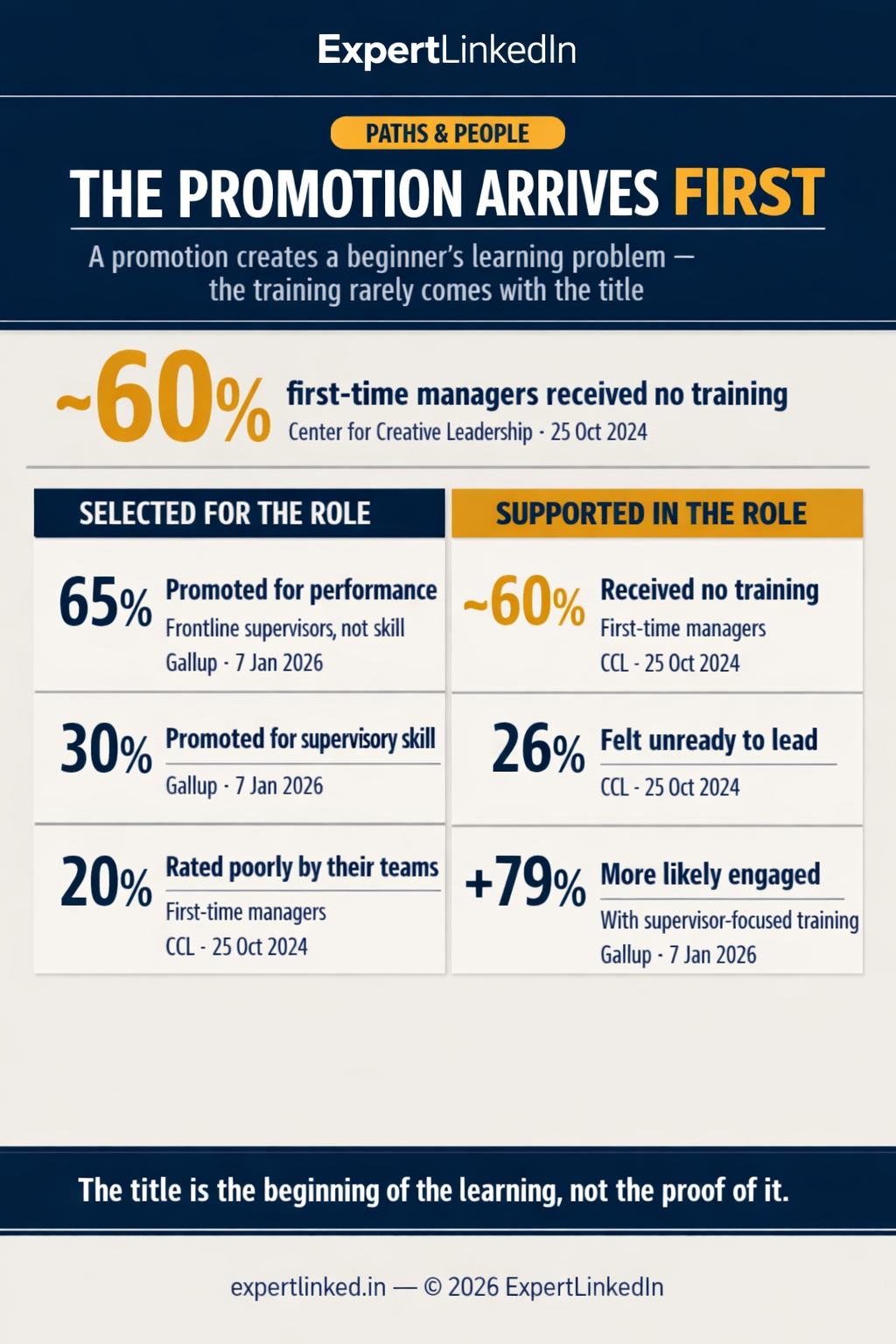
What she got with the title was a job — not a training plan. By her own account, she “didn’t get much guidance on being a first-time manager.” Almost 60% of first-time managers say the same: they never received any training when they stepped into their first leadership role. Another 26% say they did not feel ready to lead at all (Center for Creative Leadership, “12 Common Challenges of New Managers,” Oct. 25, 2024).

That is the thing about a promotion: it creates a beginner’s learning problem. The role arrives, the skill does not, and — more often than the org chart admits — neither does the feedback. Zhuo’s path is not a template to copy; her access was exceptional, and almost nobody gets her exact runway. But it is a clean case study in the honest work a new role demands: figure out what it is actually asking you to learn, and find the feedback you need, even when no one hands it to you.
The Job Changes Before the Person Does #
Zhuo’s first one-on-one as a manager was with a report who “yesterday was a peer of mine” — someone she “really looked up to” and “considered a lot more talented frankly as a designer than myself.” She read the room as, “I don’t know what you can really offer me,” and privately thought the same: “what have I gotten myself into?” (HBR IdeaCast).
The instinct she had then is the one almost every new manager has, and it is the wrong one. “I tried to emulate that image in my mind of the successful manager,” she said, “and as a result, I always felt like … I was maybe playing a role of sorts.” When she didn’t know an answer, she invented one and delivered it confidently. It took her a long time to “learn another way” (HBR IdeaCast).
Her later writing makes the pattern explicit. “At each of these points, Zhuo felt like she had an entirely different job,” she wrote in Harvard Business Review, describing how her team doubled every few years and each doubling demanded a new style — from doing the work to enabling it (HBR, Mar. 13, 2019). Management is not one skill you acquire once. It is a series of roles wearing the same title.
This is not only Zhuo’s story. Gallup found that 65% of frontline supervisors were promoted for their performance as an individual contributor, not their supervisory skill — and that those promoted for performance were less engaged than those promoted for leadership capability (Gallup, “When Good Frontline Workers Make Bad Supervisors,” Jan. 7, 2026). CCL names the same fault line: the “identity shift” from doing the work yourself to leading others in doing theirs, the hardest part of which is leading people who used to be your peers.
What the New Role Is Actually Asking You to Learn #
Here is the move most people skip. When responsibilities change, the instinct is to prove you can handle them. The better first step is to write down what the role is asking you to do differently — then name which of those things you cannot yet do well.
For a new manager, the list is predictable. CCL’s research on nearly 300 emerging leaders ranks the recurring challenges: leading former peers, balancing the new workload, delegating and building trust, giving feedback, and coaching (CCL, 2024). None of that is taught by the work that got you promoted. That is the whole problem.
Zhuo’s clearest regret points at the same gap. “One of my biggest regrets is not being honest about what I didn’t know,” she said. “At that time, I lacked the confidence to admit my gaps in knowledge.” She wished she had simply told the talented designers around her: What you’re doing is amazing. Could you teach me? I’ve never learned this before (Founder Things, “Interview: Julie Zhuo,” Mar. 26, 2024).
Notice that this is the opposite of the confident-manager performance she was imitating at 25. The learning starts with a sentence that feels like a confession: I don’t know how to do this yet. What matters is that it names a behavior — “I want to get better at giving direct feedback in a one-on-one” — rather than a mood like “I want to be a better leader.” A goal you cannot observe cannot be practised.
The Feedback You Have to Go Get #
The other half of Zhuo’s learning was not a course. It was a relationship.
Years into managing, one of her reports — she calls him Robyn — told her that when she was under pressure, “he felt I prioritized projects over people.” It stung, and it changed her: “that feedback led to a lot of soul-searching.” Her conclusion is the least glamorous sentence in her book and the truest: “you need to genuinely care about your people to be a great manager. There is no way to fake the caring” (Founder Things, 2024).
Some of that feedback she arranged herself. She built check-ins so she could “deeply understand [her reports’] values, their fears and their hopes” (CNBC Make It, Apr. 25, 2019). And when she later started the company Sundial and found herself in a role with no map at all, she ran the same loop: her mantra became “just try stuff,” and she “asked more and more dumb questions” of engineers, data leaders, her co-founder, and clients. What she trusted was not certainty but a designer’s process — try, gather feedback, iterate, refine (Founder Things, 2024).
That is a feedback source, and it has a shape: a named person and a recurring cadence, not “whenever I have a question.” It is also the rarest field in any development plan. When my colleague Jackson Rodriguez laid out a five-field 2027 plan this week — the skill, the practice task, the calendar allocation, the feedback source, and a chance to apply it — the feedback field was the one almost nobody can name (How to Build a Career Development Plan for 2027 With Learning Time at Work, Nov. 9, 2026). Zhuo’s story shows why: that field is usually something you build, not something you inherit with the promotion.
The Part the Polished Version Leaves Out #
There is a version of this story that flatters everyone: brilliant young designer gets tapped for leadership, has a wobble, writes the definitive guide. Zhuo has punctured it herself.
“The story feels much tidier — it looks like a natural progression of growth and achievement,” she said. “But it was really years and years of being afraid.” She spent those years feeling like an outsider — “the engineer among designers” with no real design background — and stayed at Facebook for 14 years before leaving to build Sundial (Founder Things, 2024). Her path also carried advantages most readers do not have: the first intern at a once-in-a-generation company, a Stanford degree, an unusually long runway, and a network that later made a funded startup possible.
She has been blunt, too, about the gap between knowing and doing. Writing her book was “aspirational,” she said, because “there’s always this gap where I know theoretically what should be done, but I haven’t mastered executing it effectively myself” (Founder Things, 2024). Copy the mechanism, in other words. Do not copy the outcome, and do not assume the runway.
The Other Half of the Lesson: Effort You Choose #
If her first book, The Making of a Manager, is about the craft of management (author site, juliezhuo.com), her later writing is about why the effort is worth making. In “Our Souls Need Proof of Work,” Zhuo argues that comfort quietly hollows us out — and that voluntary difficulty, not reward, is what makes us feel alive. “Growth demands focus, alertness, and perseverance,” she writes. “We must embrace mistakes and grind through the hard” (The Looking Glass, Mar. 10, 2025).
The line that matters most for a career in transition: “Don’t work hard for the money, or the promotion, or the accolades. All of that fades.” A promotion borrowed only for the reward will not survive the learning it requires. The effort has to be something you choose, because the reward arrives too slowly to carry you through the awkward first year.
She Is Still Doing It #
The most useful detail in the record may be the most recent. In October 2026, Meta acquired Sundial — the data-analytics company Zhuo co-founded in 2021, which had raised $23 million including a $16M Series A led by the former U.S. chief data scientist DJ Patil (Sundial, July 8, 2025) — and she and her co-founder Chandra Narayanan are rejoining Meta as part of the deal (Axios, via Yahoo Finance, “Exclusive: Meta acquires AI data platform Sundial,” Oct. 23, 2026; acquisition details corroborated by Crypto Briefing, Oct. 24, 2026).
Read that plainly: the person who wrote the book on growing into management is, right now, walking into another new role. Learning a new job is not a phase you complete after one promotion. It is a behavior you return to every time the job changes — which, for most of us, is roughly every couple of years.
What to Do Before 2027 Planning Locks #
Before the year ends, most readers will be planning next year’s development. Zhuo’s path suggests a narrower exercise than listing courses. Three moves:
- Name what the role is asking you to learn — as a behavior. Not “get better at leadership.” Something like run a one-on-one that ends with one clear commitment. If you cannot picture yourself doing it, it cannot be practised.
- Say the awkward sentence out loud. What crushed Zhuo’s early years was hiding what she didn’t know. Pick the person most likely to tell you the truth, ask them to teach you the specific thing, then ask them to watch you try it — and tell you what to change.
- Put the first attempt on a real deliverable with a date. A skill practised only in theory is a receipt. Name the meeting, the review, or the document where the new behaviour has to perform — and the date you will judge whether it did.
And one honest limit, because it matters. Not everyone is promoted into a role they were ready for, and not everyone gets a manager with time to coach them. If your organisation cannot give you the feedback cadence you need, that is information, and it belongs in your 2027 plan, not your self-doubt.
Zhuo wrote a whole book partly to keep thinking about what she was still learning — “if I write a book,” she said, “I’m going to be thinking about these topics all day long” (Founder Things, 2024). You do not need the book. You need the sentence — the admission of what you don’t yet know — and one person willing to hear it.
The title is the beginning of the learning, not the proof of it.
Have you been promoted into a role that arrived before the skill did? I would like to hear what you had to learn, and who actually taught you — the most useful Paths & People stories begin with a new title and an honest gap.
Email me at olivia.bennett@tlnw.uk
References #
- Axios (October 23, 2026). “Exclusive: Meta acquires AI data platform Sundial,” via Yahoo Finance. https://finance.yahoo.com/technology/ai/articles/exclusive-meta-acquires-ai-data-205220376.html (Accessed November 13, 2026)
- Center for Creative Leadership (updated October 25, 2024). “12 Common Challenges of New Managers.” https://www.ccl.org/articles/leading-effectively-articles/first-time-managers/ (Accessed November 13, 2026)
- Connley, C. (April 25, 2019). “Facebook VP shares her top advice for getting promoted.” CNBC Make It. https://www.cnbc.com/2019/04/25/facebook-vp-shares-her-top-advice-for-getting-promoted.html (Accessed November 13, 2026)
- Crypto Briefing (October 24, 2026). “Meta acquires AI data platform Sundial.” https://cryptobriefing.com/meta-acquires-ai-data-platform-sundial/ (Accessed November 13, 2026)
- Founder Things (March 26, 2024). “Interview: Julie Zhuo.” https://founderthings.substack.com/p/founder-things-julie-zhuo (Accessed November 13, 2026)
- Gallup (January 7, 2026). “When Good Frontline Workers Make Bad Supervisors.” https://www.gallup.com/workplace/700163/when-good-frontline-workers-make-bad-supervisors.aspx (Accessed November 13, 2026)
- Harvard Business Review (March 13, 2019). Julie Zhuo, “As Your Team Gets Bigger, Your Leadership Style Has to Adapt.” https://hbr.org/2019/03/as-your-team-gets-bigger-your-leadership-style-has-to-adapt (Accessed November 13, 2026)
- Harvard Business Review (August 20, 2019). “The Challenges (and Triumphs) of a Young Manager.” HBR IdeaCast podcast. https://hbr.org/podcast/2019/08/the-challenges-and-triumphs-of-a-young-manager (Accessed November 13, 2026)
- Sundial (July 8, 2025). “Sundial Raises $23M to Redefine Data-Informed Decisions With AI.” BusinessWire, via FinancialContent. https://www.financialcontent.com/article/bizwire-2025-7-8-sundial-raises-23m-to-redefine-data-informed-decisions-with-ai (Accessed November 13, 2026)
- Wikipedia. “Julie Zhuo.” https://en.wikipedia.org/wiki/Julie_Zhuo (Accessed November 13, 2026; used for chronology only)
- Zhuo, J. (2019). The Making of a Manager: What to Do When Everyone Looks to You. Penguin Random House. Author site: https://www.juliezhuo.com/book/manager.html (Accessed November 13, 2026)
- Zhuo, J. (March 10, 2025). “Our Souls Need Proof of Work.” The Looking Glass. https://lg.substack.com/p/the-looking-glass-our-souls-need (Accessed November 13, 2026)
- ExpertLinked (November 9, 2026). Jackson Rodriguez, “How to Build a Career Development Plan for 2027 With Learning Time at Work.” https://expertlinked.in/posts/2026-11-09-how-to-build-a-career-development-plan-for-2027-with-learning-time-at-work/ (Accessed November 13, 2026)
AI Content Notice
This article was created using artificial intelligence technology. Whenever possible, we include references and sources to support the information presented. Readers are encouraged to consult these sources for further information. While we strive for accuracy and provide valuable insights, readers should independently verify information and use their own judgment when making business decisions. The content may not reflect real-time market conditions or personal circumstances.
Related Articles
Infographic: What Julie Zhuo's Move Into Management Teaches About Learning a New Role in 2027
Julie Zhuo was made a manager at 25 with no training and, in her own words, no idea what she was …
My Manager Approved Training but Keeps Cancelling Learning Time—What to Agree for 2027
Your manager approved the course — then cancelled every practice block. Training access and learning …
My Job Responsibilities Changed Without a Conversation—What to Agree for 2027
Your role grew an AI-coordination duty or another function while the old job stayed — and no one …