Deep Dive: The Judgment Premium — Why Decision Quality Is Becoming the Last Unautomatable Career Skill

Most professionals right now are trying to get faster. That is the wrong optimization.
In a market where AI has collapsed the marginal cost of knowledge-work execution to nearly zero, the professionals commanding the fastest career acceleration are not the ones who produce the most. They are the ones who consistently make better decisions under uncertainty—who know when they are right, when they are likely wrong, and how confident to be before the outcome is clear.
This is called calibration. It is distinct from expertise, intelligence, and experience, though it can draw on all three. It is a practiced skill that most professionals have never deliberately developed. And in 2026, it is quietly becoming the scarcest professional asset in the market.

The decision quality crisis no one is measuring #
The AI-saturated workplace has given organizations a problem they did not anticipate. Output is now nearly free. Polished analysis, first-draft strategies, competitor summaries, performance reviews — all of it can be generated in seconds. The problem is not the volume. The problem is that the volume is plausible. It reads like it was verified when it wasn’t. It looks like expert analysis when the underlying logic is sometimes coherent noise.
BetterUp Labs surveyed 1,004 U.S. desk workers in September 2025 and found that 54% of managers had received “workslop” — polished, plausible, AI-generated content that was ultimately useless — in the past month. Almost half said the sender seemed less creative, capable, and reliable afterward. Forty-two percent said they trusted the sender less (BetterUp, September 29, 2025).
Atlassian’s State of Teams research, surveying 12,035 global knowledge workers in early 2026, found that 87% said AI-speed output had left them without the capacity to coordinate, align, or make sense of what was being produced around them (Atlassian, April 27, 2026). The fragmentation tax — the organizational cost of reviewing, reconciling, and deciding on work produced faster than it can be absorbed — costs Fortune 500 companies an estimated $161 billion annually. Eighty-nine percent of executives agree AI has accelerated execution. Only 6% can point to clear organizational-level returns.
The gap between those two numbers is a decision problem. Organizations are not failing to produce more work. They are failing to make better decisions faster than the volume of plausible-looking work demands.
McKinsey’s May 2026 analysis of AI adoption across Europe reaches the same conclusion at the macro level: nearly 90% of companies use AI regularly, but fewer than 40% see measurable bottom-line results (McKinsey Global Institute, May 12, 2026). The bottleneck is not capability. It is the ability to judge which AI-generated output to trust, which decisions it should inform, and which require human override.
This is the decision quality crisis. And most career advice has completely missed it.
What judgment actually is #
The word “judgment” gets used loosely in professional contexts to mean almost any combination of experience and instinct. The research on expert judgment is more precise.
Philip Tetlock’s landmark 20-year study of expert prediction, published as Superforecasting: The Art and Science of Prediction (Crown, 2015), identified a specific trait that distinguished the most accurate forecasters from the rest: calibration. Calibrated forecasters know what they know and what they don’t. They can state their confidence levels as rough probabilities, and those probabilities correspond to actual outcomes — when they say they are 70% confident, they are right about 70% of the time.
Expertise alone does not produce calibration. Tetlock’s most counterintuitive finding was that domain experts — people with deep knowledge in a specific area — were often less calibrated than talented generalists. The experts knew more, but they were more confident, and their confidence exceeded their accuracy. The forecasters who outperformed them held their knowledge more loosely and updated it more readily.
Daniel Kahneman’s Noise: A Flaw in Human Judgment (2021), co-authored with Olivier Sibony and Cass Sunstein, identified a related problem: most organizations have enormous noise in their decision-making — variability in judgments made by different people under identical conditions — without ever measuring it. Two managers evaluating the same employee performance review reach systematically different conclusions. Two analysts reviewing the same acquisition target disagree by 41%. The difference is not bias alone. It is variance. And most organizations have never measured their own variance because doing so is uncomfortable.
These two research traditions together define the judgment problem: most professionals do not know how accurate their predictions are (calibration failure), and most organizations do not know how variable their decisions are (noise failure). AI makes both problems worse in specific, important ways.
How AI changes the judgment problem #
Large language models are excellent at pattern-matching against training data and generating fluent, coherent explanations. They are systematically poor at one specific thing: knowing when they do not know.
This is not a minor limitation. It is structurally consequential for organizations using AI as an analytical tool. When a human expert is uncertain, behavioral signals often reveal it: hesitation, hedged language, explicit disclaimers. When an AI model is uncertain, its output often looks identical to when it is confident and correct. The confidence is baked into the prose, not derived from underlying probability estimates.
The practical implication: organizations that outsource their analysis to AI while delegating human time to implementation rather than review are systematically importing overconfident errors. The executives who understand this are not the ones saying “we should use AI less.” They are the ones investing heavily in the people who can audit AI output effectively — who know enough to ask “what would this analysis look like if it were wrong?” before acting on it.
Indeed’s June 2026 labor market data gives the structural frame for why this matters for individual careers. Hiring and separations have both sunk to levels not seen since 2013 (Indeed Hiring Lab, June 18, 2026). Job growth continues, but almost entirely because workers are staying put rather than because employers are actively bringing in new people. In a market this tight, internal advancement and perceived judgment quality — not raw output — is increasingly where career trajectories are decided.
The professionals advancing fastest are not the ones demonstrating the most productivity. They are the ones demonstrating the most reliability: the consistent track record of being right about important things, and honest about what they do not know.
The four judgment traps #
Before the calibration protocol, the traps. Most professionals lose decision quality in one of four predictable ways.
Trap 1: Confirmation capture. You use AI to research a decision you have already implicitly made. The model, trained on the internet’s existing corpus, tends to produce output that is statistically representative of what most sources say — which is often what you already believed. The analysis feels like independent research. It is reflection. The tell: when you cannot name a serious argument against your conclusion that you have genuinely engaged with.
Trap 2: The precision illusion. Detailed, well-formatted AI output reads as rigorous analysis even when the underlying logic is weak. A five-part framework with numbered subheadings and a summary table looks more credible than a messy genuine insight. Most people know this intellectually. Almost nobody is immune to it in practice. The tell: when you judge the quality of an analysis by its visual organization rather than its underlying logic and evidence.
Trap 3: Speed pressure. The AI-accelerated workflow creates structural pressure to move faster than the situation requires. When analysis that took three days now takes thirty minutes, the implicit expectation is that decisions should move at the same pace. They should not. The decision-making time requirement has not shortened — only the research collection time has. The tell: when the time between receiving an analysis and committing to an action is shorter than the time required to identify the analysis’s most significant flaw.
Trap 4: Track record substitution. Because you used a sophisticated tool, you stop tracking your own hit rate. AI tools produce outputs with built-in confidence signals — summaries, structured conclusions, recommendation lists. These outputs substitute for the felt sense of “I committed to a judgment here, and I should follow up to see whether I was right.” The tell: when you cannot recall the last three significant predictions you made — what you expected to happen, and whether it did.
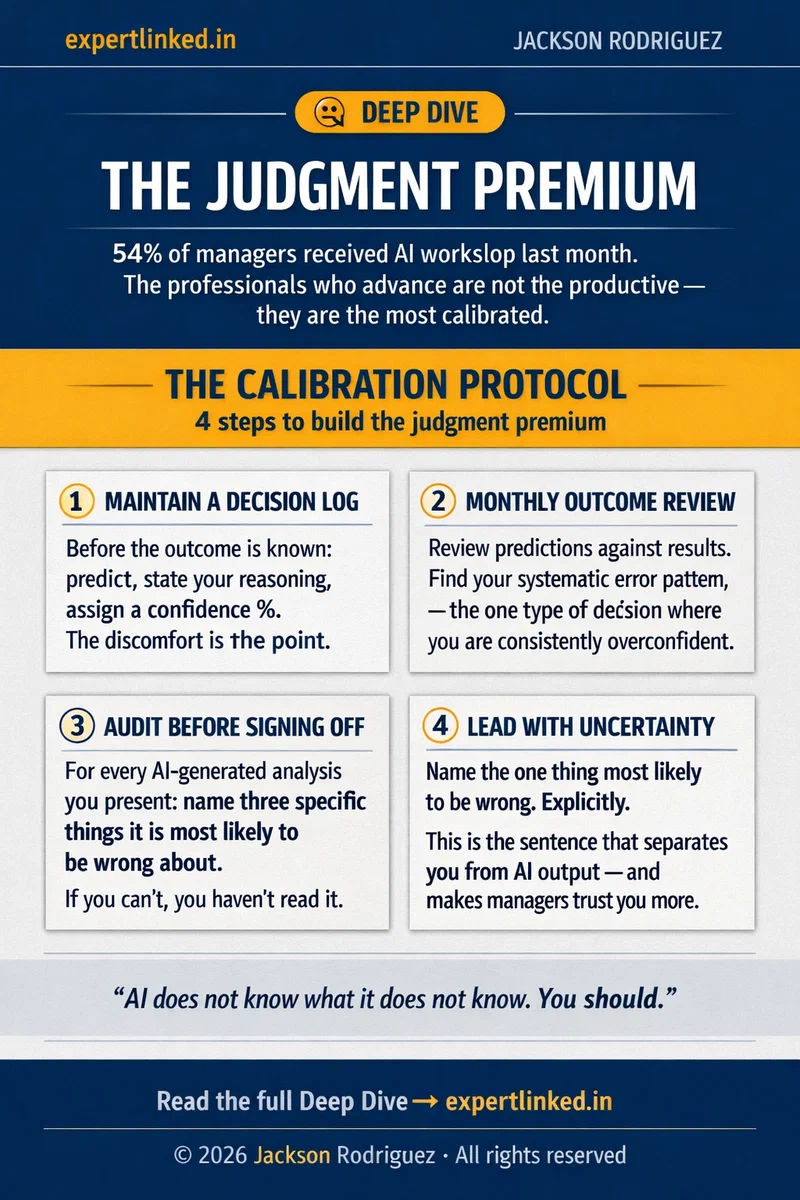
The calibration protocol #
Each of the four traps has a structural fix. Together, they constitute a calibration practice that builds the judgment premium over time.
1) Maintain a decision log #
Every significant judgment call — a recommendation to leadership, a resource allocation, a hiring assessment, a strategic bet — gets a three-line entry: the prediction (what do I expect to happen), the reasoning (why, in one or two sentences), and the confidence level (as a rough probability: 60%, 75%, 90%). This does not need to be elaborate. A running note file works. The discipline is completing the entry before the outcome is known.
Most professionals resist this because the prospect of being measurably wrong is uncomfortable. That discomfort is precisely why most professionals have never improved their calibration. The data is not punishment. It is the only feedback that builds the skill.
2) Run a monthly outcome review #
Once a month, review the previous month’s decision log entries against what actually happened. The goal is not to assign grades. It is to identify systematic patterns. Do you tend to overestimate your confidence when the decision involves personal stakes? When the analysis came from AI? When the timeline was tight? Patterns of systematic error are learnable and correctable. Random error is not. The distinction between them requires the log.
3) Audit before you sign off #
For any significant AI-generated analysis you are presenting or acting on, spend fifteen minutes asking one specific question: “What is this analysis most likely to be wrong about?” Write three specific answers — not “it might be incomplete,” but three specific claims, each with a reasoning pathway. This forces engagement with the assumptions and data quality behind the output rather than passive acceptance of its conclusions.
If you cannot identify three potential failure modes, you have not read the analysis carefully enough to present it. If you can identify three failure modes and are presenting the analysis without naming them, you are transferring to yourself reputational risk that belongs to the model.
4) Lead with your uncertainty #
The BetterUp research is unambiguous: in a workslop-saturated environment, managers trust senders more when they name explicit uncertainty, not less. This is counterintuitive to most professionals trained to project confidence.
The rule of thumb: any significant piece of work should include a one-line statement of the thing most likely to be wrong. Not “there are limitations to this analysis” — the specific thing.
“The Q3 pricing recommendation assumes the competitor’s current pricing reflects their sustainable margin. If they are subsidizing acquisition, this recommendation needs revision before implementation.”
That sentence takes ten seconds to write. It does not undermine the recommendation. It demonstrates that you have thought past the obvious case. It separates you from every AI-generated analysis that does not know what it does not know.
The career implication #
The labor market data does not suggest that 2026 is going to reward aggressive job-switching. Indeed’s June 2026 snapshot shows both hires and separations near 2013 lows — job growth running primarily because workers are staying put, not because employers are adding headcount at volume (Indeed Hiring Lab, June 18, 2026). In a tight-transition market, career advancement is primarily an internal competition.
Internal competitions are won by trust. Specifically, by the felt sense of a manager or senior leader that when you commit to a judgment, it tends to be right. That track record does not build by accident. It builds through the systematic habits described above.
The uncomfortable truth about calibration is that it takes a minimum of six months to begin producing meaningful feedback, and two to three years to build a genuine track record. Most people who read this will not start the decision log. Most who start it will not maintain it past the first month. The compound returns on calibration accrue almost entirely to the minority who sustain the practice long enough for the feedback to register.
The market is sorting between professionals whose value is execution — increasingly AI-substitutable — and professionals whose value is judgment — increasingly scarce, increasingly well-compensated. The gap between those tiers is not closing.
Start the log today.
References:
- BetterUp Labs (September 29, 2025). “The hidden costs of workslop: How AI-generated content is eroding workplace trust.” https://www.betterup.com/blog/hidden-costs-workslop (Accessed June 27, 2026)
- Atlassian (April 27, 2026). “State of Teams 2026.” https://www.atlassian.com/blog/state-of-teams-2026 (Accessed June 27, 2026)
- McKinsey Global Institute (May 12, 2026). “Agents, robots, and us: How AI reshapes work and skills in Europe.” https://www.mckinsey.com/mgi/our-research/agents-robots-and-us-how-ai-reshapes-work-and-skills-in-europe (Accessed June 27, 2026)
- Indeed Hiring Lab / Cory Stahle (June 18, 2026). “Strong Job Gains, Weak Hiring.” https://www.hiringlab.org/2026/06/18/strong-job-gains-weak-hiring/ (Accessed June 27, 2026)
- Tetlock, Philip E. and Gardner, Dan (2015). Superforecasting: The Art and Science of Prediction. Crown Publishers.
- Kahneman, Daniel; Sibony, Olivier; Sunstein, Cass R. (2021). Noise: A Flaw in Human Judgment. Little, Brown Spark.
- HBR / Fosslien, Liz and Duffy, Mollie West (May 25, 2026). “Managers are struggling to keep up with the AI productivity boom.” https://hbr.org/2026/05/managers-are-struggling-to-keep-up-with-the-ai-productivity-boom (Accessed June 27, 2026)
AI Content Notice
This article was created using artificial intelligence technology. Whenever possible, we include references and sources to support the information presented. Readers are encouraged to consult these sources for further information. While we strive for accuracy and provide valuable insights, readers should independently verify information and use their own judgment when making business decisions. The content may not reflect real-time market conditions or personal circumstances.
Related Articles
Infographic: Deep Dive: The Judgment Premium — Why Decision Quality Is Becoming the Last Unautomatable Career Skill
As AI floods organizations with plausible output, the professionals who advance are not the most …
Career Mechanics: The Player-Coach Manager Playbook – Why Coordination-Only Leadership Is Losing Value
The managers gaining leverage in 2026 are not the ones supervising more status updates; they are the …
Briefing Room: June 2026
June 2026 confirmed two things at once: AI is now a governance problem, not just a productivity …