What Anne-Laure Le Cunff's Move From Google to Neuroscience Teaches About Career Experiments for 2027

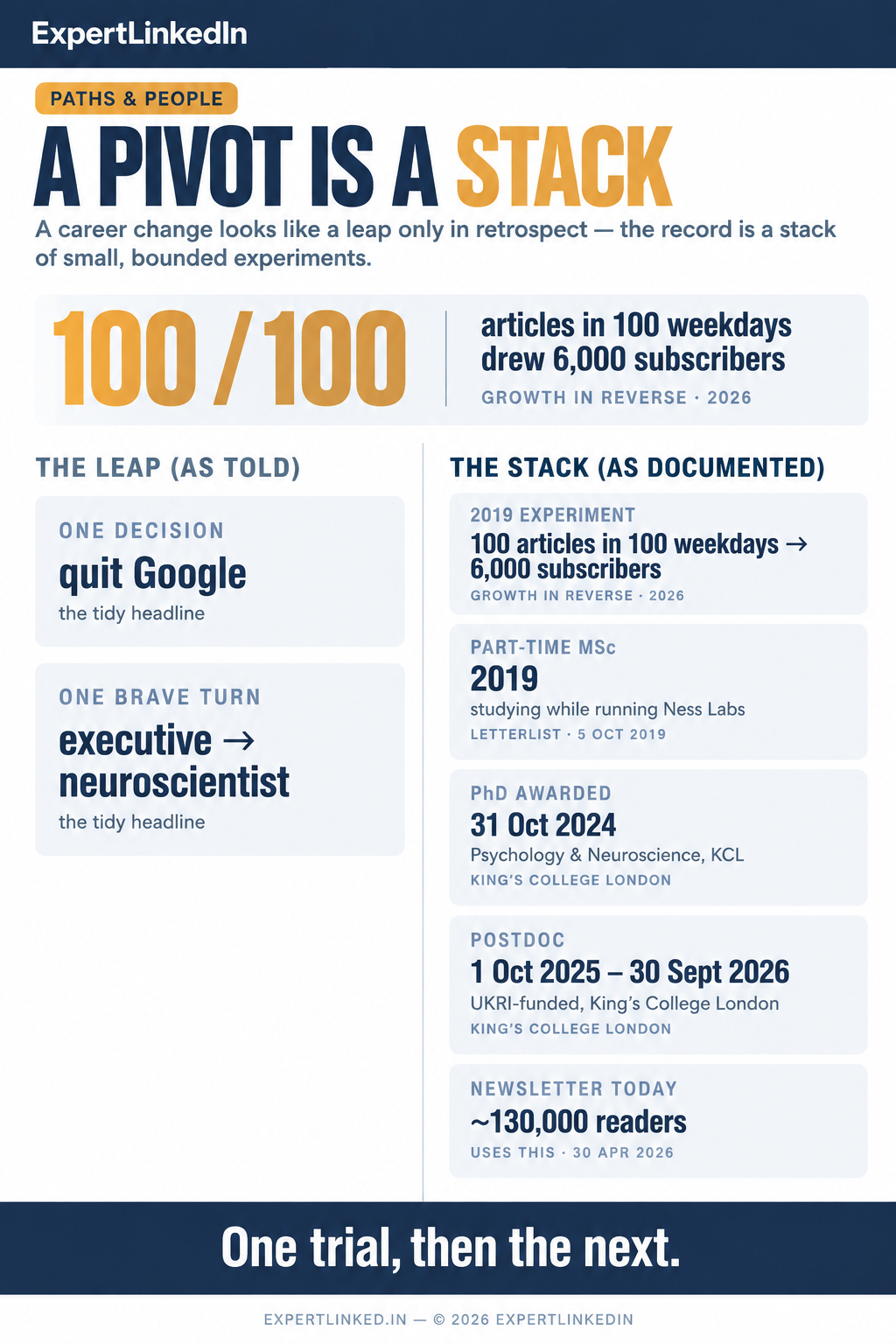
A career change looks like a leap only in retrospect. Anne-Laure Le Cunff’s move from Google to neuroscience is remembered as a single brave turn — the executive who walked away to study the brain — but the documented record is not one decision. It is a stack of small, bounded experiments, each cheap enough to run before she had to commit to anything.

That distinction matters more than her biography does. Most readers planning 2027 are not deciding whether to blow up a career. They are deciding whether a direction is worth investigating at all — and the useful lesson from Le Cunff’s public record is not “quit your job.” It is the smaller, harder question she now teaches: what is the cheapest experiment that would tell you something true?
The move that reads like a leap #
The tidy version of her story goes: executive on Google’s digital-health team, then neuroscientist, then founder of Ness Labs, then author of a bestselling book. Each arrow hides a period of overlap.
Her own career page lists the pieces plainly: Global Marketing Lead on Google Fit; founder and CEO of Ness Labs; and, at King’s College London, both a PhD in Psychology & Neuroscience and an MSc in Applied Neuroscience (anne-laure.net, accessed Nov. 27, 2026). The university’s research profile dates the PhD award to 31 October 2024 and a UKRI-funded postdoctoral fellowship to 1 October 2025 – 30 September 2026, working in Professor Eleanor Dommett’s ADHD Research Lab on the psychology and neuroscience of hypercuriosity (King’s College London research profile, accessed Nov. 27, 2026).
But the cleanest evidence that this was never a leap is a snapshot from October 2019. In a newsletter interview that year, she was already doing three things at once: running Ness Labs (“a studio where I create content and products to help makers achieve more without sacrificing their mental health”), writing the Maker Mind newsletter, and studying neuroscience part-time at King’s College London (Letterlist, updated Oct. 5, 2019). She had also lived and worked in New York, Tokyo and San Francisco before any of it.
Read that plainly: the pivot was a stack of overlapping commitments, not a resignation letter. And that is the version a reader can actually copy.
The experiment that started it #
The second career began as a self-interested learning experiment, and she has said so on the record. As a neuroscience student, she had discovered the generation effect — the finding that you understand and remember something better when you create your own version of it. So she turned her own study into a trial.
“I decided to run an experiment: I would write 100 short articles in 100 weekdays based on my studies, trying to turn a concept from neuroscience into something practical people could apply in everyday life” (Ness Labs, “The Illusion of Clarity,” April 8, 2026).
It worked — as an experiment, not as a plan. The writing forced her to confront what she only thought she understood, and the audience arrived as a side effect. Growth In Reverse, which traced the newsletter’s growth, put it this way: “After publishing 100 articles in 100 days, Anne-Laure drove 6,000 subscribers to her Maker Mind newsletter. It was the tiny experiment that kickstarted her newsletter journey” (Growth In Reverse, 2026). Her own summary of the method is almost aggressively unambitious: “I didn’t have a goal—I just committed to showing up every day for 100 days.”
Today that newsletter reaches around 130,000 readers, and the Ness Labs learning community has about 2,000 students (Uses This, April 30, 2026). The business was not the plan. It was what the experiment left behind.
The protocol: “I will [action] for [duration]” #
In a 2026 TEDx talk, she distilled the method into a single line. A tiny experiment, she says, is “a mini protocol where you just say: I will [action] for [duration]. That’s it.”
The details are the point. “This is not a habit. You’re not committing to this for the rest of your life. This is not a goal either. You’re not trying to get to a specific outcome. This is just an experiment. No targets, no success metrics, no illusion of certainty” (TEDxNashville, “How tiny experiments can set you free,” published Jan. 21, 2026).
Why strip out the goal? Because, as she puts it, “we don’t run experiments to get to a specific outcome. If we already knew the outcome, there would be no point running the experiment in the first place.” A trial is designed to produce information — a new data point about fit, energy, or interest — not a verdict.
That is a genuinely useful reframe for anyone staring at a 2027 plan. A goal you cannot yet justify (“become a researcher”) is a wish. A bounded trial (“I will shadow one research project for six weeks”) is something you can actually run, and something you can learn from even if the answer is no.
The part almost nobody copies: lateral experiments #
Here is where her framework gets counterintuitive. The most useful experiment is often the one that looks least like the destination.
In the same talk, she describes a man “stuck in a job that wasn’t right” who could not bring himself to plan an exit. Instead of attacking the problem directly, he ran an unrelated trial: “I will swim in cold water every morning for 10 days.” He discovered he could choose discomfort. Two weeks later, he resigned. Another person, unable to write a difficult letter to her father, took pottery classes for six weeks — and the messiness of clay slowly loosened her belief that everything had to be perfect, until she finally wrote it.
These are her illustrative examples, not her own life, and they are not evidence that cold water causes career clarity. But the mechanism she names is real: “if the problem is too painful to touch directly, experimenting with something completely different can be more effective than pushing through… By shifting your focus to a lower stake domain, your psychological defenses don’t get triggered.”
The uncomfortable implication: the trial does not have to resemble the new direction. Sometimes the point of a small, unrelated experiment is to find out whether you can tolerate the discomfort a change would require.
The uncomfortable truth she says herself #
This is the part that separates an honest profile from a motivational poster. Le Cunff does not pretend her experiment was free.
Asked directly why she left a good job at Google, she answered: “I felt like I wasn’t ready to settle for a corporate job, and I wanted to start my own thing. I was privileged to be in a situation where I could afford to take that risk” (Letterlist, 2019). She is equally clear about the cost on the other side: “the lack of stability and unpredictability in terms of revenue… a bit of a rollercoaster.”
She has even built a framework for the trade-off. In an essay on the “ambition trilemma,” she argues you generally cannot have all three of freedom, stability and wealth at once — you can pick two, and “we are surprisingly bad at identifying trilemmas in our own lives” (Ness Labs, “The ambition trilemma”).
So the honest lesson is not “anyone can do this.” It is: the mechanism transfers, the resources do not. A Google salary, a startup programme (she was an Entrepreneur First founder-in-residence), a funded doctorate, London, and a pre-existing audience of 130,000 are not universal. A career experiment is a way to sample a different point on the freedom/stability/wealth trade-off — but the sample has to be sized to your own runway, not hers.
Published, not proven #
One more caution, because it is the difference between a useful idea and a false promise. Her framework is now a book, Tiny Experiments: How to Live Freely in a Goal-Obsessed World (Penguin Random House / Profile Books, 2025), shortlisted for the Business Book of the Year Award and endorsed by Adam Grant, Cal Newport and Oliver Burkeman (publisher listing, Topping Books).
But endorsements are not evidence. One reviewer found it “written well enough” yet padded, with “far too many anecdotes and not enough detailed discussion of the practicalities of performing the suggested tiny experiments” (Richard Carter, July 24, 2025). The framework is her published method, not independent proof that a pivot will succeed.
The underlying principle, though, is not one influencer’s invention. Herminia Ibarra’s Working Identity, a standard reference on career change, makes the same argument from research: “common wisdom holds that we must first know what we want to do before we can act. Ibarra argues that this advice is backward. Knowing… is the result of doing and experimenting” (Herminia Ibarra, Working Identity, 2nd ed., HBR Press, 2023). Le Cunff supplies the accessible protocol and a documented life that followed it. Ibarra supplies the warrant.
She didn’t replace one identity with another #
The detail that most changes the story is where she ended up. She is not “a neuroscientist now” instead of “a businessperson then.” Her current self-description is explicitly hybrid: “I split my time between academic research and running a business” (Uses This, April 30, 2026).
That is a far more attainable model than the leap. The experiment did not swap one identity for another; it added a second one. For a reader weighing a change in 2027, that is the reassuring and the demanding part at once: you do not have to bet everything, but you do have to start somewhere small.
What to do before 2027 planning locks #
If you are building a development plan this quarter, Le Cunff’s record suggests three moves — none of which require quitting anything.
- Size the trial to your runway, not hers. Write down what you can actually afford to spend — hours, money, security — and design the experiment to fit inside it. A person with less runway runs a smaller, shorter, cheaper trial. That is not a lesser experiment; it is a correctly sized one.
- Write it as a bounded protocol. “I will [action] for [duration].” Choose a specific action and a specific end date. No targets, no success metrics — the output is information, not a verdict. And if the direct question feels too charged, run a lateral trial in a low-stakes domain instead.
- Feed the result into the plan. The experiment is not the plan; it is the practice task with a date that my colleague Jackson Rodriguez put at the centre of the five-field 2027 development plan. Name the skill, the rep, the time, the feedback source, and the chance to apply it — then let the trial tell you whether the direction deserves a bigger commitment.
And one honest limit, because it matters: not everyone can afford the same experiment, and a smaller trial is still a trial. The point of Le Cunff’s method is not that curiosity is free. It is that curiosity can be priced — and once you know the price, you can decide whether to pay it.
She did not find her direction by being brave at a crossroads. She found it by running something small, learning from it, and running the next thing. That is the whole method. One trial, then the next.
Have you run a small experiment that changed your direction — or are you trying to design one for 2027? I would like to hear what you tested and what it told you. The most useful Paths & People stories begin with a trial, not a leap.
Email me at olivia.bennett@tlnw.uk
References #
- Anne-Laure Le Cunff (accessed November 27, 2026). Public career record. https://anne-laure.net/
- Growth In Reverse (2026). “From 0 to 100K: The Science of Writing, Learning & Experimentation with Anne-Laure Le Cunff.” https://growthinreverse.com/anne-laure-le-cunff-018/
- Herminia Ibarra (2023). Working Identity: Unconventional Strategies for Reinventing Your Career, 2nd ed. Harvard Business Review Press. Book page: https://www.herminiaibarra.com/working-identity (Accessed November 27, 2026)
- King’s College London (accessed November 27, 2026). “Anne-Laure Le Cunff” research profile. https://kclpure.kcl.ac.uk/portal/en/persons/annelaure.lecunff/
- Le Cunff, A.-L. (April 8, 2026). “The Illusion of Clarity: How to Test Whether you Really Understand Something.” Ness Labs. https://nesslabs.com/illusion-of-clarity
- Le Cunff, A.-L. (January 21, 2026). “How tiny experiments can set you free.” TEDxNashville, transcript. Ness Labs. https://nesslabs.com/tiny-experiments-tedx-nashville-transcript
- Le Cunff, A.-L. (n.d.). “The ambition trilemma: freedom, stability, wealth.” Ness Labs. https://nesslabs.com/ambition-trilemma (Accessed November 27, 2026)
- Letterlist (updated October 5, 2019). “The (Maker) Mind of Anne-Laure Le Cunff.” https://letterlist.com/interviews/anne-laure-le-cunff/
- Ness Labs (accessed November 27, 2026). “Anne-Laure Le Cunff” author record. https://nesslabs.com/author/annelaure
- Richard Carter (July 24, 2025). “Book review: ‘Tiny experiments’ by Anne-Laure Le Cunff.” https://richardcarter.com/reviews/book-review-tiny-experiments-by-anne-laure-le-cunff/
- Topping Books (accessed November 27, 2026). “Tiny Experiments: How to Live Freely in a Goal-Obsessed World by Anne-Laure Le Cunff.” https://www.toppingbooks.co.uk/books/anne-laure-le-cunff/tiny-experiments/9781800819177/
- Uses This (April 30, 2026). “Anne-Laure Le Cunff.” https://usesthis.com/interviews/anne-laure.le.cunff/
- ExpertLinked (November 9, 2026). Jackson Rodriguez, “How to Build a Career Development Plan for 2027 With Learning Time at Work.” https://expertlinked.in/posts/2026-11-09-how-to-build-a-career-development-plan-for-2027-with-learning-time-at-work/ (Accessed November 27, 2026)
AI Content Notice
This article was created using artificial intelligence technology. Whenever possible, we include references and sources to support the information presented. Readers are encouraged to consult these sources for further information. While we strive for accuracy and provide valuable insights, readers should independently verify information and use their own judgment when making business decisions. The content may not reflect real-time market conditions or personal circumstances.
Related Articles
Infographic: What Anne-Laure Le Cunff's Move From Google to Neuroscience Teaches About Career Experiments for 2027
Anne-Laure Le Cunff didn’t quit Google to become a neuroscientist — she ran small experiments …
What Julie Zhuo's Move Into Management Teaches About Learning a New Role in 2027
Julie Zhuo was made a manager at 25 with no training and, in her own words, no idea what she was …
My Holiday Handover Is Done, but I'm Still Expected Online—3 Agreements to Make
A handover moves your work. It does not move your team’s habit of asking you. Three agreements …