Career Mechanics: The AI Interview Playbook – Win the Machine Round Before You Get to a Human

The machine is already interviewing you.
New data from Greenhouse, released this week, shows that nearly two-thirds of US job seekers (63%) have already experienced an AI interview — up from a niche experiment just six months ago (Greenhouse, April 30, 2026). In the UK, the figure is 47%, rising fast. And 38% of US candidates have already walked away from a hiring process specifically because it included an AI interview.
That 38% is not a signal that AI interviews are going away. It is a signal that the majority of candidates are walking into them unprepared and walking out feeling burned.
The professionals who are winning AI interviews are not the most qualified. They are the most adapted. They have figured out that an AI evaluation system does not grade the same qualities a human interviewer values, and they prepare accordingly.
Here is the playbook.
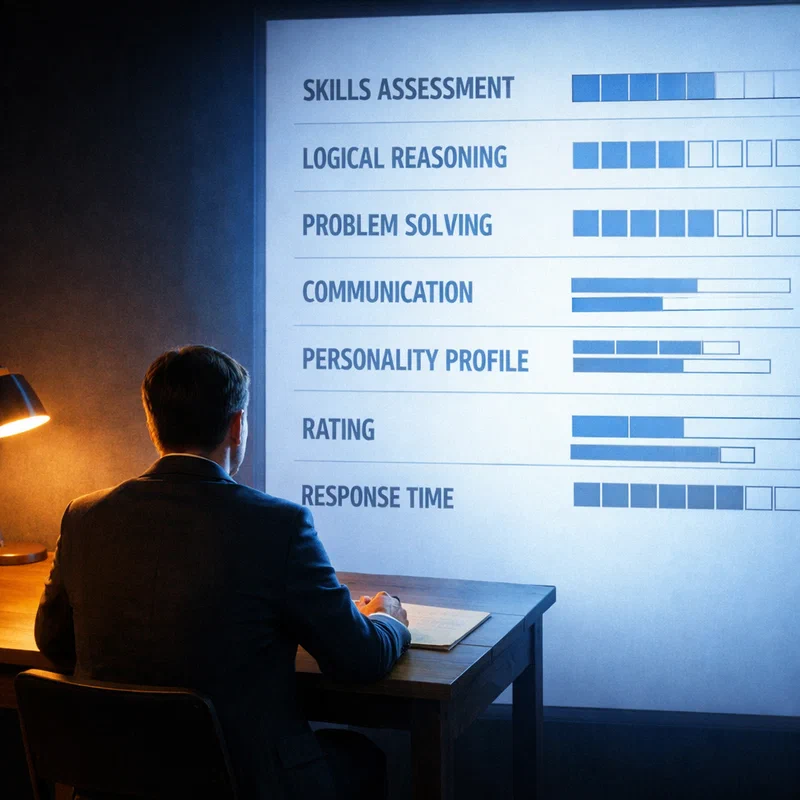
What you are actually being scored on #
Before changing how you prepare, you need to understand what the machine is evaluating.
AI interview systems — platforms like HireVue, Spark Hire, and Greenhouse’s own tooling — are trained to score candidates on a specific set of signals. While scoring methods vary by platform and employer configuration, they consistently weight:
- Verbal structure: Do your answers follow a recognisable narrative pattern? Rambling reduces scores. Tight progression (situation → action → outcome) raises them.
- Keyword alignment: Does your language match the job description and the competency framework behind the role? AI systems cross-reference your responses against what the employer defined as important before the interview began.
- Completeness: Did you actually answer the question, or did you pivot to something adjacent? AI systems do not give social credit for confident deflection the way human interviewers sometimes do.
- Pacing and clarity: Systems that analyse audio or video flag excessive filler words, very long pauses, and rapid undifferentiated speech as negative signals.
Notice what is not on this list: warmth, relatability, whether the interviewer liked you. In an AI-screened round, none of that can reach the system. You are being evaluated on structure, language, and completion — before a human ever reviews the output.
Part 1: The pre-interview intelligence scan #
Spend ten minutes before any AI interview running this four-step scan.
Step 1: Extract the competency language from the job description.
Copy the job description into a blank document. Identify every competency phrase — “stakeholder management,” “cross-functional collaboration,” “data-driven decision-making,” “bias for action” — and highlight it. These are the keywords the employer built the interview scoring against. Your answers must include them, naturally, without stuffing.
Step 2: Map each competency to one proof story.
For each competency phrase you highlighted, identify one specific story from your work history that demonstrates it. The story does not need to be long. It needs to be concrete: a specific project, a specific outcome, a specific number if you have one. Your goal is to have a mapped library of four to six stories before you record a single answer.
Step 3: Identify the company’s stated values.
AI interview questions — especially behavioural ones — are often designed to score candidates against the employer’s listed values. Look at the company’s careers page, their “About” section, and any recent press. Note the exact language they use. Mirror it.
Step 4: Test your setup.
Thirty minutes before any recorded interview: test your camera framing (face centred, not too close, not too far), your audio (clear, no echo), and your background (neutral, not distracting). Greenhouse’s data shows 70% of candidates are not told AI is involved before their interview begins. Do not let a technical surprise become the thing that tanks your score.
Part 2: The response architecture #
The STAR framework (Situation, Task, Action, Result) is the standard coaching advice for behavioural interviews. In an AI interview, you need STAR+ — a version optimised for machine scoring.
STAR+ structure:
-
Signal (5 seconds): Name the competency being demonstrated before you begin the story. “This is a situation where I had to demonstrate [exact competency from JD].” AI systems score more accurately when you help them locate the competency signal at the start.
-
Situation (10–15 seconds): Set the context quickly. Business, team, challenge. No backstory.
-
Task (5 seconds): Your specific role or responsibility. One sentence.
-
Action (30–45 seconds): The bulk of your answer. What you specifically did — not “we.” Use the exact language from the job description where it fits naturally.
-
Result (10–15 seconds): Quantify if possible. Even approximate numbers count. “Revenue grew 12%,” “reduced cycle time by three days,” “team attrition dropped.”
-
Reconnect (5 seconds): One closing sentence that connects your result back to the competency. “That experience is why I believe [competency] is the foundation of [relevant skill area].”
Total: 80–90 seconds. Not 45 seconds (too thin, scores as incomplete). Not 3 minutes (scores as unfocused, raises filler-word count).
Practise this until the six-step rhythm is automatic.
Scripts for three question types #
Behavioural: “Tell me about a time when you had to manage a difficult stakeholder.” #
“This is a situation that required strong stakeholder management under pressure. [Situation: one sentence.] My specific task was to [task: one sentence]. What I did: I [action: 2–3 sentences, using the words ‘stakeholder alignment,’ ‘clear communication,’ and the relevant JD phrase]. The result was [outcome with number]. That experience shaped how I approach stakeholder complexity — I now treat it as a communication architecture problem first, not a relationship problem.”
Values/culture: “What does ‘ownership’ mean to you in practice?” #
“To me, ownership means [mirror the exact word from their values page] before it’s required. Specifically, in my last role, [30-second STAR story that demonstrates the value without being asked]. I’d rather over-communicate a risk I spotted than wait for it to become my manager’s problem. That’s what ownership looks like in practice.”
Situational: “How would you handle a situation where a project was at risk of missing its deadline?” #
“My default is to surface the risk as early as possible with a proposed path forward, not just the problem. If I saw a deadline at risk, I would [specific 3-step action: assess the gap, identify the critical path items I can control, escalate with a recommendation, not just a flag]. The outcome I aim for is to give stakeholders options, not surprises. I have done this in [brief context] and the result was [outcome].”
The cold-open technique #
Most candidates waste the first eight seconds of their AI interview answer on throat-clearing: “Um, great question, so I think what I would say is…” That opening scores as filler and telegraphs low confidence to the scoring system.
Replace it with the Signal step from STAR+. Name the competency immediately:
“This is a situation where I had to demonstrate [competency].”
It sounds direct because it is. It signals to the scoring system exactly what competency evidence follows. And it eliminates the nervous wind-up that undermines otherwise strong answers.
After the AI interview: the 24-hour follow-up #
Greenhouse’s data found that 51% of US candidates who completed an AI interview never received an outcome. You cannot control that. But you can control one thing that most candidates miss entirely.
Within 24 hours of completing the AI interview, send a short, specific follow-up email to the recruiter or hiring contact. Do not send a generic “thank you for the opportunity.” Instead:
“Thank you for the opportunity to complete the [platform/process name] interview for [role]. I want to briefly flag that my answer on [specific question] didn’t fully capture [specific thing you would have added]. I would welcome the chance to elaborate if helpful. I am available for any next steps at your convenience.”
This accomplishes two things. First, it signals professionalism and follow-through — signals that the AI cannot register but the human reviewer of AI output can. Second, it gives you an opportunity to correct a weak answer you know exists before a human reviews the transcript.
Most candidates treat the AI interview as a black box they have no influence over after they close the browser. It is not.
The failure mode to avoid #
The most expensive mistake in an AI interview is treating it as a hurdle to tolerate rather than a round to win.
The candidate who walks in, delivers relaxed conversational answers because “the AI can’t really tell anyway,” and coasts on charm is not going to make it to the human round. The candidate who spends forty minutes the night before mapping competencies to proof stories, practises the STAR+ structure out loud twice, and runs the cold-open technique on every answer — that candidate moves forward.
Greenhouse’s data shows that when AI interviews go well, 38% of candidates come away with a more positive impression of the employer. Which means the AI interview is also an audition for how you handle structured processes under ambiguity. Companies that use AI screening are, intentionally or not, selecting for candidates who can adapt quickly and work within a system.
That is exactly the kind of signal a good hiring manager wants to see from day one.
Prepare for the machine. Get to the human. Win the role.
References #
- Clinton, Jane. (May 1, 2026). “‘Completely horrible’: UK job hunters share frustration with AI interviews.” The Guardian. https://www.theguardian.com/technology/2026/may/01/uk-job-hunters-frustration-ai-interviews (Accessed May 1, 2026, 04:30 UTC)
- Greenhouse. (April 30, 2026). “AI interviews in hiring: What candidates actually want – and how to get it right.” Greenhouse Blog. https://www.greenhouse.com/blog/2026-candidate-ai-interview-report (Accessed May 1, 2026, 04:45 UTC)
- HireVue. (2026). “2026 Global AI in Hiring Report.” HireVue. https://www.hirevue.com/resources/ebooks/2026-global-ai-in-hiring-report (Accessed May 1, 2026, 05:00 UTC)
- Perez, Sarah. (April 15, 2026). “LinkedIn data shows AI isn’t to blame for hiring decline… yet.” TechCrunch. https://techcrunch.com/2026/04/15/linkedin-data-shows-ai-isnt-to-blame-for-hiring-decline-yet/ (Accessed May 1, 2026, 05:10 UTC)
AI Content Notice
This article was created using artificial intelligence technology. Whenever possible, we include references and sources to support the information presented. Readers are encouraged to consult these sources for further information. While we strive for accuracy and provide valuable insights, readers should independently verify information and use their own judgment when making business decisions. The content may not reflect real-time market conditions or personal circumstances.
Related Articles
Career Mechanics: Build a Skills Evidence Stack Before the Market Forces You To
Use this step-by-step skills evidence stack to prove capability faster than a resume can signal it.
Career Mechanics: The Internal Mobility Playbook – Own Your Next Move Before the Org Chart Owns It for You
When the external market tightens and restructuring accelerates, your internal career capital …
Signals & Shifts: Three Currents Beneath April's Hiring Surface
Beneath April 2026’s flat hiring headlines, three structural currents are rewriting employment …