LinkedIn's 'Cut the Bullspend' Has a Punchline Nobody Said Out Loud

At its NewFront presentation in New York last week, LinkedIn launched a campaign called “Cut the Bullspend.” The biggest bullspend it didn’t mention? The company page strategy LinkedIn itself convinced you to invest in for the last decade.
I’ve spent eight years helping B2B companies build LinkedIn presences. I’ve told clients — honestly — that company pages are worth the investment: consistent posting, growing follower bases, refining brand voice, publishing thought leadership articles. That advice was sound when I gave it. It is no longer sound today. And the platform that made it obsolete had the audacity to launch a campaign this week telling you to stop wasting money on things that don’t work.
They’re not wrong. But they’re not being fully honest either.
The Company Page’s Quiet Collapse #
Here is what the data shows, and it is not ambiguous.
Organic reach for LinkedIn company pages dropped between 60% and 66% from 2024 to early 2026, according to platform analysis published by Ordinal, citing AuthoredUp data. A post that reached 10,000 people in 2024 now struggles to hit 4,000 with an identical follower count. Company pages now represent just 1–2% of content appearing in typical user feeds, while personal profiles dominate 65% of what people actually see.
LinkedIn expert Richard van der Blom, whose annual algorithm report is widely cited across the industry, puts average company page reach at 2–4% of followers. The comparison that matters: personal profiles generate up to 561% more reach when sharing the same content as a company page. The Refine Labs study — often cited in employee advocacy discussions — found employee posts drive 2.75x more impressions and 5x more engagement than company page posts, despite having 46% fewer followers.
This is not a temporary dip. This is structural.
LinkedIn’s Three-Act Strategy #
I want to be precise about what happened, because the temptation is to call this an algorithm change. It is more than that.
Phase one: LinkedIn spent the better part of the 2010s building the company page as a cornerstone of B2B marketing. They published best practices guides, held webinars about optimizing page content, and sold the narrative that a company with a strong LinkedIn presence was a company that serious buyers would trust. Brands invested — in content teams, in page optimization, in follower campaigns.
Phase two: Gradually, then suddenly, the algorithm began deprioritizing company content in favor of personal posts. The reasoning is commercially sound. People engage more with people than logos. LinkedIn’s feed engagement increased when personal posts dominated. The algorithm reflected this reality, and company page organic reach started to erode.
Phase three: This week. LinkedIn’s NewFront in New York. VP Matthew Derella on stage, and then to Marketing Brew: “Part of what we’re advocating for for marketers is to make sure that you’re not wasting your precious media investment on vanity metrics.” The “Cut the Bullspend” campaign launches. New premium products — Thought Leader Ads, Top Voices 360, BrandLink upgrades with a Stripe creator payment integration — arrive simultaneously.
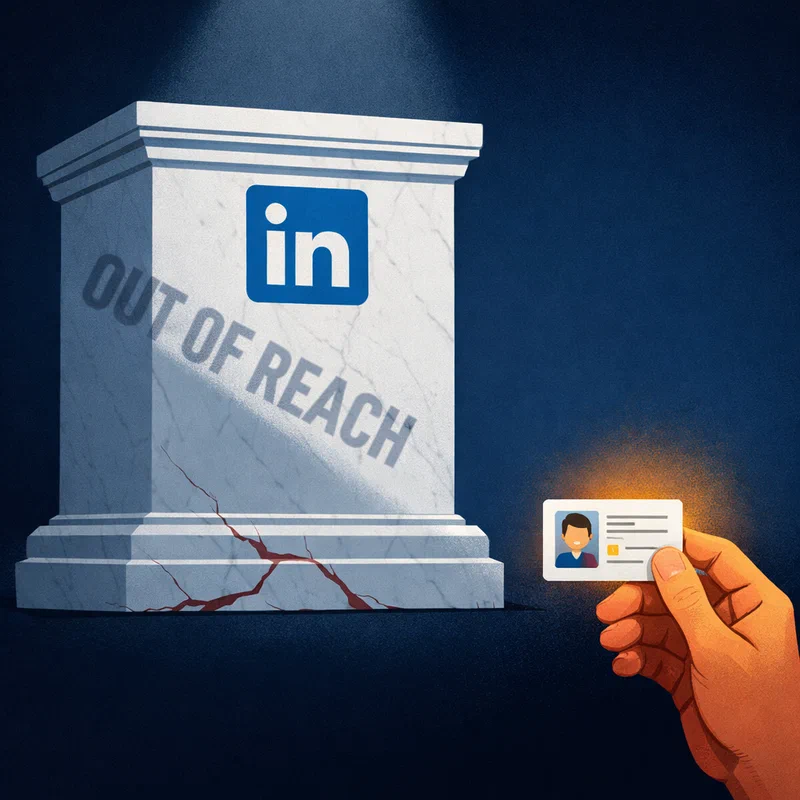
Organic company pages are dead. Paid amplification of personal voices is the replacement. LinkedIn has turned the gap it created into a product line.
The Paid Replacement Is Actually Good — And That’s What Makes This Complicated #
I will not pretend Thought Leader Ads don’t perform. They do. Extraordinarily well.
ZenABM’s 2026 LinkedIn ABM Benchmarks Report, analyzing 2,828 ads across 211 companies, found that TLAs deliver a median click-through rate of 2.68% — 6.4 times higher than standard single image ads. Cost per click comes in at $2.29 versus $13.23 for single image ads. $1,000 in TLA spend delivers 327 landing page clicks, compared to just 71 for the same spend on company-branded ads. Dwell time: 6.63 seconds versus 3.64 seconds for standard ads.
Why do they perform this way? Because, as ZenABM’s own analysis puts it, “they look like organic posts from real people, not ads from company pages.” LinkedIn’s feed is built for personal content. A founder sharing a perspective fits the medium. A corporate ad interrupts it.
Here is the irony worth sitting with: companies spent years trying to make their company pages sound authentic. LinkedIn’s algorithmic response was to send those posts to the back of the feed anyway. Now those same companies can pay to boost their executives’ personal posts — and get dramatically better performance precisely because those posts feel organic.
You are paying to borrow your employees’ authenticity. LinkedIn takes a percentage.
The AI Layer Makes This Harder #
The timing intersects with another crisis. Harvard Business Review published “Has AI Ended Thought Leadership?” on March 9, written by John Winsor — a man who, by his own description, is “by any conventional measure, a thought leader.” His conclusion: “I’m here to tell you the category is dying.”
The LinkedIn feed in 2026 is saturated with AI-generated content. Frameworks that look like frameworks. Insights that look like insights. Hot takes engineered for engagement rather than earned from experience. The flood has trained audiences to develop a sharp nose for manufactured authenticity — and to ignore it with remarkable efficiency.
This creates a precise problem for companies now pivoting to Thought Leader Ads. The format requires genuine content underneath. ZenABM’s top-performing TLA patterns: “write in first person, place links at the end, and share real experiences.” The structural advantage of TLAs collapses entirely if the underlying post is polished corporate messaging dressed in executive voice.
Companies that built authentic executive voices before this became a paid media strategy are about to compound that advantage dramatically. Companies scrambling to ghost-write LinkedIn posts for their CFO in Q2 2026 will spend significant money on ads that perform like company page posts: poorly.
What Corporate Strategists Should Actually Do #
Treat the company page as infrastructure, not distribution. Keep it complete, accurate, and visually consistent. It matters for brand discovery when prospects research you directly. It does not belong at the center of your content investment.
Invest in employee advocacy programs with structural depth. Not “encourage employees to share posts.” Build the internal infrastructure: regular content briefings, pre-approved assets employees can remix, social media policies that empower rather than restrict. According to Ordinal’s analysis, employee networks are 10x larger than company follower bases in aggregate. Employee posts are two times more likely to generate engagement than brand posts. This is your distribution network, and 97% of your employees aren’t using it.
Start developing genuine executive voices now — before you start spending on TLAs. Identify three to five internal voices across functions, not just the CEO. Help them develop a point of view that is actually theirs. The executives who post from genuine perspective, not corporate positioning, are the ones TLAs can turn into high-performing mid-funnel assets. The executives who post corporate messaging in first person are not.
Then, and only then, allocate TLA budget. ZenABM’s recommendation — 7–10% of LinkedIn ad budget to TLAs — is backed by performance data. The Brainlabs analysis of LinkedIn’s NewFront makes the strategic case clearly: B2B buyers are forming shortlists before they ever search. Your brand’s LinkedIn presence now functions as a pre-consideration filter. TLAs are how you buy your way into that filter — if the organic content underneath is real.
The Honest Version #
LinkedIn’s “Cut the Bullspend” campaign is good advice delivered by an entity with a pronounced conflict of interest. The platform eliminated the organic channel, then launched a paid one to replace it, then told you to stop wasting money on channels that don’t work — while standing in front of a chart showing their new paid products.
For corporate strategists, the task is not to be cynical about this. It’s to understand it clearly. Company pages as distribution channels are over. Personal voices, genuine employee advocacy, and paid amplification of authentic content are the mechanism that now works. The companies that figured this out early — building real executive voices, running structured employee advocacy, treating LinkedIn as a brand platform before it was a performance platform — are about to pull significantly ahead.
LinkedIn will continue to evolve the products and the pricing. The underlying truth won’t: people trust people, not logos. That was always true. The platform has just made it very expensive to ignore.
References #
| Source | Date | URL | Description |
|---|---|---|---|
| Marketing Brew | March 25, 2026 | https://www.marketingbrew.com/stories/2026/03/25/linkedin-newfront-pitch-ad-updates | LinkedIn’s NewFront pitch, Matthew Derella quotes, “Cut the Bullspend” campaign |
| Brainlabs Digital | March 2026 | https://www.brainlabsdigital.com/linkedin-newfront-2026-b2b-marketers/ | Full analysis of LinkedIn NewFront 2026 — buying groups, discovery, measurement |
| Ordinal | January 2026 | https://www.tryordinal.com/blog/the-declining-reach-of-linkedin-company-pages | Company page reach drop 60–66%, 1–2% of feeds, personal vs company page data |
| DowSocial | 2025 | https://www.dowsocial.com/linkedin-algorithm-2026/ | Richard van der Blom’s algorithm analysis — 2–4% company page reach, 90-minute window |
| ZenABM | 2026 | https://zenabm.com/blog/tla-benchmarks | TLA benchmarks: 2,828 ads, 211 companies, CTR/CPC/dwell data |
| Getathenic | 2025 | https://getathenic.com/blog/linkedin-organic-reach-crisis-tactics-2026 | November 2024 algorithm update, reach drops by content type |
| HBR / John Winsor | March 9, 2026 | https://hbr.org/2026/03/has-ai-ended-thought-leadership | “Has AI Ended Thought Leadership?” — the declining category argument |
| NetInfluencer | 2026 | https://www.netinfluencer.com/linkedin-expands-creator-video-ad-tools-as-b2b-marketers-demand-greater-scale/ | BrandLink revenue growth, Top Voices 360, NewFront creator announcements |
AI-Generated Content Notice
This article was created using artificial intelligence technology. While we strive for accuracy and provide valuable insights, readers should independently verify information and use their own judgment when making business decisions. The content may not reflect real-time market conditions or personal circumstances.
Related Articles
LinkedIn's Video Revolution: Why Corporate Strategists Must Rethink Content in 2026
LinkedIn’s pivot to short-form video creates unprecedented opportunities—and risks—for …
The LinkedIn AI Training Pivot: What Corporate Strategists Must Do Now That Your Data Feeds the Algorithm
LinkedIn’s AI training data policy that went live November 3rd requires corporate LinkedIn …
The Employee Advocacy Multiplier: How Smart B2B Companies Are Turning Their Workforce Into Their Biggest Distribution Engine
Companies with employee advocacy programs see 561% higher reach and 8x more engagement—yet only 31% …