Most 'AI Layoffs' Are a Cover Story. Here's the Real One You Should Be Reading.

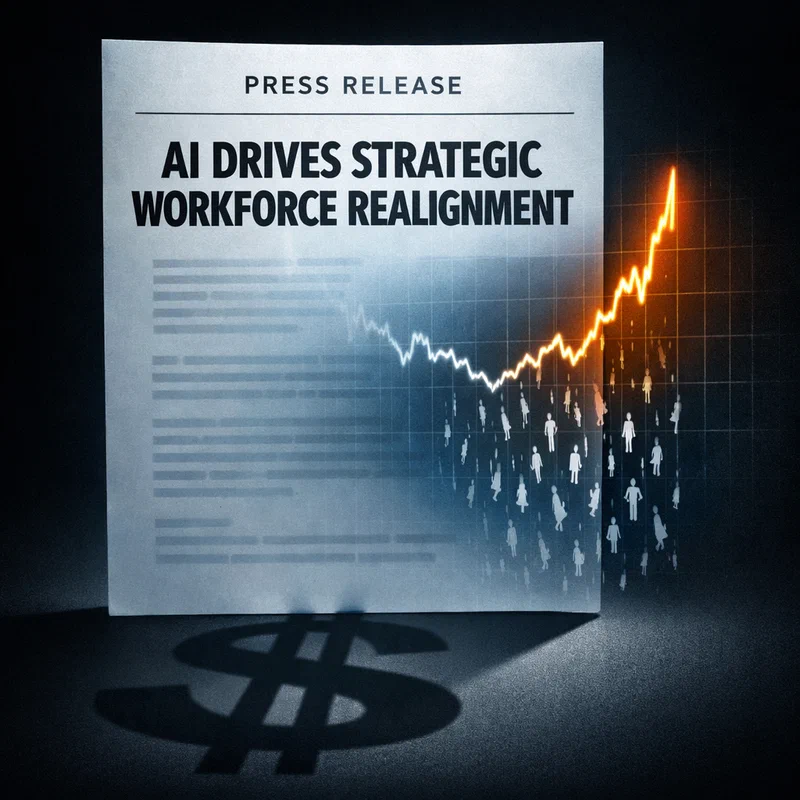
On February 26, Block Inc. — the profitable fintech company behind Square and Cash App — announced it was cutting more than 4,000 employees, nearly 40% of its entire workforce. The same day, its stock jumped 25%. Evercore ISI analysts called it “a seminal moment in the AI era.”
Read that again: a company thriving financially cut nearly half its people, and the market rewarded it overnight.
That is not the story of AI replacing workers. That is the story of what happens when “AI did it” becomes the most powerful phrase in investor relations.
Why “AI” Is Now the CEO’s Best Excuse #
Here is a number that should stop you cold: 59% of companies frame workforce reductions as AI-driven in order to appeal to stakeholders, according to data cited in TechTimes’ March 2026 workforce analysis (Accessed March 24, 2026). Not because AI actually caused the cuts. Because saying so sends a signal to investors that your strategy is modern and your costs are being ruthlessly optimized.
Since ChatGPT launched in late 2022, AI-related stocks have accounted for roughly 75% of S&P 500 returns. That’s the incentive. Frame your restructuring as an AI play and you don’t just absorb the cost — you get rewarded for it. Jack Dorsey watched his stock surge a quarter in a single trading session. Every other CEO board is doing the math.
This is not cynicism. It is arithmetic.
Block grew from 3,800 employees in 2019 to over 10,000 at its pandemic peak before cutting to just under 6,000. That trajectory — explosive COVID-era hiring followed by structural contraction — looks a lot like every other over-hiring correction we’ve seen since 2022. The AI framing is real enough: Block genuinely builds AI tools and CFO Amrita Ahuja says the cuts will let the company “move faster with smaller, highly talented teams using AI to automate more work.” But the pandemic swing alone would have forced a correction regardless.
Atlassian told a more honest version of the same story when it cut 1,600 employees (10% of its global workforce) on March 12. CEO Mike Cannon-Brookes said plainly: “It would be disingenuous to pretend AI doesn’t change the mix of skills we need or the number of roles required in certain areas.” He also acknowledged that the freed-up funds would “self-fund further investment in AI and enterprise sales” (Accessed March 24, 2026). Atlassian is laying off people partly to fund its AI bet, not because AI has already replaced them. There’s a material difference. Most companies won’t say so this clearly.
What the Research Actually Shows #
If you want to cut through the noise, start with two sources that have no stake in either narrative.
The first is a paper published earlier this month by Anthropic on the labor market impacts of AI (Accessed March 24, 2026). Anthropic’s team developed a new metric called “observed exposure” — combining both what AI can theoretically do and what it is actually being used for. The finding is clarifying: AI’s actual coverage remains a fraction of its theoretical capability. The most exposed occupations are computer programmers, customer service representatives, and data entry workers. But even in those fields, AI use remains limited in practice, and the researchers found no systematic increase in unemployment for highly exposed workers since late 2022.
The second is a Goldman Sachs report often cited but rarely quoted accurately: if AI were deployed across the economy for everything it currently could do, roughly 2.5% of US employment would be at risk of job loss — not the sweeping displacement that corporate announcements imply (Accessed March 24, 2026). Workers in AI-exposed occupations are currently no more likely to lose their jobs than anyone else.
This is a long way from the apocalypse the headlines suggest.
The Signal Buried in the Noise #
Here is the part I need you to pay attention to, because this is where most career transition advice goes wrong.
The macro data is reassuring. The micro data is not.
Anthropic’s paper flags one specific, early warning signal: hiring of younger workers has measurably slowed in AI-exposed occupations. The TechTimes analysis puts a number on it — workers aged 22–25 in AI-exposed roles saw their job-finding rate drop by approximately 14% since ChatGPT launched in 2022, and unemployment in that cohort rose by nearly 3% in the first half of 2025 alone.
That is not a sweeping displacement across the workforce. It is a compression at the bottom of the career pyramid — specifically at the entry point. Companies that once hired junior employees to do routine analytical work, basic content production, entry-level coding, and customer support triage are now doing it with AI tools instead. They still need the senior people who can supervise those tools and exercise judgment. They just don’t need as many people at the bottom anymore.
The World Economic Forum projects 92 million jobs displaced globally by 2030 — and 170 million new ones created. That sounds like a net gain. But the jobs lost and the jobs created don’t overlap cleanly. Different skills, different industries, different geographies. The workers being displaced are not automatically qualified for the roles being created. That gap is where career transitions either succeed or fail.
Where This Leaves You #
If you’re one of the 43% of workers who told FlexJobs in a March 2026 survey that you’re actively trying to change careers because of AI fears (Accessed March 24, 2026), the question is whether you’re reacting to the right data.
The reflexive move — flee the field that scares you and find something safer — is often wrong. If you’re in customer service and pivot to administrative support, you’ve moved laterally within the same risk band. If you’re in junior content production and move to general marketing coordination, same story. The panic is real; the direction it picks is often arbitrary.
The data points somewhere much more specific. Workers who combine domain expertise with demonstrable AI fluency are commanding a 56% wage premium compared to their peers, according to workforce analysis covering AI-exposed industries (Accessed March 24, 2026). AI-related job postings increased 92% in 2026. The demand is not for people who use AI to replace human work — it’s for people who understand how to combine both, who can exercise judgment that AI can’t replicate, and who can supervise AI-assisted workflows with credibility.
The practical implication is this: most people who need to transition in 2026 don’t need to change industries. They need to change their skill layer. The finance professional who adds AI fluency to her risk modeling isn’t competing against a bot — she’s outcompeting the finance professional who doesn’t. The customer success manager who learns to supervise AI triage workflows isn’t doing a different job. He’s doing the same job at a higher level, with more leverage, for significantly more compensation.
The Pivot Framework for 2026 #
When I work with clients navigating this environment, I push them through three questions before we discuss any career move:
Is your current role at the execution layer or the judgment layer? Execution is what AI is replacing — routine task completion, pattern-matching, output production at scale. Judgment is what it isn’t — interpreting ambiguous situations, managing relationships, making decisions with incomplete information, understanding the context that data doesn’t capture. Execution-layer roles are shrinking at the junior level. Judgment-layer roles are growing, especially when combined with the ability to deploy AI tools.
What is your domain expertise actually worth without the execution layer? A customer service rep who has built expertise in a specific industry — say, healthcare compliance or financial regulatory frameworks — has domain knowledge that AI doesn’t have and can’t easily replicate. That knowledge, reframed as AI oversight, policy review, or training data quality work, becomes much more valuable than the same person doing triage.
Are you fleeing or pivoting? Fleeing is picking a direction away from the scary thing. Pivoting is identifying the intersection between your existing strengths and an underserved demand. The professionals who thrive in these transitions aren’t reinventing themselves — they’re recomposing, stacking new capabilities onto a real foundation.
Block offered its laid-off employees $5,000 in transition support. Atlassian gave notice and severance. The market has made clear what it values: companies that move decisively toward AI fluency. The question for professionals is whether they do the same.
The Real Ending of This Story #
Most of the AI layoff headlines are written to serve someone — investors who want to see AI-first strategy, companies who want to rationalize correction, and media that knows “AI” gets clicks. The number of jobs that AI has actually displaced in a clean, direct causal chain is smaller than you think. For now.
What’s happening right now — and what will matter more in 18 months — is structural. The bottom of the talent pyramid is being compressed. The premium on AI fluency is already 56% and growing. Entry into AI-exposed fields is getting harder for people who haven’t adapted.
That’s not a reason to panic. It’s a reason to be precise.
Don’t run from the headline. Read the data. Find the intersection of your domain knowledge and AI fluency. That intersection is the most valuable place to be in the 2026 job market — and most of the people who should be standing there are too busy reading layoff announcements to notice.
References
- TechTimes (March 21, 2026). “Tech Layoffs Surge While AI Jobs Soar: Key Trends Shaping the 2026 Tech Industry.” https://www.techtimes.com/articles/315282/20260321/tech-layoffs-surge-while-ai-jobs-soar-key-trends-shaping-2026-tech-industry.htm (Accessed March 24, 2026)
- TechCrunch (February 26, 2026). “Jack Dorsey just halved the size of Block’s employee base — and he says your company is next.” https://techcrunch.com/2026/02/26/jack-dorsey-block-layoffs-4000-halved-employees-your-company-is-next/ (Accessed March 24, 2026)
- The Conversation (March 2026). “Tech companies are blaming massive layoffs on AI. What’s really going on?” https://theconversation.com/tech-companies-are-blaming-massive-layoffs-on-ai-whats-really-going-on-278314 (Accessed March 24, 2026)
- Anthropic (March 2026). “Labor Market Impacts.” https://www.anthropic.com/research/labor-market-impacts (Accessed March 24, 2026)
- ABC News Australia (March 12, 2026). “Australian tech Atlassian cuts 1,600 jobs from global workforce.” https://www.abc.net.au/news/2026-03-12/australian-tech-atlassian-cuts-1600-jobs-from-global-workforce/106445334 (Accessed March 24, 2026)
- OpenTools (March 2026). “2026 Tech Layoffs Hit 45,000 in March: AI and Automation Take the Lead.” https://opentools.ai/news/2026-tech-layoffs-hit-45000-in-march-ai-and-automation-take-the-lead (Accessed March 24, 2026)
- 4 Corner Resources (March 2026). “Block Layoffs 2026: Jack Dorsey Cuts 4,000 Jobs, Cites AI.” https://www.4cornerresources.com/job-market-news/block-ai-layoffs-jack-dorsey-2026/ (Accessed March 24, 2026)
- CNBC (March 3, 2026). “AI, layoffs spur workers to want a career change, FlexJobs finds.” https://www.cnbc.com/2026/03/03/career-change-ai-layoffs.html (Accessed March 24, 2026)
- The World Data (2026). “AI Job Displacement Statistics 2026: Key Facts.” https://theworlddata.com/ai-job-displacement-statistics/ (Accessed March 24, 2026)
AI-Generated Content Notice
This article was created using artificial intelligence technology. While we strive for accuracy and provide valuable insights, readers should independently verify information and use their own judgment when making business decisions. The content may not reflect real-time market conditions or personal circumstances.
Related Articles
Rethinking Expertise in the Age of AI: The Skills Revolution That's Changing Career Transitions
AI is democratizing expertise and driving a skills-based hiring revolution—learn how to position …
Skills-Based Hiring: The Career Transition Game-Changer You've Been Waiting For
The transition from degree-based to skills-based hiring is revolutionizing career transitions, …
Compete for Your Job: The Performance-Based Hiring Revolution
Competition-based hiring is transforming recruitment as companies move from credentials to …