Horizon 1000: When AI Meets Africa's Healthcare Crisis Head-On

Last week at the World Economic Forum in Davos, Bill Gates and Sam Altman announced something that made me simultaneously hopeful and deeply concerned. Their $50 million Horizon 1000 initiative aims to deploy artificial intelligence across 1,000 primary care clinics in Africa by 2028, starting in Rwanda. As someone who has spent fifteen years at the intersection of AI and healthcare, I understand the genuine promise here. But I also know that what sounds transformative in a Davos conference hall can become dangerously reductive when deployed in the complex reality of low-resource healthcare settings.
The timing of this announcement is not coincidental. Global child mortality is rising for the first time this century—4.8 million children died in 2025, up from 4.6 million in 2024—largely because international aid budgets have been slashed. Sub-Saharan Africa faces a shortage of nearly 6 million healthcare workers. Rwanda has just one healthcare worker per 1,000 people, far below the WHO-recommended ratio. In this context, AI-powered tools that can support triage, clinical decision-making, and administrative workflows seem like an obvious solution.
But here’s what keeps me up at night: we are deploying sophisticated AI systems into settings that lack the fundamental infrastructure, regulatory frameworks, and contextual data these systems need to work safely and equitably. This isn’t just a technical problem—it’s a structural one that threatens to replicate the very inequities we claim to be solving.
The Promise: AI as Force Multiplier #
Let me be clear about what Horizon 1000 gets right. According to the joint announcement from the Gates Foundation and OpenAI, the initiative will provide funding, technology, and technical support to help frontline health workers with patient intake, triage, referrals, and access to medical information in local languages. These are precisely the high-burden, low-complexity tasks where AI can legitimately help.
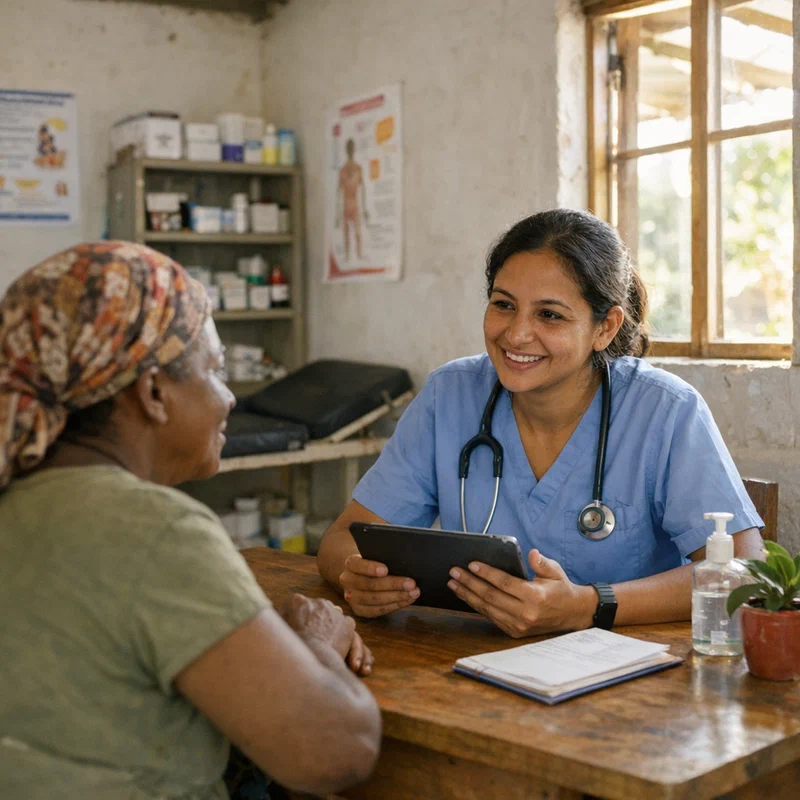
Rwanda’s Minister of ICT and Innovation, Paula Ingabire, explained at Davos that 70% of cases handled by the country’s 60,000-plus community health workers involve malaria. An AI tool that helps with diagnosis and disease trajectory prediction could dramatically improve outcomes. Rwanda has already used drones and AI to identify and spray mosquito breeding sites—they understand how to deploy technology pragmatically.
Peter Sands, CEO of the Global Fund, described how their $170 million investment in AI-based tuberculosis screening has delivered “very significant impact” in settings like Sudanese refugee camps in Chad. “There are well over a million Sudanese refugees in Chad, and we set up mobile clinics with the government of Chad to go into these refugee camps and do screening for TB,” Sands said. Without radiologists available, “if you want the screening to be interpreted, there is no alternative” to AI.
These are real examples of AI working in exactly the kind of constrained environments where Horizon 1000 will operate. The technology isn’t theoretical—it’s already saving lives.
The Infrastructure Reality Check #
But here’s where the promise meets harsh reality. During the same Davos panel, Peter Sands identified what he called “very basic problems” that need fixing: many African primary healthcare facilities lack internet connectivity, and some lack reliable electricity.
Think about what this means. Large language models require constant connectivity to function. They need consistent power. They generate and process sensitive patient data that needs secure transmission and storage. None of these prerequisites exist reliably in many of the 1,000 clinics Horizon 1000 plans to reach.
This isn’t hypothetical concern. During the COVID-19 pandemic, India’s Aarogya Setu contact tracing app failed to reach populations without smartphones—effectively excluding rural and low-income communities from public health protection. The digital divide isn’t just about who has devices; it’s about who gets protected and who gets left behind.
The initiative acknowledges these challenges. Gates told the Davos audience that Rwanda has rolled out internet access to around 97% of its population—a remarkable achievement. But Horizon 1000 plans to expand beyond Rwanda to Kenya, South Africa, and Nigeria. Infrastructure readiness varies dramatically across these countries, especially in rural areas where healthcare worker shortages are most acute.
The Data Bias Crisis We’re Not Discussing #
Here’s the part that concerns me most as someone who has spent my career addressing algorithmic bias in healthcare AI: most of these systems are being trained on data that systematically excludes the populations they’re meant to serve.
A recent study in Frontiers in Public Health examined algorithmic bias in low-resource settings and found that “AI systems are only as effective as the data used to train them and the assumptions under which they are created.” The problem? Most public health AI models draw from datasets in populations that are unrepresentative of those in low- and middle-income countries.
This isn’t an abstract concern. The study documented how a widely-used U.S. healthcare risk prediction algorithm systematically underestimated the health needs of Black patients by using prior healthcare expenditure as a proxy—unintentionally replicating patterns of historical underutilization of care. Sepsis prediction models developed in high-income settings showed significantly reduced accuracy among Hispanic patients due to unbalanced training data.
When you deploy AI systems trained primarily on data from Western hospitals into African primary care clinics, you’re not just importing technology—you’re importing embedded assumptions about what “normal” health metrics look like, what symptoms matter, what treatment protocols work. These assumptions don’t transfer cleanly across genetic, environmental, cultural, and economic contexts.
At Stanford Medicine, my research team has pioneered diagnostic algorithms that outperform human specialists in specific narrow tasks. But we learned the hard way that these systems consistently underperform with underrepresented populations when trained on non-diverse datasets. Current models often fail to account for genetic variation, environmental exposures, dietary differences, and disease presentations that vary across populations.
The Governance Gap #
Rwanda’s Paula Ingabire emphasized something crucial at Davos: “These models need to be trained on our own data, they need to be context specific, and they need to come in to address real problems.” This is exactly right. But it also reveals the massive governance challenge ahead.
Developing context-specific models requires:
- Robust local data collection systems that preserve privacy
- Clinical validation studies in the actual populations being served
- Regulatory frameworks that can evaluate and approve AI tools
- Technical capacity to audit algorithms for bias and performance
- Ongoing monitoring systems to catch problems as they emerge
According to research published in the American Journal of Managed Care, most low-resource settings lack effective regulatory frameworks to govern AI, have weak or unenforced data protection laws, and lack the technical capacity to conduct audits of AI systems. This creates what researchers call a “perfect storm in which suboptimal algorithms can be injected into national health policy with inadequate oversight.”
The initiative’s $50 million budget is substantial, but is it sufficient to build not just the AI tools but also the entire governance infrastructure needed to deploy them safely? Rwanda is ahead of most African nations in digital infrastructure and policy capacity. What happens when Horizon 1000 scales to countries with weaker regulatory systems?
The Digital Colonialism Question #
Gates said something revealing at Davos: “I believe we’ll see faster progress with the rollout of AI in healthcare in developing world health than the ‘rich world’ because the need is so great, and the governments are embracing this.”
He’s right about the need. But this statement also captures something troubling about how we approach healthcare AI in low-resource settings. We treat the lack of existing infrastructure and looser regulatory oversight as an advantage for rapid deployment—a chance to “move fast and break things” in regions where breaking things means people dying.
This is what critics call digital colonialism: technologies developed in the Global North, optimized for high-resource settings, deployed in the Global South with minimal adaptation or local participation in their design. The promise is always empowerment and efficiency. The risk is that we export not just technology but the embedded assumptions, biases, and blind spots of the contexts where they were created.
Ingabire pushed back against this dynamic, noting that Rwanda wants local control: “We have a lot of data that we’re not using. Building national data intelligence platforms that help us is critical. Once we build these models, they need to be trained on our own data.” She’s also in conversations with Anthropic about developing locally-relevant AI tools.
This tension—between the speed of deployment that crisis demands and the careful local adaptation that equity requires—sits at the heart of Horizon 1000.
What Success Actually Requires #
If Horizon 1000 is going to work, it needs to go beyond the headline $50 million commitment. Based on both research and my own experience implementing AI in diverse healthcare settings, here’s what successful deployment demands:
Infrastructure first: AI tools are useless without reliable power and connectivity. Any deployment must either ensure these basics exist or develop offline-capable AI systems that can function with intermittent connectivity.
Local data, local validation: Every AI tool must be validated on data from the actual populations it will serve. This isn’t optional—it’s the difference between a tool that works and one that kills people through systematic misdiagnosis.
Transparent governance: There must be clear regulatory frameworks, regular audits for bias and performance, and mechanisms for frontline workers to report problems and have them addressed quickly.
Workforce training: Community health workers need comprehensive training not just in how to use AI tools, but in understanding their limitations and when to override AI recommendations based on local knowledge.
Ongoing monitoring: Performance metrics must be tracked continuously, disaggregated by patient demographics, to catch emerging problems before they become crises.
True partnership: This cannot be a top-down deployment of Western AI tools. It requires genuine collaboration with local health systems, adaptation to local clinical guidelines, and respect for local expertise about what patients actually need.
The Frontiers in Public Health study emphasizes that “AI implementation should focus on building intelligence into existing systems and institutions rather than attempting to start from scratch or hoping to replace existing systems.” This is wisdom we cannot ignore.
The Stakes Are Too High for Half-Measures #
Sam Altman said at Davos: “AI is going to be a scientific marvel no matter what, but for it to be a societal marvel, we’ve got to figure out ways that we can use this incredible technology to improve people’s lives.”
I agree completely. The question is whether we’re willing to do the hard, unglamorous work that makes the difference between AI as genuine force multiplier and AI as yet another well-intentioned intervention that exacerbates the inequities it promises to solve.
The child mortality statistics are devastating. The healthcare worker shortage is real and urgent. The potential for AI to help is genuine. But potential isn’t the same as impact, and impact requires more than technology—it requires structural investment in the foundations that make technology work safely and equitably.
Horizon 1000 represents one of the largest AI healthcare initiatives ever deployed in low-resource settings. Its success or failure will shape how we think about AI in global health for decades. That’s why I’m pushing for rigorous standards, transparent governance, and genuine partnership rather than just celebrating the announcement.
The 1,000 clinics that will receive these AI tools serve some of the most vulnerable populations on Earth. They deserve systems that have been designed with their specific contexts in mind, validated on data that represents them, governed by frameworks that protect them, and monitored continuously to ensure they’re actually helping.
Anything less isn’t innovation—it’s experimentation on populations that have already borne too much of that burden.
Looking Forward #
I want Horizon 1000 to succeed. The alternative—continued decline in global health outcomes as aid budgets shrink and healthcare worker shortages worsen—is unacceptable. But success requires acknowledging the hard truths about what AI deployment in low-resource settings actually demands.
The Gates Foundation and OpenAI have the resources and expertise to do this right. The question is whether they’ll invest not just in the technology but in the infrastructure, governance, and local partnership that technology needs to work. Rwanda’s proactive approach, with leaders like Paula Ingabire insisting on local data and context-specific models, offers a template.
As we watch Horizon 1000 unfold over the next two years, the metrics that matter aren’t just how many clinics get AI tools. They’re whether those tools actually improve outcomes equitably across all patient populations, whether they empower rather than replace healthcare workers, whether they respect local contexts and expertise, and whether they build foundations for sustainable local AI capacity rather than creating permanent dependence on external systems.
The stakes are life and death. We owe it to the communities these systems will serve to get this right.
References #
- Observer (January 21, 2026). “Bill Gates and OpenAI Join Forces to Launch Health Program in Africa in $50M Deal.” https://observer.com/2026/01/bill-gates-openai-launch-health-program-africa/ (Accessed January 31, 2026)
- Health Policy Watch (January 21, 2026). “Gates and OpenAI Team Up to Pilot AI Solutions to African Healthcare Problems.” https://healthpolicy-watch.news/gates-and-openai-team-up-to-pilot-ai-solutions-to-african-healthcare-problems/ (Accessed January 31, 2026)
- American Journal of Managed Care (January 21, 2026). “Gates Foundation, OpenAI Launch $50M AI Health Initiative in Africa.” https://www.ajmc.com/view/gates-foundation-openai-launch-50m-ai-health-initiative-in-africa (Accessed January 31, 2026)
- Frontiers in Public Health (2025). “Algorithmic bias in public health AI: a silent threat to equity in low and middle-income settings.” https://www.frontiersin.org/journals/public-health/articles/10.3389/fpubh.2025.1643180/full (Accessed January 31, 2026)
AI-Generated Content Notice
This article was created using artificial intelligence technology. While we strive for accuracy and provide valuable insights, readers should independently verify information and use their own judgment when making business decisions. The content may not reflect real-time market conditions or personal circumstances.
Related Articles
The AI Health Assistant Rush: Why ChatGPT Health and Claude for Healthcare Mark a Pivotal—and Precarious—Moment for Medicine
The January 2026 launches of ChatGPT Health and Claude for Healthcare represent both tremendous …
Breakthrough AI Approaches: Transforming Undruggable Proteins and Medical Diagnosis
Nobel laureate David Baker’s team develops AI breakthrough for targeting …
Biocomputing and Brain Organoids: Healthcare AI's Most Controversial Frontier
Brain organoids are evolving from research tools to computational platforms, creating both …