Biocomputing and Brain Organoids: Healthcare AI's Most Controversial Frontier

When Lena Smirnova’s team at Johns Hopkins University successfully demonstrated brain organoids capable of learning and memory-like functions earlier this year, they weren’t just advancing neuroscience—they were opening a Pandora’s box that has the medical AI community simultaneously excited and deeply concerned. The emergence of “organoid intelligence” represents perhaps the most philosophically complex development in healthcare technology since the first artificial heart, forcing us to confront questions that blur the boundaries between biology, computation, and consciousness itself.
This isn’t science fiction. It’s happening in laboratories right now, and the implications for healthcare are profound.
The Biocomputing Revolution Takes Shape #
At a recent ethics conference at the Asilomar Center in California, brain organoid pioneers gathered to discuss concerns that their field is careening toward a public backlash. The worry? That overhyped claims about “organoid intelligence” and biocomputing could trigger restrictive regulations that hamstring legitimate medical research aimed at understanding and treating neurological disorders.
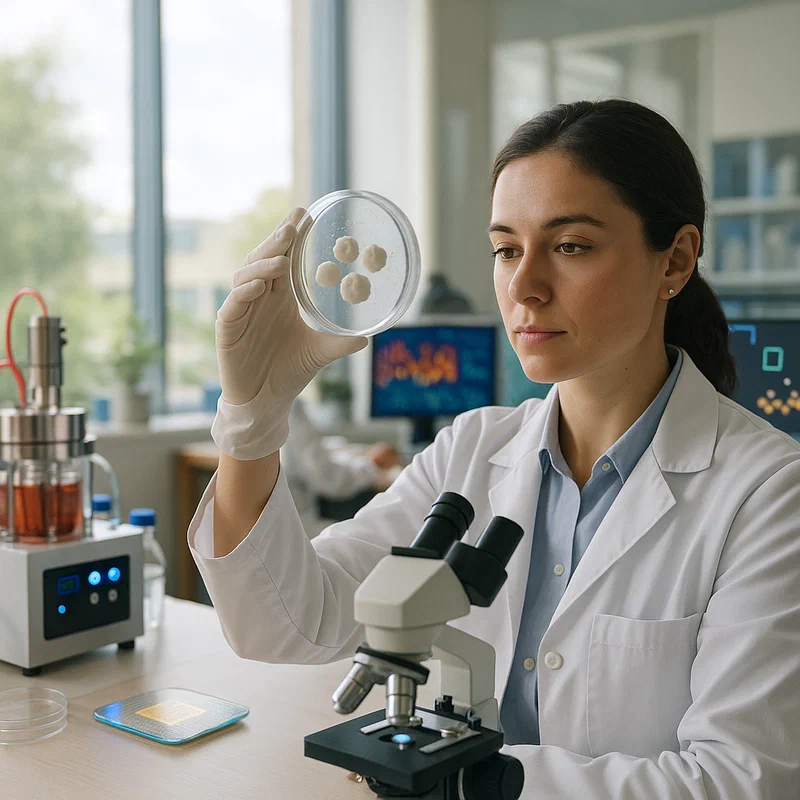
The tension is palpable. On one side, researchers like Smirnova argue that biocomputing offers a path toward understanding how environmental toxins affect developing brains—work that could revolutionize prenatal care and developmental neuroscience. On the other, critics like Tony Zador from Cold Spring Harbor Laboratory dismiss organoid-based AI as “a scientific dead-end,” arguing that we lack the fundamental understanding to wire neural circuits to perform computational tasks on command.
Yet the investment tells a different story. Both the National Science Foundation and DARPA have poured millions into organoid-based biocomputing research. Companies like Cortical Labs in Melbourne are already selling biocomputer units for $35,000 to approved laboratories. In 2022, Cortical demonstrated lab-grown neurons successfully playing the classic video game Pong—a feat that sounds trivial until you consider what it represents: biological tissue demonstrating learning, adaptation, and goal-directed behavior.
Real-World Healthcare AI: Beyond the Hype #
While biocomputing grapples with existential questions, other AI applications in healthcare are delivering measurable, transformative results today. St. Luke’s Health System in Boise, Idaho provides a compelling case study in practical AI implementation that addresses one of healthcare’s most pressing crises: clinician burnout.
Facing increasing documentation burden and rising “pajama time”—the hours physicians spend completing electronic health records after hours—St. Luke’s deployed Ambience Healthcare’s AI documentation system across 18,000 employees spanning eight medical centers and 370 clinics. The results, as reported by Healthcare IT News on November 20, 2025, demonstrate AI’s capacity for immediate, tangible healthcare improvement:
- 75% of physicians now use AI documentation with 83% encounter-level utilization
- 35% decrease in after-hours documentation time
- 15% increase in direct patient face time
- $13,049 in annual revenue per clinician through improved coding accuracy
- 75% of pilot clinicians reported reduced cognitive burden
“This was the first time we had physicians and advanced practice providers clamoring for new technology,” noted Dr. Terry Ribbens, St. Luke’s associate chief medical officer and practicing pediatric nephrologist. The enthusiasm is telling—healthcare workers typically resist new technologies that complicate workflows. When they actively demand them, it signals genuine utility.
The St. Luke’s implementation demonstrates what I call “pragmatic AI”—systems designed to augment rather than replace human expertise, freeing clinicians to focus on the irreducible human elements of care while automating legitimately automatable tasks. This is the sweet spot where AI delivers value without triggering the ethical alarm bells that accompany more ambitious projects.
The Ethics Paradox: Innovation vs. Caution #
The contrast between biocomputing’s ethical quandaries and AI scribes’ straightforward benefits illuminates a fundamental tension in healthcare AI development. We need both the moonshot thinking that produces breakthrough discoveries and the incremental improvements that solve immediate problems. The challenge is preventing the controversies surrounding the former from constraining the latter.
Sergiu Pasca, a Stanford neural organoid researcher who organized the Asilomar ethics meeting, articulated the core concern: “Using accurate terms that neither hype nor misrepresent the work really does matter. Overly expansive claims can confuse the public and policymakers about what these systems actually do.”
This caution is warranted. According to the November 17, 2025 STAT News investigation, some biocomputing companies have made claims suggesting their organoid systems possess “intelligence” comparable to silicon-based AI—assertions that many researchers find scientifically premature and potentially damaging to the field’s credibility.
Yet Smirnova and her husband Thomas Hartung, who coined the term “organoid intelligence,” maintain they’ve centered ethics from the beginning. Their NSF-funded project includes bioethicists as co-authors, and the agency required ethics considerations to receive equal weight with scientific merit during proposal reviews—a rare 50-50 split that signals how seriously these concerns are being taken.
The couple insist they’re “not trying to create a mind in a dish.” Rather, organoid intelligence represents a tool for studying the physiological functionality of brain organoids—particularly their capacity for behavioral changes that could validate them as alternatives to animal testing in toxicology studies. When a pregnant person is exposed to flame retardants, how do those chemicals interfere with fetal neural development? Organoids hooked to electrode arrays could answer such questions without requiring animal sacrifice.
The Dual-Use Dilemma #
The same week that brain organoid ethics dominated headlines, another AI story emerged highlighting technology’s double-edged nature. At the HIMSS AI and Cybersecurity Virtual Forum on November 18, cybersecurity expert Benoit Desjardins outlined the escalating AI arms race in healthcare security, as reported by Healthcare IT News.
With healthcare organizations experiencing an average of two breaches daily, threat actors are leveraging generative AI to create sophisticated phishing campaigns, deepfake videos, and voice clones. In one striking 2024 case, an Arup Group employee transferred $25 million after a video conference with what appeared to be company executives—all of whom were AI-generated deepfakes. She was the only human on the call.
“This was a very creative case of social engineering,” Desjardins noted dryly.
The defensive response? More AI. Commercial cybersecurity models now exceed 99% accuracy in detecting intrusions, malware, and phishing attacks. But this creates an eternal escalation: attackers using AI versus defenders using AI, each iteration becoming more sophisticated.
Desjardins’s conclusion mirrors the broader healthcare AI narrative: “AI will not replace either doctors or cybersecurity experts. Physicians who know how to use AI will overcome physicians who don’t know how to use AI.” The same holds for researchers, administrators, and every healthcare role. AI literacy is transitioning from optional skill to professional necessity.
Navigating the Regulatory Future #
Perhaps the most pressing question is how to regulate these technologies without stifling innovation. Brain organoids fall outside existing frameworks for human or animal research. They’re neither fully human (lacking the organization and complexity of an actual brain) nor simply cellular cultures (demonstrating emergent properties that resemble rudimentary cognition).
Madeline Lancaster, who developed the first brain organoids at Cambridge, recently expressed concern to Nature that overly broad laws could “bring in regulations that prevent all work, including on the side of the field that’s really doing research to try to help people.” This tension—between protecting against potential harms and enabling medical progress—is familiar to anyone who’s worked in healthcare innovation.
The solution likely requires what I call “calibrated governance”: regulatory frameworks sophisticated enough to distinguish between applications with different risk profiles. AI documentation systems like St. Luke’s Ambience platform pose minimal ethical concerns and should face proportionately lighter regulatory burdens. Biocomputing systems that might develop consciousness-like properties require intensive oversight, with built-in safeguards and continuous ethical review.
The NSF’s approach to its biocomputing grants offers a template: requiring ethicists as co-principal investigators, evaluating ethical frameworks alongside scientific merit, and embedding ethics consideration throughout the research process rather than treating it as an afterthought.
The Path Forward: Responsible Innovation at Scale #
As someone who has spent fifteen years at the intersection of AI and healthcare, I’ve watched technology repeatedly outpace our collective wisdom about how to deploy it responsibly. The brain organoid debate represents this dynamic in its most acute form—technology advancing so rapidly that we’re forced to grapple with questions we haven’t fully formulated, let alone answered.
Here’s what I believe healthcare organizations should do:
For immediate AI adoption: Deploy proven systems like AI documentation that demonstrably reduce clinician burden and improve patient care. St. Luke’s results show this isn’t theoretical—75% physician adoption with measurable ROI proves the value proposition. Don’t let perfect be the enemy of good.
For emerging technologies: Engage with biocomputing and organoid intelligence research thoughtfully but cautiously. These fields may yield breakthrough insights into neurological disorders, drug development, and brain function. They may also raise ethical issues we’re not prepared to handle. Active participation in ethical discussions—not passive observation—is essential.
For cybersecurity: Recognize that AI-powered threats require AI-powered defenses. The “eternal battle” Desjardins describes isn’t going away. Organizations that fail to deploy defensive AI will find themselves increasingly vulnerable to offensive AI.
For workforce development: Invest heavily in AI literacy across all roles. The physicians, nurses, researchers, and administrators who master AI augmentation will thrive. Those who resist will struggle. This isn’t about replacing human judgment—it’s about enhancing it.
Conclusion: Embracing Complexity #
The brain organoid controversy crystallizes healthcare AI’s central challenge: how do we pursue transformative innovations while maintaining ethical guardrails? How do we prevent legitimate concerns from becoming innovation-killing paralysis?
There’s no simple answer. Smirnova’s team isn’t wrong that organoid intelligence could revolutionize developmental neuroscience and toxicology testing. Critics aren’t wrong that overhyped claims could trigger regulatory backlash. St. Luke’s physicians aren’t wrong that AI documentation dramatically improves their work lives. Ethicists aren’t wrong to scrutinize technologies that might develop consciousness-like properties.
They’re all right. That’s the complexity we must navigate.
The most dangerous path would be binary thinking—embracing all AI applications uncritically or rejecting entire categories out of fear. Healthcare demands nuance, careful evaluation of specific use cases, and willingness to update our frameworks as evidence accumulates.
Brain organoids learning to play Pong should inspire wonder and caution in equal measure. AI scribes reducing physician burnout should inspire rapid, thoughtful deployment. Defensive AI protecting patient data should inspire investment and vigilance. Each application requires its own calibrated response.
The future of healthcare AI isn’t singular—it’s plural. Multiple technologies advancing along parallel tracks, each requiring different levels of oversight, each offering different benefits and risks. Our job is to nurture the ones that enhance human flourishing while constraining the ones that threaten it.
That’s the work ahead. It’s complex, messy, and absolutely essential. And unlike brain organoids, we don’t have the luxury of living in a controlled laboratory environment. We’re figuring this out in real-time, with real patients, real clinicians, and real consequences.
Let’s make sure we get it right.
Dr. Sophia Patel is an AI in Healthcare Expert and Machine Learning Specialist with dual doctorates in Computer Science and Biomedical Engineering. Her research at Stanford Medicine focuses on ensuring AI systems enhance rather than replace clinical judgment.
References #
All sources accessed November 21, 2025:
-
Molteni, M. (2025, November 17). Brain organoid pioneers fear inflated claims about biocomputing could backfire. STAT News. https://www.statnews.com/2025/11/17/brain-organoid-pioneers-fear-backlash-over-biocomputing/
-
Siwicki, B. (2025, November 20). St. Luke’s Health System gains hard dollar ROI with AI scribe. Healthcare IT News. https://www.healthcareitnews.com/news/st-lukes-health-system-gains-hard-dollar-roi-ai-scribe
-
Siwicki, B. (2025, November 18). AI vs. AI in healthcare cybersecurity. Healthcare IT News. https://www.healthcareitnews.com/news/ai-vs-ai-healthcare-cybersecurity
AI-Generated Content Notice
This article was created using artificial intelligence technology. While we strive for accuracy and provide valuable insights, readers should independently verify information and use their own judgment when making business decisions. The content may not reflect real-time market conditions or personal circumstances.
Related Articles
AI-Powered Early Disease Detection: Transforming Preventive Healthcare
AI-powered early disease detection systems are revolutionizing preventive healthcare by identifying …
AI Heart Attack Risk Prediction: Promise and Pitfalls in Modern Healthcare
AI models are revolutionizing heart attack risk prediction, but responsible deployment and …
When AI Becomes a Mind Reader: How Foundation Models Are Revolutionizing Healthcare's Understanding of Human Cognition
Meta’s Llama 3.1 transforms into ‘Centaur’—an AI foundation model predicting human …