AI as an Equalizer: How Assistive Technology is Transforming Work for Neurodivergent Professionals

For millions of professionals living with ADHD, autism, dyslexia, and other neurodivergent conditions, the traditional workplace has long been a landscape of unnecessary obstacles. Simple tasks that neurotypical colleagues navigate effortlessly—managing email overload, staying organized during meetings, processing dense written documents—can become exhausting challenges that mask true capabilities and potential. Yet a quiet revolution is underway, driven not by policy mandates or diversity initiatives alone, but by artificial intelligence tools that are fundamentally rewriting what workplace accessibility means.
Recent reports from major technology outlets, including a notable CNBC feature published this week, highlight how neurodivergent professionals are increasingly turning to AI agents and assistive technologies to level the playing field at work. These aren’t simple accommodations or workarounds—they represent a fundamental shift in how we think about matching human capabilities with work requirements. As someone who has spent years studying the intersection of AI ethics and workplace transformation, I find this development both promising and instructive. It demonstrates how technology, when designed and deployed thoughtfully, can genuinely expand opportunity rather than constrain it.
The Neurodiversity Challenge in Traditional Workplaces #
Neurodiversity encompasses a range of neurological variations, including attention deficit hyperactivity disorder (ADHD), autism spectrum disorder (ASD), dyslexia, dyspraxia, and other conditions. Estimates suggest that 15-20% of the global population is neurodivergent, yet workplace environments remain overwhelmingly designed for neurotypical brains. Open office plans assault sensory sensitivities. Communication norms privilege verbal fluency over written clarity. Task management systems assume linear thinking and sustained attention spans.
The cost of this mismatch is staggering. Talented professionals struggle to demonstrate their capabilities when basic environmental factors drain their cognitive resources. Organizations lose access to perspectives and problem-solving approaches that neurodivergent thinking patterns naturally provide—pattern recognition in autism, creative problem-solving in ADHD, spatial reasoning in dyslexia. Research from the Harvard Business Review has shown that neurodiverse teams, when properly supported, often outperform homogeneous teams in innovation and problem-solving tasks.
Traditional accommodations have helped, but remain limited. Providing quiet workspaces, allowing flexible schedules, or offering written instructions alongside verbal ones are valuable steps. However, they position neurodivergence as a deficit requiring compensation rather than a different but equally valid way of processing information and engaging with work. Moreover, many accommodations depend on disclosure, which carries its own risks in workplaces where neurodivergent professionals may face stigma or lowered expectations.
AI Tools Redefining Accessibility #
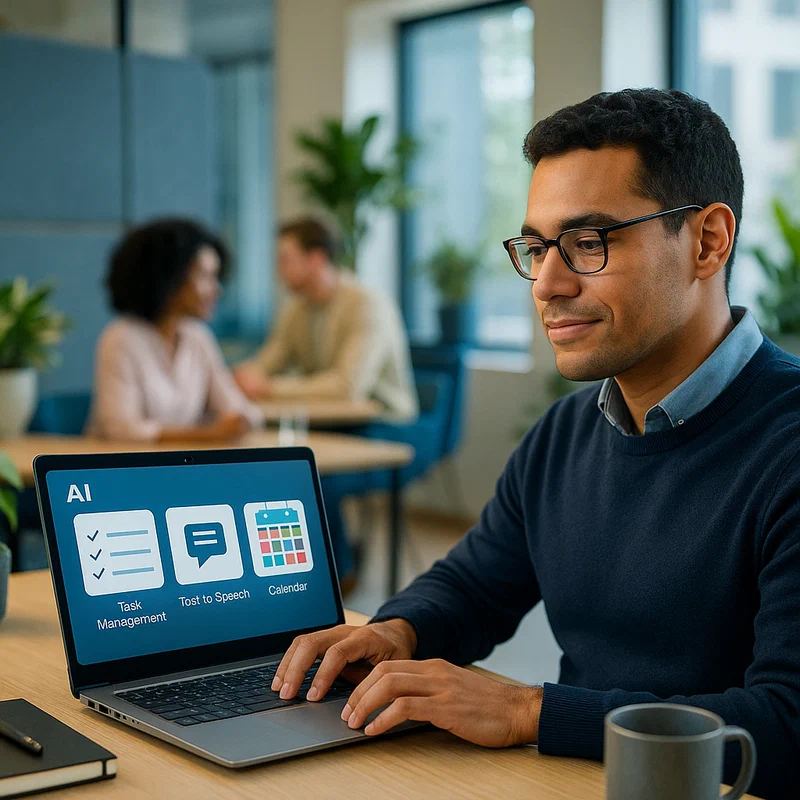
The emergence of sophisticated AI assistive technologies is changing this calculus in profound ways. Unlike previous generations of assistive tools, which often required specialized training and marked users as “different,” modern AI capabilities are increasingly embedded in mainstream productivity applications. This normalization matters enormously—it removes stigma and makes powerful accommodations available to everyone, neurodivergent or not.
For professionals with ADHD, AI tools are proving transformative in managing the executive function challenges that characterize the condition. Smart task management systems use natural language processing to automatically categorize, prioritize, and schedule work from email and chat conversations. Instead of the overwhelming cognitive load of deciding what to do next, professionals receive contextual suggestions based on deadlines, importance, and even their own productivity patterns. AI meeting assistants transcribe conversations in real-time, extract action items, and send automated reminders—eliminating the anxiety of missing critical information while trying to focus on active participation.
Calendar management, a notorious pain point for those with time blindness (a common ADHD trait), becomes dramatically easier with AI scheduling assistants that understand context, buffer meeting times appropriately, and learn individual work patterns. Some newer tools even detect when a user is hyperfocusing on a task and intelligently reschedule non-critical obligations to preserve that productive state—something human assistants might struggle to recognize and act upon.
For autistic professionals, AI tools address different but equally significant challenges. Communication platforms enhanced with sentiment analysis and tone detection help decode the often-ambiguous social signals of workplace conversations. These systems can flag when an email might be perceived as too direct or when a message’s intended humor might not translate, offering alternatives that maintain authentic voice while reducing miscommunication risk. For those who find real-time verbal communication exhausting, AI-powered transcription and summarization tools enable asynchronous participation in meetings while ensuring no critical information is lost.
Sensory processing differences, common in autism, also benefit from AI assistance. Smart environmental controls learn individual preferences and automatically adjust lighting, temperature, and noise levels. Some advanced systems use wearable sensors to detect early signs of sensory overload and proactively suggest breaks or environment modifications before stress becomes overwhelming.
Dyslexic professionals, who may struggle with traditional text-heavy work environments, are finding liberation in AI text-to-speech and speech-to-text tools that have reached near-human quality. Documents can be consumed aurally at customized speeds. Complex reports can be drafted through natural conversation and then polished with AI editing assistance that catches the spelling and grammatical errors dyslexia often produces. Visual AI tools can transform dense textual information into diagrams, flowcharts, or other formats that align with dyslexic strengths in spatial and visual reasoning.
Real-World Impact and Implementation #
The practical impact of these tools extends beyond individual productivity to fundamentally alter career trajectories. A software engineer with ADHD who previously struggled with project management overhead can now focus creative energy on coding while AI handles task tracking and deadline management. An autistic data analyst whose insights were sometimes dismissed because of unconventional communication style can now draft reports with AI assistance that translates technical findings into business-appropriate language without diluting substance.
Several forward-thinking organizations are beginning to recognize this potential and actively support neurodivergent employees in adopting AI assistive tools. Microsoft’s neurodiversity hiring programs, for instance, provide employees with access to a curated suite of AI productivity tools and training on effective use. JPMorgan Chase’s Autism at Work initiative has similarly integrated assistive technology into onboarding and ongoing support, reporting both higher employee satisfaction and strong performance outcomes.
Crucially, many of these tools operate on personal devices and cloud platforms, giving neurodivergent professionals agency in their use without requiring formal accommodation requests or HR approvals. This private, self-directed adoption reduces barriers and stigma while enabling professionals to experiment and find combinations that work for their unique needs.
The educational technology sector has been particularly active in developing AI assistive tools specifically for neurodivergent users. Platforms like Speechify, Otter.ai, and Notion’s AI features, while marketed to general audiences, have become indispensable for many neurodivergent professionals. Their mainstream positioning removes the “special needs” labeling that characterized earlier assistive technologies, while their AI capabilities provide sophisticated support that simple text-to-speech or organizational tools never could.
Ethical Considerations and Challenges #
Yet this technological promise comes with important ethical considerations that deserve careful attention. As an AI ethicist, I’m acutely aware that the same tools offering liberation can also create new forms of exclusion or dependency if not implemented thoughtfully.
Privacy concerns loom large. Many AI assistive tools require access to emails, calendars, documents, and communication platforms to function effectively. While neurodivergent professionals may willingly trade privacy for functionality, organizations must ensure data is protected and not used in ways that could disadvantage users. Imagine an AI tool’s usage data revealing an employee’s neurodivergent status to managers who then view that employee differently, or productivity analytics systems that penalize working patterns that diverge from neurotypical norms despite equal or superior output.
The risk of creating a “digital divide” within neurodivergent communities is equally concerning. Premium AI tools with the most sophisticated capabilities often come with substantial costs—subscription fees that individual professionals or small organizations may struggle to afford. If the most effective assistive technologies remain accessible only to well-resourced individuals or large corporations, we risk creating new inequities where neurodivergent professionals in marginalized communities or smaller organizations lack access to tools that their peers take for granted.
There’s also the question of dependency and skill development. While AI assistive tools can dramatically improve current functioning, we must ensure they complement rather than replace skill development in areas where growth is possible and beneficial. A dyslexic professional should have access to excellent AI writing assistance, but should also receive support in developing fundamental literacy skills where desired. The goal is empowerment and choice, not creating permanent reliance on technology that might not always be available.
Organizations implementing these tools must also grapple with fairness perceptions. When some employees use powerful AI assistants that handle task management, communication support, and information processing, how do managers evaluate performance fairly across neurodiverse teams? How do we ensure that AI assistance is seen as legitimate accommodation rather than “cheating” by colleagues who don’t fully understand neurodivergence?
Designing for Inclusion: A Better Path Forward #
Creating genuinely inclusive AI assistive technology requires moving beyond technical capability to embrace design principles centered on neurodivergent experiences and needs. This means involving neurodivergent individuals as equal partners in development, not merely as users to study or problems to solve.
Several emerging practices point toward more ethical and effective approaches:
Universal Design Principles: Rather than creating separate “neurodivergent tools,” we should push for AI capabilities that benefit everyone while being essential for some. Gmail’s smart compose, for instance, helps all users draft emails faster while being particularly valuable for those with dyslexia or executive function challenges. This universality reduces stigma and increases adoption.
Transparency and Control: AI assistive tools should clearly communicate what they’re doing and why, giving users meaningful control over automation levels. A neurodivergent professional should be able to understand how their AI assistant prioritizes tasks and adjust those algorithms based on personal preferences and work styles. Black-box AI that makes inscrutable decisions may work against the self-determination that true accessibility requires.
Customization and Flexibility: Neurodivergence manifests differently across individuals. Effective AI tools must accommodate this variability through extensive customization options. One autistic professional might want communication AI that makes their messages more effusive and warm; another might want exactly the opposite. Both should find their needs met by adaptable systems.
Integration with Human Support: Technology alone cannot create inclusive workplaces. AI assistive tools should complement, not replace, human relationships, mentorship, and organizational culture changes. The most successful implementations pair technological support with neurodiversity training for managers, clear accommodation processes, and workplace cultures that genuinely value cognitive diversity.
Affordable Access: Ethical implementation requires ensuring financial accessibility. Organizations should subsidize or provide assistive AI tools for neurodivergent employees. Software developers should consider tiered pricing models that make basic capabilities widely accessible while generating revenue from premium features. Some advocates are pushing for assistive AI to be covered under healthcare or disability benefits, recognizing these tools as essential support rather than optional productivity enhancers.
The Broader Implications for Future of Work #
The rise of AI assistive technology for neurodivergent professionals carries implications that extend well beyond this population. It challenges fundamental assumptions about how we design work, evaluate performance, and think about human capability.
If AI can help neurodivergent professionals overcome environmental barriers to demonstrate their talents, what does that suggest about barriers facing other marginalized groups? Could similar tools help non-native speakers navigate communication norms in global organizations? Could they help professionals with physical disabilities access information or complete tasks currently beyond their reach? Could they help working parents manage the cognitive load of juggling professional and caregiving responsibilities?
The neurodiversity context also forces us to reconsider what we mean by “merit” and “productivity” in modern work. If someone produces excellent strategic analysis with the support of AI tools that help process information and communicate findings, is that less valuable than analysis produced without such tools? Most would say no—the output matters, not the process. Yet we don’t yet apply this logic consistently across different forms of AI assistance or different types of human variation.
Furthermore, the success of AI assistive tools in supporting neurodivergent professionals demonstrates the value of matching work to human strengths rather than forcing humans to conform to rigid work templates. Instead of asking “How can we make neurodivergent people fit traditional roles?” we should ask “How can we design roles that leverage neurodivergent strengths while AI handles areas of challenge?” This inversion could benefit everyone, neurodivergent or not, by focusing on what humans uniquely contribute rather than what can be standardized or automated.
Moving Forward Together #
As AI assistive technologies continue advancing, we stand at a critical juncture. The tools being developed today will shape neurodivergent professionals’ work experiences for years to come. We can allow this evolution to proceed haphazardly, with market forces alone determining what gets built and who benefits. Or we can intentionally guide development toward genuinely inclusive outcomes.
This requires sustained dialogue among technologists, neurodivergent advocates, ethicists, employers, and policymakers. It requires funding for research that centers neurodivergent experiences and needs. It requires regulatory frameworks that ensure privacy and prevent discrimination while encouraging innovation. It requires organizational leaders who recognize that true diversity and inclusion mean more than hiring quotas—they mean transforming how work gets done.
Most fundamentally, it requires shifting from a deficit model of neurodivergence to a strengths-based approach. AI assistive technology should not aim to make neurodivergent professionals “more normal” but rather to remove barriers that prevent them from contributing their unique talents. The goal isn’t conformity but rather creating conditions where diverse minds can thrive on their own terms.
I remain cautiously optimistic about this trajectory. When I speak with neurodivergent professionals using AI assistive tools, I hear stories of reduced anxiety, increased confidence, and expanded career possibilities. I hear about talents finally visible after years of being obscured by executive function challenges or communication differences. I hear about workplace experiences transformed from sources of stress to sources of satisfaction and achievement.
These outcomes aren’t inevitable—they require deliberate choices about how we design, deploy, and govern AI assistive technologies. But they demonstrate what becomes possible when we harness technology’s power to expand human potential rather than constrain it. As we continue navigating the AI revolution’s implications for the future of work, the neurodivergent experience offers valuable lessons about designing systems that work for all of us, in all our human diversity.
References and Further Reading:
- “People with ADHD, autism, dyslexia say AI agents are helping them succeed at work” - CNBC, November 8, 2025
- “The state of AI in 2025: Agents, innovation, and transformation” - McKinsey & Company, November 2025
- “Neurodiversity as a Competitive Advantage” - Harvard Business Review
- “AI assistive technology for disability employment” - Various industry reports, November 2025
- Microsoft Neurodiversity Hiring Program documentation
- JPMorgan Chase Autism at Work initiative reports
For more insights on AI ethics and the future of work, follow Emily Chen’s research at MIT Technology Review and Stanford HAI.
AI-Generated Content Notice
This article was created using artificial intelligence technology. While we strive for accuracy and provide valuable insights, readers should independently verify information and use their own judgment when making business decisions. The content may not reflect real-time market conditions or personal circumstances.
Related Articles
The Hidden Cost of AI Hiring Tools: Balancing Efficiency with Equity
AI hiring tools promise efficiency but risk perpetuating bias—organizations must navigate the …
The Invisible Watchers: When AI Surveillance Enters the Workplace
A $249 pair of AI glasses that records all conversations raises urgent questions about consent, …
The AI Workplace Ethics Crisis: Why Trust and Transparency Must Lead the Way Forward
As AI reshapes the modern workplace, new ethical challenges around trust, transparency, and human …