Workplace Clinic: How to Push Back on ‘Urgent’ Culture Without Career Damage

A reader wrote in with a pattern I see constantly in high-pressure teams: “Everything is urgent, every message is ‘ASAP,’ and I’m scared that if I stop responding instantly, I’ll be seen as uncommitted.”
If this is your situation, the career risk is not setting limits. The career risk is becoming unreliable through overload.
Workplace Clinic Case #
Situation: Your manager and stakeholders label routine requests as urgent, message across multiple channels, and expect rapid responses at all hours.
Fear: “If I challenge this pace, I’ll lose trust or growth opportunities.”
Clinical read: You do not need a softer boundary. You need a clearer operating protocol.
MIT Sloan Management Review reports that off-hours interruptions are rising and are often experienced as intrusive, with 83% of people reporting interruptions at least twice a week and 41% reporting increases versus pre-COVID patterns (MIT Sloan Management Review, October 2, 2024). Gallup’s workplace data similarly shows that burnout outcomes are strongly shaped by how people are managed, not just by personal resilience (Gallup, July 12, 2018).
Translation: this is a system problem. Treat it like one.
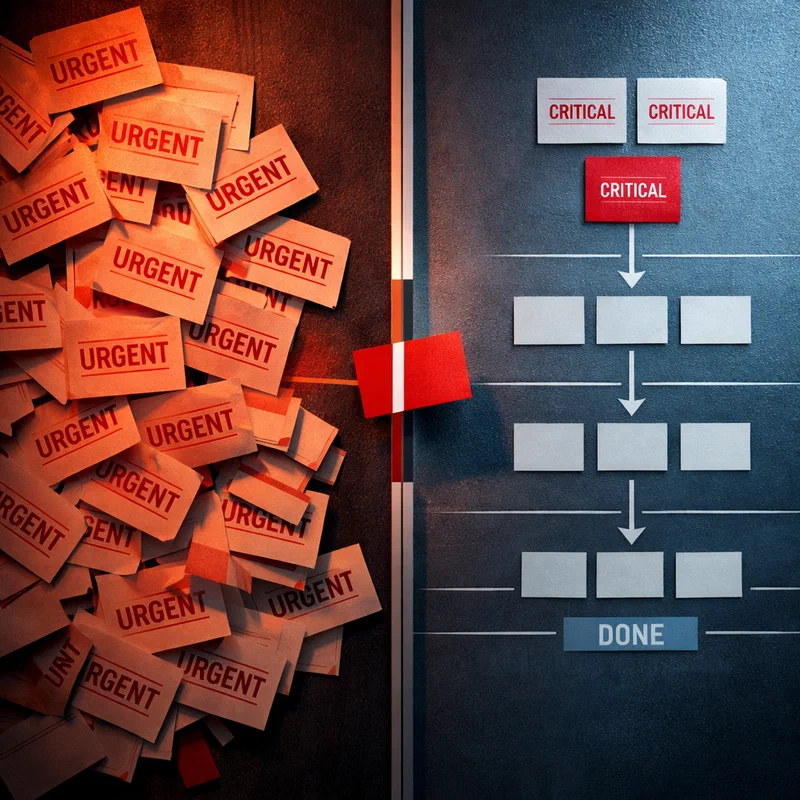
The 4-Part “Urgency Reset” Script #
Use this script framework with your manager first, then your closest stakeholders.
- Commitment anchor — reaffirm outcomes, not hours.
- Triage definition — define what counts as urgent.
- Response windows — set realistic response times by priority.
- Escalation path — give one clear route for true emergencies.
Example Script for Your Manager #
“I’m committed to delivering high-quality work on our priority outcomes this quarter. Right now, routine and urgent requests are arriving through the same channel and timeframe, which is creating preventable context switching. Can we align on a triage model: P1 = same-day business-critical blockers, P2 = next-business-day, P3 = this-week planning items? I’ll respond within one hour for P1 during work hours and within one business day for P2. For true after-hours emergencies, please text me directly with ‘P1’ so I can jump in quickly.”
This works because it does not reject urgency; it classifies it.
What to Say in Common High-Risk Moments #
1) When someone says “Need this ASAP” with no context #
“Happy to help. To prioritize correctly, is this a same-day blocker (P1) or a next-day deliverable (P2)? I can start immediately if it’s blocking revenue, clients, or a hard deadline.”
Why this works: You are not resisting; you are forcing decision-quality.
2) When a late request threatens today’s committed deliverable #
“I can take this today. Which current priority should move so quality stays intact on both?”
Why this works: It makes trade-offs visible before quality drops.
3) When your manager expects instant replies at night #
“I check messages until 7:00 p.m. for next-day prep. After that, I’m offline unless there’s a P1 emergency. If something is truly critical, text ‘P1’ and I’ll respond.”
Why this works: It sets a boundary with an explicit emergency lane.
The Leadership Psychology Behind This #
Many professionals assume responsiveness equals commitment. It does not. Over time, unstructured urgency creates three predictable problems:
- Priority inflation: Everyone labels requests urgent to win attention.
- Decision fatigue: Constant interruption degrades judgment quality.
- Reliability erosion: You become “busy and available” but less predictably effective.
Gallup’s long-running engagement research finds managers account for up to 70% of variance in team engagement (Gallup, June 14, 2024 update). In practice, urgency culture improves only when managers and teams co-design communication norms.
HBR’s burnout research also reinforces that burnout is principally a workplace design issue, meaning workload systems and expectation structures need redesign — not just individual coping tactics (Harvard Business Review, December 11, 2019).
10-Day Urgency Reset Plan #
- Day 1-2: Track every “urgent” request. Record channel, time, and true business impact.
- Day 3: Sort requests into P1/P2/P3 buckets to show current misclassification rate.
- Day 4: Align triage and response windows with your manager.
- Day 5: Publish team norms in one shared place (Slack pin, project page, or team doc).
- Day 6-8: Apply the script consistently in real conversations.
- Day 9: Review what changed: fewer false urgencies, fewer channel hops, better delivery consistency.
- Day 10: Tune the protocol (for example, redefine P1 or shorten one response window if needed).
Red Flags That Mean You Need Escalation, Not Better Scripts #
If any of these persist after two weeks of protocol use, escalate:
- You are penalized for not responding outside agreed emergency lanes.
- Priorities are repeatedly changed without corresponding scope trade-offs.
- “Urgent” is used to bypass planning on a weekly basis.
At that point, this is not a personal productivity issue. It is a team operating model issue that needs manager-of-manager or HR support.
Bottom Line #
The goal is not to be less responsive. The goal is to be predictably responsive to what actually matters.
If your team can tell what counts as urgent, how to escalate, and what delivery standard to expect from you, your professional credibility rises — even as your stress load falls.
References #
- MIT Sloan Management Review (October 2, 2024). “Manage Boundaries Better With Your Team.” https://sloanreview.mit.edu/article/manage-boundaries-better-with-your-team/ (Accessed May 7, 2026, 23:39 UTC)
- Gallup (June 14, 2024 update). “Managers Account for 70% of the Variance in Team Engagement.” https://www.gallup.com/workplace/236570/managers-account-variance-team-engagement.aspx (Accessed May 7, 2026, 23:39 UTC)
- Gallup (July 12, 2018). “Employee Burnout, Part 1: The 5 Main Causes.” https://www.gallup.com/workplace/237059/employee-burnout-part-main-causes.aspx (Accessed May 7, 2026, 23:40 UTC)
- Harvard Business Review (December 11, 2019). “Burnout Is About Your Workplace, Not Your People.” https://hbr.org/2019/12/burnout-is-about-your-workplace-not-your-people (Accessed May 7, 2026, 23:40 UTC)
- Harvard Business Review (March 27, 2026). “Are You Overburdening Your Most Engaged Employees?” https://hbr.org/2026/03/are-you-overburdening-your-most-engaged-employees (Accessed May 7, 2026, 23:41 UTC)
AI Content Notice
This article was created using artificial intelligence technology. Whenever possible, we include references and sources to support the information presented. Readers are encouraged to consult these sources for further information. While we strive for accuracy and provide valuable insights, readers should independently verify information and use their own judgment when making business decisions. The content may not reflect real-time market conditions or personal circumstances.
Related Articles
Workplace Clinic: How to Set Boundaries Without Looking Disengaged
Set boundaries in a way that protects your energy while making your commitment and accountability …
Building Change-Resilient Teams Without Burning Out: A Sustainable Approach to Ungovernable Change
In an era of ungovernable change, the most effective leaders build resilient teams through …
Micro-Boundaries: The New Leadership Imperative for Work-Life Integration
Leaders don’t need dramatic boundary declarations—they need micro-boundaries: tiny, strategic …