The Hidden Cost of AI Hiring Tools: Balancing Efficiency with Equity

The explosion of artificial intelligence in recruitment has transformed how organizations identify talent. According to recent industry surveys, 99% of Fortune 500 companies now use Applicant Tracking Systems (ATS), with an increasing number incorporating AI-powered screening capabilities. These systems promise to process thousands of applications in seconds, identify top candidates with precision, and eliminate human bias from hiring decisions. Yet beneath this efficiency revolution lies a troubling paradox: the very tools designed to create fairer hiring processes may be perpetuating—and in some cases, amplifying—historical inequities.
As someone who has spent years examining the intersection of AI ethics and workplace transformation, I’ve watched this tension unfold across countless organizations. The promise of algorithmic objectivity collides repeatedly with the reality of biased training data, opaque decision-making processes, and insufficient accountability frameworks. The question isn’t whether to use AI in hiring—that ship has sailed. Instead, organizations must grapple with how to harness these tools’ power while mitigating their profound risks to equity and fairness.
The Efficiency Imperative #
The business case for AI hiring tools appears compelling. Large enterprises receive hundreds of applications for every open position, making manual review practically impossible. AI systems can screen resumes in milliseconds, analyze video interviews for communication patterns, assess coding skills through automated challenges, and even predict cultural fit based on candidate data profiles.
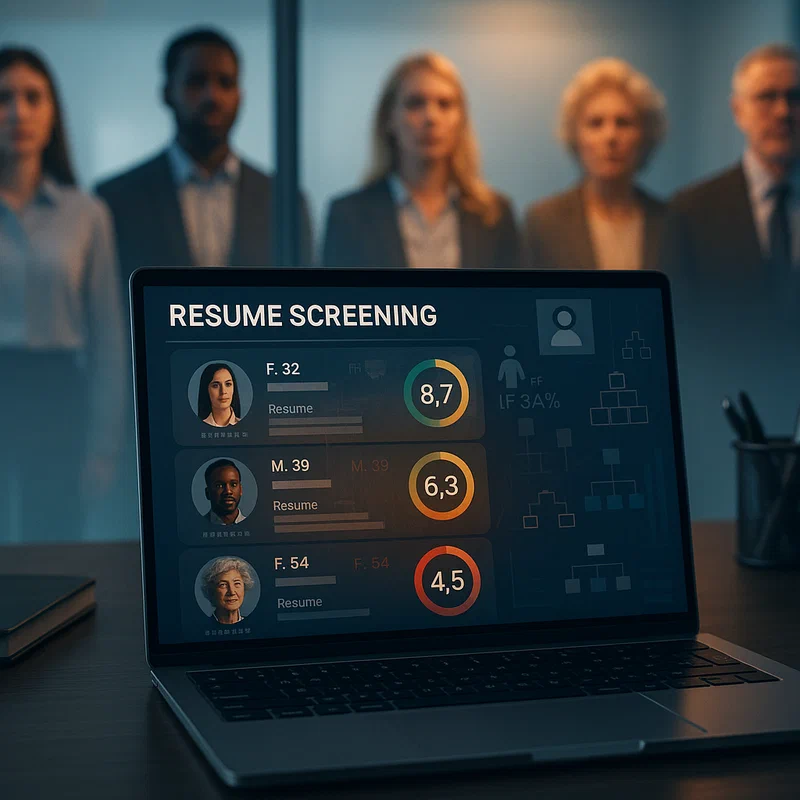
Companies like Unilever have publicized their success with AI hiring platforms, claiming they’ve saved thousands of recruiter hours while expanding candidate diversity. Their system uses game-based assessments and AI-analyzed video interviews to evaluate applicants, reportedly increasing hiring efficiency by 90% while improving retention rates. Such testimonials have driven widespread adoption across industries, from retail and hospitality to technology and finance.
The COVID-19 pandemic accelerated this trend dramatically. As hiring moved entirely virtual, organizations turned to AI tools to maintain recruitment velocity without in-person interactions. What began as emergency measures quickly became standard practice, with the global AI recruitment market projected to exceed $1 billion by 2025.
When Algorithms Inherit Our Biases #
However, the efficiency narrative obscures a more complex reality. AI systems learn from historical data—and that data inevitably reflects past human decisions, complete with their biases and blind spots. Amazon’s experience provides a cautionary tale. In 2018, the company abandoned an experimental recruiting tool after discovering it systematically downgraded applications from women. The algorithm had been trained on resumes submitted over a 10-year period, during which male candidates dominated technical roles. It learned to penalize resumes containing words like “women’s” (as in “women’s chess club captain”) and downgraded graduates from all-women’s colleges.
Amazon’s case wasn’t isolated. Research from MIT and the University of Chicago found that AI systems often discriminate against candidates with disabilities, as algorithms struggle to parse non-traditional career paths or employment gaps. A 2023 study published in Science revealed that AI video interview platforms exhibited racial bias in facial recognition and speech pattern analysis, systematically rating candidates from underrepresented minorities lower than identically qualified white candidates.
These biases emerge from multiple sources. Training data may reflect historical discrimination in hiring practices. Feature selection might inadvertently use proxy variables for protected characteristics—zip codes correlating with race, for instance, or college extracurriculars signaling socioeconomic status. Even seemingly neutral algorithms can produce disparate impacts when applied to populations with different baseline characteristics.
The Accountability Gap #
Beyond bias concerns, AI hiring tools create a troubling accountability vacuum. When a human recruiter makes a discriminatory decision, legal frameworks provide clear avenues for recourse. But when an algorithm rejects a qualified candidate, who bears responsibility? The software vendor? The company deploying the tool? The data scientists who trained the model? The historical hiring managers whose decisions created the training data?
This “responsibility gap” has prompted regulatory responses. New York City’s Local Law 144, implemented in 2023, became the first US legislation specifically addressing AI hiring tools. The law requires companies using automated employment decision tools to conduct annual bias audits and publicly disclose their use of such systems to candidates. Violations carry substantial penalties, and the law explicitly grants candidates the right to request alternative evaluation methods.
The European Union has gone further. Under the EU AI Act, AI systems used for recruitment and employee management are classified as “high-risk,” triggering stringent requirements for transparency, human oversight, accuracy, and cybersecurity. Organizations deploying these tools must maintain detailed documentation, enable meaningful human review of decisions, and demonstrate that systems don’t produce discriminatory outcomes across protected categories.
Yet regulation alone cannot solve the underlying technical and ethical challenges. Even well-intentioned compliance can produce perverse outcomes. After NYC’s law took effect, some companies responded by making their AI systems less transparent rather than risk exposing potential biases. Others simply moved recruitment operations to jurisdictions without such requirements.
Building Better Frameworks #
Creating genuinely equitable AI hiring systems requires moving beyond regulatory compliance to embrace fundamental design principles. Organizations successfully navigating this landscape share several characteristics:
Diverse Development Teams: Companies like Microsoft and IBM have made significant investments in diversifying their AI development teams, recognizing that homogeneous groups often fail to anticipate how systems might disadvantage different populations. Research from Stanford’s Human-Centered AI Institute confirms that diverse teams produce more equitable algorithms—not through good intentions alone, but because they bring varied perspectives to feature selection, testing scenarios, and potential failure modes.
Continuous Bias Testing: Leading organizations treat bias audits not as annual compliance exercises but as ongoing monitoring processes. They test systems across multiple demographic slices, examine where algorithms show higher confidence or uncertainty, and investigate surprising patterns. Pymetrics, an AI hiring platform, publishes regular “fairness reports” demonstrating how their algorithms perform across gender, age, and racial categories—making transparency a competitive advantage rather than a liability.
Human-in-the-Loop Design: The most effective implementations position AI as an assistant to human decision-makers rather than a replacement. At Hilton Hotels, AI screens applications and flags top candidates, but human recruiters make all final decisions. Critically, the system highlights candidates the AI ranks highly and those it might have undervalued, explicitly prompting recruiters to reconsider potentially excluded applicants. This approach acknowledges that algorithms excel at pattern matching but struggle with context, creativity, and circumstances that don’t fit historical norms.
Algorithmic Transparency: Progressive organizations are experimenting with “explainable AI” systems that articulate why they rank candidates particular ways. Rather than producing inscrutable scores, these tools identify which specific qualifications, experiences, or skills influenced their assessments. This transparency enables both candidates and hiring managers to understand and, when appropriate, challenge algorithmic decisions.
Multiple Assessment Dimensions: Rather than relying solely on resume screening or standardized tests, sophisticated hiring processes incorporate multiple evaluation methods. They might use AI for initial screening but supplement it with work sample tests, structured interviews, and collaborative exercises that reveal capabilities algorithms might miss. This multi-method approach reduces the impact of bias in any single evaluation dimension.
The Path Forward #
The future of work will undoubtedly include AI hiring tools—they’re simply too efficient and too widely adopted to disappear. But their ubiquity makes the ethical stakes higher, not lower. Organizations have a choice: they can deploy these systems thoughtlessly, prioritizing short-term efficiency gains while perpetuating historical inequities, or they can embrace the harder work of building genuinely fair systems that expand opportunity rather than constrain it.
This requires acknowledging several uncomfortable truths. First, there is no purely technical solution to bias—algorithmic fairness requires value judgments about which definitions of fairness matter most in specific contexts. Second, transparency and accountability must be design requirements, not afterthoughts. Third, companies must invest in the organizational capabilities—diverse teams, ongoing monitoring, robust governance—needed to deploy AI responsibly.
The most promising developments aren’t purely technological but socio-technical: they combine algorithmic improvements with organizational practices, regulatory frameworks, and cultural norms that collectively shape how AI hiring tools operate in practice. As noted in recent research from the Brookings Institution, effective AI governance requires “aligning technical capabilities with human values”—a process that demands ongoing dialogue between technologists, ethicists, policymakers, and the communities these systems affect.
I remain cautiously optimistic. When organizations approach AI hiring with appropriate humility, recognizing both its potential and its limitations, they can create systems that genuinely expand opportunity. But this outcome isn’t inevitable—it requires deliberate choices, sustained effort, and willingness to prioritize equity alongside efficiency.
The hidden cost of AI hiring tools isn’t measured in dollars but in opportunities denied, talents overlooked, and potential unrealized. As we build the future of work, we must ensure these tools serve to amplify human potential rather than constrain it. The path forward demands that we hold AI systems—and ourselves—to higher standards than those inherited from the past.
For more insights on AI ethics and the future of work, follow Emily Chen’s research at MIT Technology Review and Stanford HAI.
AI-Generated Content Notice
This article was created using artificial intelligence technology. While we strive for accuracy and provide valuable insights, readers should independently verify information and use their own judgment when making business decisions. The content may not reflect real-time market conditions or personal circumstances.
Related Articles
The AI Black Box Problem: Why Your Next Promotion Might Depend on Algorithmic Transparency
When AI algorithms decide who gets hired, promoted, or fired, employees deserve to know how these …
LinkedIn's AI Writing Reality Check: Why Smart Workers Are Choosing Authenticity Over Automation
Explore why LinkedIn’s AI writing assistant failed to gain traction and what this reveals …
The AI Workplace Ethics Crisis: Why Trust and Transparency Must Lead the Way Forward
As AI reshapes the modern workplace, new ethical challenges around trust, transparency, and human …